orange precipitate; melting temperature of the derivative names the compound
aldehyde or ketone
iodine and alkali, warm
pale yellow precipitate of CHI₃
CH₃CO– group (ethanal, methyl ketones)
sodium carbonate
effervescence of CO₂
carboxylic acid
PCl₅
misty fumes of HCl
–OH group (alcohol or acid)
Definitions to learn word for word
Spectroscopy in brief
Evidence
What it gives
accurate mass of the molecular ion
molecular formula: add the accurate atomic masses and match to four decimal places
number of carbon-13 peaks
number of carbon environments (equivalent carbons give one peak)
carbon-13 shift
type of carbon, using the ranges above
number of proton peaks
number of hydrogen environments
proton peak area
ratio of hydrogens in each environment
proton splitting
n neighbouring hydrogens give n + 1 lines: singlet 1, doublet 1 : 1, triplet 1 : 2 : 1, quartet 1 : 3 : 3 : 1
Rf
distance moved by spot ÷ distance moved by solvent front, between 0 and 1
Common mistakes
Chiral centre: "four different atoms". Say atoms or groups.
SN2 and optical activity: SN2 gives one enantiomer, which is optically active. It is SN1 that gives a racemic (inactive) product.
Racemic mixtures contain chiral molecules but have no net rotation.
Aldehyde formula: write CHO, never COH. Ester name: the alcohol part comes first.
Carbonyl hydrogen bonds: aldehydes and ketones cannot hydrogen-bond to each other, but can accept a hydrogen bond from water.
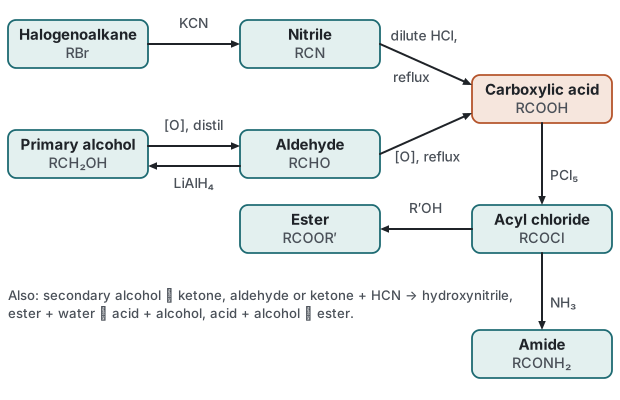
Acid wanted from an alcohol:reflux with excess oxidant. Distil only to collect an aldehyde.
Alkaline hydrolysis gives the salt, not the acid. Esterification is an equilibrium, but alkaline hydrolysis and acyl chloride reactions go to completion.
Spectra: count peaks by environments, not atoms. The CH₂ of an ethyl group is a quartet because of the 3 hydrogens on the neighbouring CH₃.
Rf: measure from the origin line to the centre of the spot, and use the same line for the solvent front.
Mixed test
Define a chiral centre and state whether butan-2-ol and propan-2-ol have one.
A pure enantiomer of a tertiary bromoalkane reacts with hydroxide ions and the product is optically inactive. Name the mechanism and explain.
Write the equation and give the conditions for the conversion of propanal into propan-1-ol, and state what type of alcohol is formed.
Name the two reagents and the conditions for converting bromoethane into propanoic acid. How many carbon atoms does the product have compared with the starting material?
Write an equation for the reaction of ethanoyl chloride with ethanol, and explain why the reaction goes to completion but esterification does not.
An organic compound has a molecular ion peak at 74.0366. Calculate which of C₃H₆O₂ (use H = 1.0078, C = 12.0000, O = 15.9949) and C₄H₁₀O (accurate mass 74.0729) it is.
Predict the number of peaks in the carbon-13 NMR spectrum of ethyl ethanoate, and the pattern of the proton NMR peaks.
A spot moves 3.6 cm when the solvent front moves 9.0 cm. Calculate its Rf and state what would happen to the Rf value if a different solvent were used.
Answers cover these until you have tried the questions
A carbon atom bonded to four different atoms or groups. Butan-2-ol has one (C2: H, OH, CH₃, CH₂CH₃). Propan-2-ol does not, as its central carbon has two CH₃ groups.
SN1. The bromide ion leaves first to form a planar carbocation. The hydroxide ion attacks from either side with equal probability, giving equal amounts of the two enantiomers, a racemic mixture, which is optically inactive.
CHX3CHX2CHO+2[H]CHX3CHX2CHX2OH, using lithium tetrahydridoaluminate(III) in dry ether. A primary alcohol (propan-1-ol) is formed.
Step 1: KCN in ethanol, heated under reflux, to give propanenitrile. Step 2: dilute hydrochloric acid, heated under reflux. The product has 3 carbon atoms, one more than the 2 in bromoethane, because the carbon of the CN group becomes the carboxyl carbon.
CHX3COCl+CHX3CHX2OHCHX3COOCHX2CHX3+HCl. The reaction goes to completion because the acyl chloride is very reactive and the HCl escapes as a gas, so it is not reversible. Esterification from an acid and an alcohol is reversible, and reaches an equilibrium that contains the reactants and products.
C₃H₆O₂: 3 × 12.0000 + 6 × 1.0078 + 2 × 15.9949 = 36.0000 + 6.0468 + 31.9898 = 74.0366, which matches the measured value. C₄H₁₀O is 74.0729 and does not. The compound has molecular formula C₃H₆O₂.
4 peaks in carbon-13 NMR (four carbon environments: C=O, OCH₂, CH₃CO and CH₃). Proton NMR has three peaks: a singlet (3 H, CH₃CO), a quartet (2 H, OCH₂) and a triplet (3 H, CH₃).
Rf = 3.6 ÷ 9.0 = 0.40. A different solvent changes how soluble each substance is in the mobile phase, so the Rf value would change.