Topic 15 · page 16 of 28
Esterification
A carboxylic acid and an alcohol, heated with a little concentrated sulfuric acid as catalyst, form an ester and water in an equilibrium. Esters are named from the alcohol first and the acid second.
Read first: Reactions of carboxylic acids
The reaction 15.12(iv)
A carboxylic acid reacts with an alcohol to form an ester and water. The reaction needs an acid catalyst, usually a few drops of concentrated sulfuric acid, and heat.
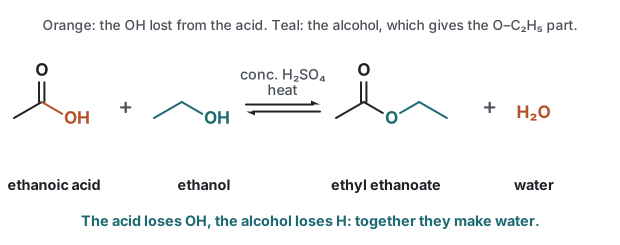
The acid loses its –OH and the alcohol loses the H of its –OH. Together they make water, and the rest of the two molecules join through an ester link, –COO–.
MethodConditions
Carboxylic acid + alcohol, a few drops of concentrated sulfuric acid, warm or heat under reflux.
The reaction is reversible and reaches an equilibrium, so the yield is not 100%. You can push the equilibrium towards the ester in two ways: use an excess of one reactant (usually the cheaper alcohol), or remove the water as it forms. Concentrated sulfuric acid helps in both ways, because it is also a dehydrating agent that takes up water.
Naming and uses 15.12(iv)
The ester name has two parts: alkyl (from the alcohol) then -oate (from the acid). The alcohol part comes first in the name but second in the formula.
| Acid | Alcohol | Ester |
|---|---|---|
| ethanoic acid | ethanol | ethyl ethanoate |
| ethanoic acid | methanol | methyl ethanoate |
| propanoic acid | methanol | methyl propanoate |
| butanoic acid | ethanol | ethyl butanoate |
Esters are sweet-smelling, volatile liquids that do not form hydrogen bonds with each other. Ethyl ethanoate is a common solvent (as in some nail varnish removers and glues). Esters with longer chains have fruit smells and are used as flavourings and in perfumes. Ethyl butanoate smells of pineapple.
PracticalPreparing ethyl ethanoate
This is the further suggested practical on esters. Wear eye protection. Ethanol and ethyl ethanoate are flammable, so use a hot water bath and no naked flame. Concentrated sulfuric acid is corrosive.
- Put about 2 cm³ of ethanol and 2 cm³ of ethanoic acid in a boiling tube.
- Add a few drops of concentrated sulfuric acid carefully and mix.
- Warm the tube in a beaker of hot water for 5 to 10 minutes.
- Pour the mixture into a beaker of sodium carbonate solution. This neutralises the left-over acids and the ester is left as a separate layer on top.
- Smell the ester by wafting. It has a sweet, fruity smell.
For a larger sample, heat the mixture under reflux, then distil off the ester, wash it with sodium carbonate solution and dry it. The ester has a lower boiling temperature than the acid, as it has no hydrogen bonds between its molecules.
Check yourself
- Write an equation for the formation of methyl propanoate from propanoic acid and methanol.
- State the catalyst and the conditions for esterification.
- Name the ester formed from butanoic acid and ethanol, and write its structural formula.
- Explain why the yield of the ester is less than 100% and describe two ways to increase it.
- Why is the mixture poured into sodium carbonate solution at the end of the practical?
Answers cover these until you have tried the questions
- A few drops of concentrated sulfuric acid, with warming (or heating under reflux).
- Ethyl butanoate, CH₃CH₂CH₂COOCH₂CH₃.
- The reaction is reversible and reaches equilibrium, with both reactants and products present. The yield rises if you use an excess of one reactant (such as the alcohol) or remove water as it forms, either of which shifts the equilibrium to the right.
- The sodium carbonate reacts with the unreacted acid and the sulfuric acid catalyst, which removes them as salts (with effervescence of CO₂), so that the smell of the ester can be detected and the ester separates as a layer on top.