Topic 15 · page 10 of 28
2,4-DNPH and the iodoform test
2,4-dinitrophenylhydrazine gives an orange precipitate with any aldehyde or ketone, and its melting temperature identifies which one. Iodine and alkali give a pale yellow precipitate of triiodomethane with a CH₃CO group.
Read first: Oxidation tests for aldehydes
Testing for a carbonyl group 15.8(iv)
The reagent 2,4-dinitrophenylhydrazine (DNPH), made up in acid solution, reacts with the C=O group of any aldehyde or ketone. It gives a yellow-orange to orange precipitate of a 2,4-dinitrophenylhydrazone. The equation is not required.
| Sample | Result with 2,4-DNPH |
|---|---|
| aldehyde or ketone | orange precipitate |
| alcohol, carboxylic acid, ester | no precipitate |
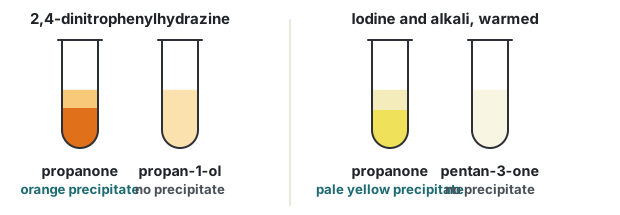
This is a test for the carbonyl group, so it does not separate aldehydes from ketones. For that, use Tollens' reagent or Fehling's solution, as on the previous page about oxidation tests.
Identifying the carbonyl compound 15.8(iv)
Each aldehyde and ketone gives a hydrazone with its own sharp melting temperature. This lets you identify an unknown carbonyl compound:
- Add the unknown to 2,4-DNPH solution and collect the orange crystals by filtration.
- Purify the crystals by recrystallisation, which removes impurities that would lower and blur the melting temperature.
- Dry them and measure the melting temperature.
- Compare it with a table of melting temperatures of the derivatives.
| Carbonyl compound | Melting temperature of the 2,4-DNPH derivative / °C |
|---|---|
| ethanal | 168 |
| propanal | 154 |
| propanone | 126 |
| butanone | 115 |
| pentan-2-one | 144 |
| pentan-3-one | 156 |
These values are typical data-book figures. In the examination you are given a table, so use the values in the question.
Worked exampleIdentify the carbonyl compound
A liquid X forms an orange precipitate with 2,4-DNPH. After recrystallisation the derivative melts at 125–127 °C. X gives no silver mirror with Tollens' reagent. Identify X.
- The orange precipitate shows X contains C=O: an aldehyde or ketone.
- No silver mirror means X is not an aldehyde, so it is a ketone.
- A melting temperature of 125–127 °C matches 126 °C, the derivative of propanone. Butanone (115 °C) and pentan-2-one (144 °C) do not fit.
- X is propanone.
The iodoform test 15.8(v)
Warm the sample with iodine and aqueous sodium hydroxide. A pale yellow precipitate of triiodomethane, (also called iodoform), with an antiseptic smell, is a positive result.
The test is positive for compounds that contain the CH₃CO– group: that is, a carbonyl carbon with a CH₃ group on one side. Ethanal and methyl ketones such as propanone, butanone and pentan-2-one are positive.
| Compound | Contains CH₃CO–? | Iodoform test |
|---|---|---|
| ethanal | yes | pale yellow precipitate |
| propanone | yes | pale yellow precipitate |
| pentan-2-one | yes | pale yellow precipitate |
| propanal | no | no precipitate |
| pentan-3-one | no, two ethyl groups | no precipitate |
Ethanal is the only aldehyde that gives the test. The reaction also happens with alcohols that contain CH₃CH(OH)–, such as ethanol and propan-2-ol, because the reagent first oxidises them to the carbonyl compound. If a question asks which of a set of carbonyl compounds is positive, look for CH₃CO–.
Check yourself
- What does an orange precipitate with 2,4-DNPH show, and what does it not show?
- Describe how the precipitate is used to identify the carbonyl compound.
- Which of ethanal, propanal, propanone and pentan-3-one give a pale yellow precipitate with iodine and alkali? Explain your choice.
- How would you distinguish pentan-2-one from pentan-3-one using one test?
- A carbonyl compound gives a derivative that melts at 115 °C and a pale yellow precipitate in the iodoform test. Use the table to identify it.
- Name the pale yellow precipitate formed in the iodoform test.
Answers cover these until you have tried the questions
- It shows the presence of a carbonyl group (an aldehyde or ketone). It does not show which of the two, since both react.
- Filter the orange precipitate, recrystallise it to purify, dry it and measure its melting temperature. Compare this with the melting temperatures of known 2,4-DNPH derivatives in a table.
- Ethanal and propanone. Each contains the CH₃CO– group (a CH₃ group bonded to a carbonyl carbon). Propanal has CH₃CH₂– on the carbonyl, and pentan-3-one has an ethyl group on each side, so neither has CH₃CO–.
- Use the iodoform test. Pentan-2-one contains CH₃CO– and gives a pale yellow precipitate. Pentan-3-one does not.
- A melting temperature of 115 °C matches butanone. Butanone contains CH₃CO–, so it also gives the pale yellow precipitate in the iodoform test. Both pieces of evidence agree.
- Triiodomethane, CHI₃ (iodoform).