Topic 15 · page 9 of 28
Addition of hydrogen cyanide
Cyanide ion attacks the δ+ carbon of a C=O group in nucleophilic addition, making a hydroxynitrile. Because the C=O group is flat, an aldehyde gives a racemic mixture.
Read first: Reducing carbonyl compounds with LiAlH₄
The reaction 15.8(iii)
Aldehydes and ketones react with hydrogen cyanide, HCN, to give a hydroxynitrile: a compound with an –OH group and a –CN group on the same carbon.
The product from ethanal is 2-hydroxypropanenitrile. The carbon of the –CN group is carbon 1 of the chain, so the OH is on carbon 2.
MethodConditions
Use HCN in the presence of a little KCN at room temperature. HCN is a weak acid and gives very few cyanide ions, which are the attacking species. Potassium cyanide supplies the cyanide ion, CN⁻, and makes the reaction fast enough to be useful.
Hydrogen cyanide and cyanides are extremely poisonous, so this reaction is only done under strict controls and is not a student experiment.
This is nucleophilic addition. The C=O group is polar, with a δ+ carbon, so it is attacked by a nucleophile, which is an electron-pair donor. The product is formed by adding HCN across the C=O, and nothing is lost.
The mechanism 15.8(iii)
The mechanism has two steps. Curly arrows show the movement of a pair of electrons, from the tail of the arrow to its head.
Step 1: the nucleophile attacks the δ+ carbon.
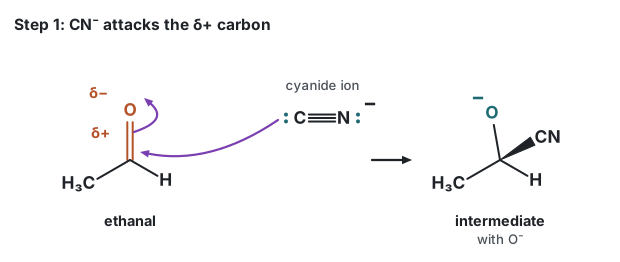
- The first arrow starts at the lone pair on the carbon atom of CN⁻ (the carbon is the nucleophilic end) and points to the δ+ carbon.
- The second arrow starts at the C=O double bond and points to the oxygen, which becomes negatively charged.
Step 2: the oxygen picks up a proton.
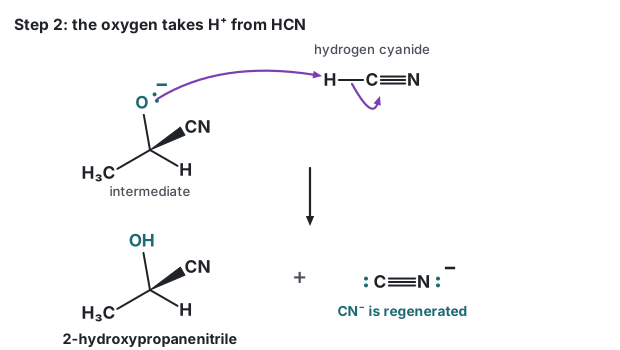
- The first arrow starts at a lone pair on O⁻ and points to the hydrogen of HCN.
- The second arrow starts at the H–C bond and points to the carbon, which becomes the lone pair of a new CN⁻ ion.
The cyanide ion used in step 1 is regenerated in step 2, which is why only a little KCN is needed. Draw the lone pair on the cyanide carbon, the δ+ and δ− on the C=O, and all curly arrows from a lone pair or a bond, never from an atom.
Optical activity shows the C=O is flat 15.5
The carbon of the C=O group is trigonal planar. Cyanide ion can attack from above or below with equal chance.
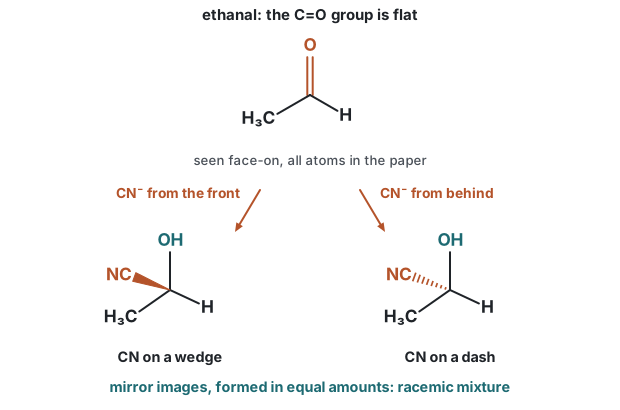
In 2-hydroxypropanenitrile the carbon holding the OH has four different groups: H, CH₃, OH and CN. It is a chiral centre. Attack from the front gives one enantiomer and attack from behind gives the other.
The two enantiomers form in equal amounts, so the product is a racemic mixture and is optically inactive. This observation is evidence that the C=O group is planar and attacked equally from both sides.
Check yourself
- State the reagents and conditions for converting ethanal to 2-hydroxypropanenitrile, and write the equation.
- Explain why the reaction is called nucleophilic addition.
- Describe the two steps of the mechanism, naming where each curly arrow starts and ends.
- Explain why the product from ethanal is optically inactive although the molecule has a chiral centre.
- Write the equation for the reaction of propanone with HCN, and explain why this product is not optically active.
- Name the product of propanal with HCN.
Answers cover these until you have tried the questions
- HCN in the presence of a little KCN, at room temperature. .
- The attacking species, CN⁻, is a nucleophile (an electron-pair donor), and the product is formed by adding HCN across the C=O bond so that no atoms are lost.
- Step 1: a curly arrow from the lone pair on the carbon of CN⁻ to the δ+ carbon of C=O, and a second from the C=O double bond to the oxygen, giving an intermediate with O⁻. Step 2: a curly arrow from a lone pair on O⁻ to the hydrogen of HCN, and a second from the H–C bond of HCN to carbon, forming the hydroxynitrile and regenerating CN⁻.
- The C=O group is planar, so CN⁻ attacks from either face with equal probability. Equal amounts of the two enantiomers form, a racemic mixture. Their rotations cancel, so the mixture shows no optical activity.
- . The carbon bearing the OH holds two identical CH₃ groups, so it does not have four different groups. The product is not chiral, and so it has no optical activity at all.
- is 2-hydroxybutanenitrile.