Topic 15 · page 23 of 28
Proton NMR, environments and peak areas
A proton NMR spectrum has one peak for each set of equivalent hydrogen atoms. The chemical shift shows the type of hydrogen and the area under each peak is in the ratio of the number of hydrogens in that environment.
Read first: Carbon-13 NMR
Hydrogen environments 15.20(i)
Proton NMR works in the same way as carbon-13 NMR, but it detects hydrogen nuclei (protons). Hydrogen atoms in the same environment give one peak. A hydrogen's environment is set by what its carbon is bonded to, and by symmetry.
In a spectrum measured at low resolution, you see one single peak for each hydrogen environment.
Count the environments in ethyl ethanoate, CH₃COOCH₂CH₃:
| Hydrogens | Environment | Number of H |
|---|---|---|
| a | CH₃ bonded to C=O | 3 |
| b | CH₂ bonded to O | 2 |
| c | CH₃ of the ethyl group | 3 |
Three environments give three peaks. The three hydrogens in any CH₃ group are equivalent, because the group spins freely.
Chemical shift 15.20(i)
The position of a peak, its chemical shift δ in ppm, depends on the atoms near the hydrogen. Hydrogens next to electronegative atoms or groups, such as O or C=O, are more downfield (higher δ). The reference is TMS at δ = 0, and the axis runs from high δ at the left to 0 at the right.
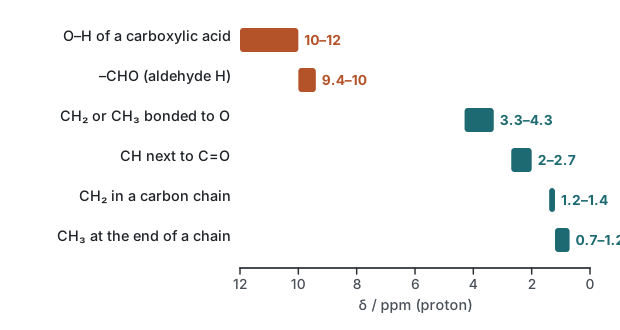
| Type of hydrogen | δ / ppm |
|---|---|
| carboxylic acid, –COOH | 10–12 |
| aldehyde, –CHO | 9.4–10.0 |
| CH₂ or CH₃ bonded to O | 3.3–4.3 |
| CH₂ or CH₃ next to C=O | 2.0–2.7 |
| CH₂ in a carbon chain | 1.2–1.4 |
| CH₃ at the end of a chain | 0.7–1.2 |
In ethyl ethanoate, b (next to the electronegative O) is at about 4.1, a (next to the C=O) is at about 2.0, and c (only bonded to carbon) is at about 1.2.
Peak areas 15.20(ii)
The area under each peak is proportional to the number of hydrogen atoms in that environment. The ratio of the areas is the ratio of the numbers of hydrogens.
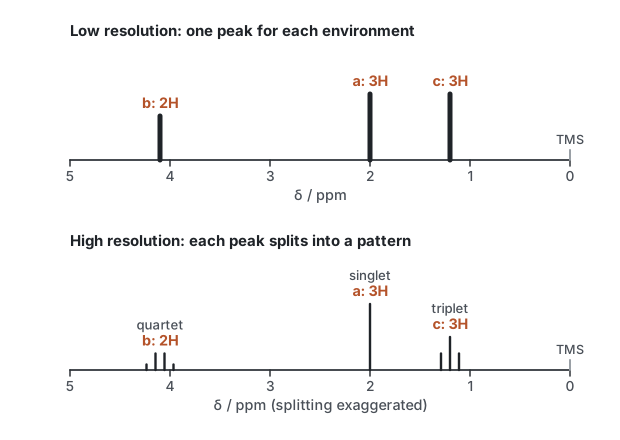
Spectrometers show the areas either as an integration trace, in which the height of each step is proportional to the area, or as numbers printed above each peak. Measure the heights and simplify the ratio.
Worked exampleFrom an integration trace to a ratio
The step heights on the integration trace of an ester are 1.0 cm, 1.5 cm and 1.5 cm, for peaks at δ = 4.1, 2.0 and 1.2. The ester has molecular formula C₄H₈O₂. Work out how many hydrogens give each peak.
- Ratio of heights = 1.0 : 1.5 : 1.5, which simplifies to 2 : 3 : 3.
- The ratio adds up to 2 + 3 + 3 = 8 parts, and the formula has 8 hydrogens, so each part is one hydrogen.
- The peaks are 2 H (δ = 4.1), 3 H (δ = 2.0) and 3 H (δ = 1.2).
Check yourself
- State the number of different hydrogen environments in each: (a) propanone, (b) propan-2-ol, (c) propan-1-ol, (d) ethanal.
- Give the ratio of the peak areas for propan-2-ol, (CH₃)₂CHOH.
- A peak at δ = 9.8 integrates for one hydrogen in a compound of formula C₃H₆O. What functional group does this suggest, and what is the compound?
- The integration trace of an unknown compound has steps of 3.0 cm, 2.0 cm and 1.0 cm and the compound contains 6 hydrogen atoms. State how many hydrogens give each peak.
- Why does the CH₃ group in ethyl ethanoate give a single peak and not three?
Answers cover these until you have tried the questions
- (a) 1: all six hydrogens are equivalent. (b) 3: the two CH₃ groups, the CH, and the OH. (c) 4: CH₃, CH₂, CH₂O and OH. (d) 2: CH₃ and CHO.
- 6 : 1 : 1, for the two CH₃ groups together (6 H), the CH (1 H) and the OH (1 H).
- A peak at 9.8 is in the 9.4–10.0 range for an aldehyde hydrogen, –CHO. The compound is propanal, CH₃CH₂CHO.
- The ratio 3.0 : 2.0 : 1.0 is 3 : 2 : 1. This totals 6, which equals the number of hydrogens, so the peaks are 3 H, 2 H and 1 H.
- The three hydrogens of a CH₃ group are in the same environment, because the group rotates freely and all three are bonded in the same way, so they absorb at the same chemical shift and give one peak with an area for 3 H.