Topic 15 · page 24 of 28
Splitting and the (n + 1) rule
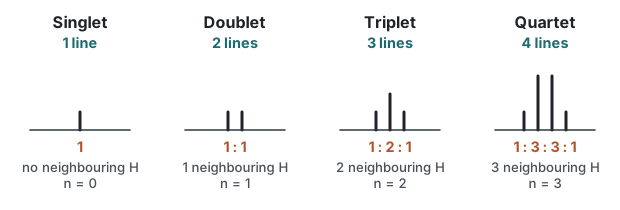
At high resolution a peak splits into a pattern. A hydrogen with n hydrogens on the adjacent carbon atoms gives n + 1 lines, with heights in the ratio of Pascal's triangle.
Read first: Proton NMR, environments and peak areas
Splitting at high resolution 15.20(iii)
At high resolution each peak you saw at low resolution splits into a group of lines. The splitting happens because the hydrogens on neighbouring carbon atoms act as tiny magnets and slightly change the field felt by the hydrogen being observed.
| Number of neighbouring H, n | Lines | Name | Relative heights |
|---|---|---|---|
| 0 | 1 | singlet | 1 |
| 1 | 2 | doublet | 1 : 1 |
| 2 | 3 | triplet | 1 : 2 : 1 |
| 3 | 4 | quartet | 1 : 3 : 3 : 1 |
Two rules about which hydrogens count:
- Only hydrogens on the adjacent carbon atom split a peak. Hydrogens on the same carbon, or hydrogens in the same environment, do not split each other.
- Hydrogens bonded to oxygen (O–H) normally appear as a singlet and do not split their neighbours at this level.
Reading the splitting 15.20(iii)
Count the neighbouring hydrogens to predict the pattern.
Worked exampleEthyl ethanoate, CH₃COOCH₂CH₃
Predict the splitting of each peak.
- CH₃ next to C=O (a): the adjacent atom is the carbonyl carbon, which has no hydrogens, so n = 0 and the peak is a singlet (3 H, δ about 2.0).
- OCH₂ (b): the adjacent carbon is the CH₃, with 3 hydrogens, so n = 3 and the peak is a quartet (2 H, δ about 4.1).
- CH₃ of the ethyl group (c): the adjacent carbon is the CH₂, with 2 hydrogens, so n = 2 and the peak is a triplet (3 H, δ about 1.2).
A pair of linked groups split each other. In an ethyl group, CH₃–CH₂–, the CH₂ is a quartet because of the CH₃, and the CH₃ is a triplet because of the CH₂. This triplet plus quartet pair is the sign of an ethyl group in a spectrum.
| Group | Neighbouring H | Pattern |
|---|---|---|
| CH₃ in CH₃CH₂– | 2 | triplet |
| CH₂ in –CH₂CH₃ | 3 | quartet |
| CH₃ in CH₃CHO | 1 | doublet |
| CHO in CH₃CHO | 3 | quartet |
| CH₃ bonded to C=O in a ketone, CH₃COCH₃ | 0 | singlet |
| CH₃ in (CH₃)₂CHOH, each | 1 | doublet |
The area of a multiplet gives the number of hydrogens in the group, not the number of lines. The number of lines tells you about the neighbours. For example, a quartet with area 2 is a CH₂ (area 2) next to a CH₃ (3 neighbours).
Check yourself
- State the splitting pattern, with the number of lines, of a CH₂ group whose neighbouring carbon is a CH₃.
- Predict the splitting patterns of the hydrogens in (a) propanone, (b) CH₃CH₂Cl and (c) ethanal.
- In the spectrum of butanone, CH₃COCH₂CH₃, predict the pattern and area of each peak.
- Explain why the CH₃ in an ethyl group gives a triplet.
- A peak is a doublet with an area for 3 hydrogens. What group is next to this CH₃?
Answers cover these until you have tried the questions
- Quartet: 3 neighbouring hydrogens give 3 + 1 = 4 lines, in the ratio 1 : 3 : 3 : 1.
- (a) Propanone: a single singlet (all six hydrogens equivalent, no neighbouring H). (b) CH₃CH₂Cl: the CH₃ is a triplet and the CH₂ is a quartet. (c) Ethanal: the CH₃ is a doublet (1 neighbour, the CHO hydrogen), and the CHO hydrogen is a quartet (3 neighbours).
- CH₃CO–: singlet, area 3 (no neighbouring H). –CH₂–: quartet, area 2 (next to CH₃). –CH₃: triplet, area 3 (next to CH₂).
- The CH₃ has two hydrogens on the adjacent CH₂, so n = 2, and it gives 2 + 1 = 3 lines, in the ratio 1 : 2 : 1.
- A doublet means one neighbouring hydrogen, so the CH₃ is next to a CH group, as in (CH₃)₂CHOH or CH₃CHO.