Topic 15 · page 4 of 28
Optical activity as evidence for a mechanism
Start with a single enantiomer and check whether the product is optically active. A reaction that keeps the activity works by SN2, and one that loses it passes through a flat intermediate, as in SN1.
Read first: Optical activity and racemic mixtures
The idea 15.5
Topic 10 gave two mechanisms for nucleophilic substitution of halogenoalkanes. They differ in what happens to the carbon that carries the halogen. If that carbon is a chiral centre, the optical activity of the reactant and product shows which mechanism ran.
The test is simple. Start with one pure enantiomer of the halogenoalkane, which is optically active. Then ask whether the product is optically active.
| Product | What it tells you |
|---|---|
| optically active | the carbon kept a definite 3D arrangement: the attack was from one side only |
| not optically active (racemic) | a flat intermediate formed and the nucleophile attacked from either side equally |
SN2: one step, one side 15.5
In SN2 the nucleophile attacks the carbon from the side opposite the leaving group, and the leaving group leaves at the same moment. There is no intermediate, only a transition state with five groups around the carbon. The three other groups flip over like an umbrella in the wind, so the arrangement is inverted.
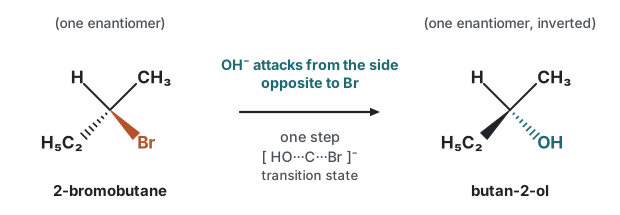
If you start with one enantiomer of 2-bromobutane, you get one enantiomer of butan-2-ol. The product is optically active.
SN1: a flat intermediate 15.5
In SN1 the halogenoalkane first ionises slowly, losing the halide ion to give a carbocation. The positive carbon has three groups arranged in a flat triangle (trigonal planar), so it has no left or right. The nucleophile then attacks fast, with equal chance from the front or the back.
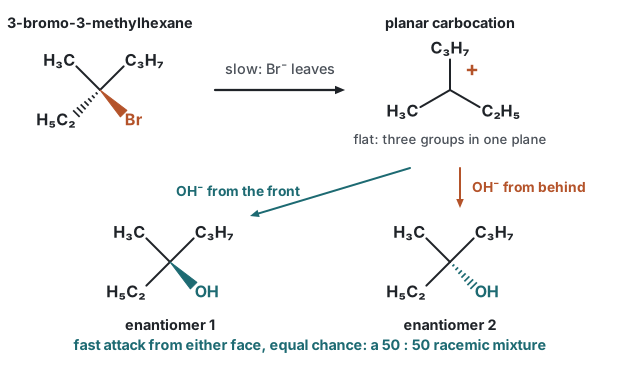
The two products are mirror images and form in equal amounts, so the product is a racemic mixture. It is optically inactive, even though the starting material was optically active.
Reading an exam question 15.5
| Observation | Conclusion | Wording to use |
|---|---|---|
| single enantiomer of the halogenoalkane gives a product that rotates plane-polarised light | SN2 | the nucleophile attacks from one side (the side opposite the halogen) |
| single enantiomer gives a product with no rotation | SN1 | the carbocation is planar, so the nucleophile attacks from either side with equal probability, giving a racemic mixture |
In general, primary halogenoalkanes react by SN2 and tertiary halogenoalkanes by SN1. Secondary halogenoalkanes can use both routes, so a partly active product is possible.
Check yourself
- A pure enantiomer of 2-bromobutane reacts with aqueous sodium hydroxide and the product butan-2-ol is optically active. State the mechanism and explain how the data support it.
- A pure enantiomer of 3-bromo-3-methylhexane gives an optically inactive product with aqueous hydroxide. State the mechanism and explain the lack of optical activity.
- Why is the carbocation intermediate in SN1 important to the explanation?
- Explain why SN2 inverts the arrangement at the carbon atom.
- A student says that if a reaction of a chiral halogenoalkane gives an optically inactive product it must be SN2. Is the student right?
Answers cover these until you have tried the questions
- SN2. The product is optically active, so it has a single enantiomer. This means the hydroxide attacked from one side only, the side opposite to the bromine, in a single step, so the arrangement is kept in a definite form (inverted).
- SN1. The bromide ion leaves first to give a planar carbocation. The hydroxide ion attacks the flat carbon from either side with equal probability, giving equal amounts of the two enantiomers. This is a racemic mixture, in which the rotations cancel, so it is optically inactive.
- The carbocation is trigonal planar, so it has no left- or right-handed arrangement. Attack from the front or the back is equally likely, and the original 3D arrangement is lost.
- The nucleophile attacks from the opposite side to the leaving group, and the other three groups swing across as the new bond forms, like an umbrella blown inside out. The nucleophile ends up on the face opposite to where the halogen was.
- No. An optically inactive product is evidence for SN1, in which a flat carbocation is attacked from both sides to give a racemic mixture. SN2 gives a single enantiomer, which is optically active.