Topic 15 · page 5 of 28
Naming aldehydes and ketones
Aldehydes end in -al with the C=O on the end carbon. Ketones end in -one with the C=O inside the chain. You need to draw each as structural, displayed and skeletal formulae.
The carbonyl group 15.6
A carbonyl compound contains a carbon–oxygen double bond, C=O. Where that group sits decides the family.
| Family | Where the C=O is | Group | Suffix | Example |
|---|---|---|---|---|
| aldehyde | at the end of the carbon chain, bonded to an H | –CHO | -al | propanal, CH₃CH₂CHO |
| ketone | inside the chain, bonded to two carbon atoms | –CO– | -one | propanone, CH₃COCH₃ |
Write an aldehyde group as CHO, never COH. The COH form looks like an alcohol, and a mark scheme will not give the mark.
Naming rules 15.6
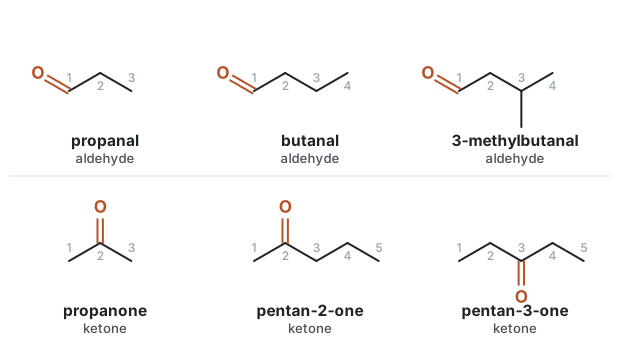
- Find the longest carbon chain that includes the C=O carbon. This gives the stem (prop-, but-, pent-).
- For an aldehyde, the C=O carbon is always carbon 1, so no number is needed: propanal, butanal.
- For a ketone, number the chain from the end that gives the C=O the lowest number, and put that number before "one": pentan-2-one, pentan-3-one. Propanone and butanone need no number, because the C=O can only be in one place.
- Name branches as prefixes with their numbers: 3-methylbutanal.
| Name | Structural formula | Family |
|---|---|---|
| methanal | HCHO | aldehyde |
| ethanal | CH₃CHO | aldehyde |
| propanal | CH₃CH₂CHO | aldehyde |
| butanal | CH₃CH₂CH₂CHO | aldehyde |
| propanone | CH₃COCH₃ | ketone |
| butanone | CH₃COCH₂CH₃ | ketone |
| pentan-2-one | CH₃COCH₂CH₂CH₃ | ketone |
| pentan-3-one | CH₃CH₂COCH₂CH₃ | ketone |
Butanal and butanone both have the molecular formula C₄H₈O. They are functional-group isomers: the same atoms arranged as different families.
Three ways to draw them 15.6
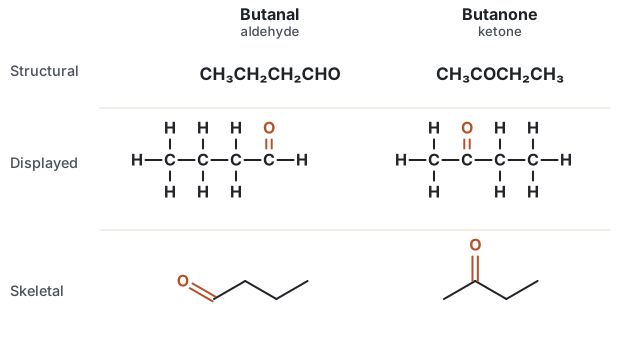
- Structural formula: shows the groups in order, such as CH₃CH₂CH₂CHO.
- Displayed formula: shows every atom and every bond, including the C–H bonds and the C=O double bond.
- Skeletal formula: a zig-zag line where each corner and each end is a carbon atom. Hydrogen atoms on carbon are not drawn. The C=O is drawn with its oxygen, and the aldehyde H is not written.
Check yourself
- Name CH₃CH₂CH₂CH₂CHO and CH₃CH₂COCH₂CH₃.
- Give the structural formula of 3-methylbutanal and of butanone.
- Draw the skeletal formula of pentan-2-one and describe how to tell it from pentan-3-one.
- Explain why the name "propan-2-one" is not needed.
- State the molecular formula of propanal and propanone, and say what type of isomerism they show.
Answers cover these until you have tried the questions
- CH₃CH₂CH₂CH₂CHO is pentanal: an aldehyde with a five-carbon chain. CH₃CH₂COCH₂CH₃ is pentan-3-one: a ketone, five carbons, C=O on carbon 3.
- 3-methylbutanal: (CH₃)₂CHCH₂CHO, that is CH₃CH(CH₃)CH₂CHO. Butanone: CH₃COCH₂CH₃.
- Pentan-2-one is a five-carbon zig-zag with the C=O on the second carbon from one end, leaving a CH₃ on one side of the carbonyl carbon and a propyl group on the other. Pentan-3-one has the C=O in the middle carbon, with an ethyl group on each side, so its skeleton is symmetrical.
- The C=O in a three-carbon chain can only be on the middle carbon, because on an end carbon it would be an aldehyde. There is only one possible ketone, so no number is needed.
- Both are C₃H₆O. They are functional-group isomers: propanal is an aldehyde and propanone is a ketone.