Edexcel International A Level Chemistry
Topic 15: Organic Chemistry: Carbonyls, Carboxylic Acids and Chirality
Mirror-image molecules, the C=O group and everything built on it, and the spectra and chromatography that prove what you have made.
The one idea
A left hand and a right hand have the same parts but do not match. Some molecules are the same: they have the same atoms and bonds, but one is the mirror image of the other. They behave identically in most reactions, yet they rotate plane-polarised light in opposite directions. That is chirality, and it opens this topic.
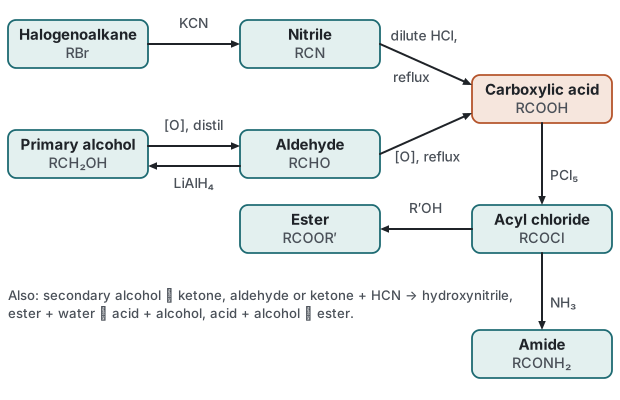
The rest of the topic follows one functional group, C=O. In an aldehyde or ketone it is attacked by nucleophiles, and the flat C=O group is why some products come out as a mixture of mirror images. Add an –OH to the carbon and you have a carboxylic acid. Swap that –OH for –Cl, –OR or –NH₂ and you have the derivatives: acyl chlorides, esters and amides. The topic ends with the tools for proving a structure: accurate mass, carbon-13 and proton NMR, and chromatography.
Three ideas carry most of the marks:
- Chirality and optical activity as evidence. Whether a product keeps its optical activity tells you which mechanism ran (SN1, SN2, or addition to C=O).
- The reaction web. From the alcohol or nitrile to the acid, and from the acid to its derivatives, with the reagent and condition for every step.
- Putting spectra together. Use accurate mass, carbon-13 NMR and proton NMR together to deduce a structure.
The five parts
| Part | Pages |
|---|---|
| 15A Chirality: chiral centres, drawing enantiomers, optical activity, racemic mixtures and the evidence they give about mechanisms | Chiral centres to Optical activity as evidence |
| 15B Carbonyl compounds: naming, physical properties, the oxidation tests, reduction, addition of HCN, 2,4-DNPH and the iodoform test | Naming aldehydes and ketones to Practical, identifying carbonyls |
| 15C Carboxylic acids: naming, hydrogen bonding, making them, their reactions and esterification | Naming carboxylic acids to Esterification |
| 15D Derivatives: acyl chlorides and esters, their reactions, ester hydrolysis and polyesters | Naming acyl chlorides and esters to Polyesters |
| 15E Spectroscopy and chromatography: accurate mass, carbon-13 and proton NMR, TLC, column chromatography, and combining the data | Accurate relative molecular mass to Putting the data together |
When you have finished, use Topic 15 on a page for a last read.
What you need first
- Nucleophilic substitution, SN1 and SN2, and the oxidation of alcohols, from the halogenoalkanes and alcohols topic.
- Mass spectra and infrared spectroscopy from Topic 10, which this topic extends.
- Intermolecular forces and hydrogen bonding, and curly arrows for movement of electron pairs.
- Equilibrium and Le Chatelier's principle, for esterification.
Values used in these notes
| Quantity | Value |
|---|---|
| accurate relative atomic masses | H 1.0078, C 12.0000, N 14.0031, O 15.9949 |
| TMS reference | δ = 0 ppm |
| carbon-13 shifts | C–C 5–55, C–O 50–90, C=C 90–150, C=O in acids and esters 160–185, C=O in aldehydes and ketones 190–220 |
| proton shifts | CH₃ 0.7–1.2, CH₂ in a chain 1.2–1.4, next to C=O 2.0–2.7, bonded to O 3.3–4.3, –CHO 9.4–10.0, –COOH 10–12 |
Check the shift ranges against the data booklet your exam gives you. They are quoted here as typical values.
Pages
- Chiral centres
A carbon atom with four different groups attached is a chiral centre. Its molecule can exist as two mirror-image forms that cannot be placed on top of each other.
- Drawing enantiomers
A 3D diagram uses plain lines, a wedge and a dashed line around the chiral carbon. The mirror image swaps left and right while the wedge stays a wedge and the dash stays a dash.
- Optical activity and racemic mixtures
A single enantiomer rotates the plane of plane-polarised light. Its mirror image rotates it by the same angle the other way, so an equal mixture of the two has no effect.
- Optical activity as evidence for a mechanism
Start with a single enantiomer and check whether the product is optically active. A reaction that keeps the activity works by SN2, and one that loses it passes through a flat intermediate, as in SN1.
- Naming aldehydes and ketones
Aldehydes end in -al with the C=O on the end carbon. Ketones end in -one with the C=O inside the chain. You need to draw each as structural, displayed and skeletal formulae.
- Physical properties of carbonyl compounds
Aldehydes and ketones have no O–H bond, so they cannot hydrogen-bond to each other and boil lower than alcohols. Their oxygen atom can accept a hydrogen bond from water, so small ones dissolve.
- Oxidation tests for aldehydes
Aldehydes are easily oxidised to carboxylic acids and ketones are not. Tollens' reagent, Fehling's or Benedict's solution and acidified dichromate(VI) all react with aldehydes and not with ketones.
- Reducing carbonyl compounds with LiAlH₄
Lithium tetrahydridoaluminate(III) in dry ether reduces an aldehyde to a primary alcohol and a ketone to a secondary alcohol. A ketone such as butanone gives a racemic product, because the flat C=O is attacked from both sides.
- Addition of hydrogen cyanide
Cyanide ion attacks the δ+ carbon of a C=O group in nucleophilic addition, making a hydroxynitrile. Because the C=O group is flat, an aldehyde gives a racemic mixture.
- 2,4-DNPH and the iodoform test
2,4-dinitrophenylhydrazine gives an orange precipitate with any aldehyde or ketone, and its melting temperature identifies which one. Iodine and alkali give a pale yellow precipitate of triiodomethane with a CH₃CO group.
- Practical, identifying carbonyl compounds
A sequence of test-tube tests with 2,4-DNPH, Tollens' reagent and iodine and alkali separates aldehydes, methyl ketones, other ketones and alcohols. The melting temperature of the derivative then names the compound.
- Naming carboxylic acids
A carboxylic acid contains the –COOH group and its name ends in -oic acid. The carboxyl carbon is always carbon 1, so a number is never needed for it.
- Hydrogen bonding in carboxylic acids
A carboxylic acid has both a C=O oxygen to accept and an O–H hydrogen to give hydrogen bonds. This gives high boiling temperatures and, for small acids, complete solubility in water.
- Making carboxylic acids
Carboxylic acids are made by oxidising primary alcohols or aldehydes under reflux with acidified dichromate(VI), or by hydrolysing a nitrile with acid or alkali. The nitrile route lengthens the carbon chain by one carbon.
- Reactions of carboxylic acids
Carboxylic acids are reduced to primary alcohols by lithium tetrahydridoaluminate(III), neutralised by bases to give salts, and converted to acyl chlorides by phosphorus(V) chloride.
- Esterification
A carboxylic acid and an alcohol, heated with a little concentrated sulfuric acid as catalyst, form an ester and water in an equilibrium. Esters are named from the alcohol first and the acid second.
- Naming acyl chlorides and esters
Acyl chlorides end in -oyl chloride and contain –COCl. Esters are named alkyl alkanoate, with the part from the alcohol first and the part from the acid second.
- Reactions of acyl chlorides
Ethanoyl chloride reacts quickly at room temperature with water, alcohols, concentrated ammonia and amines. Each reaction swaps the Cl for –OH, –OR, –NH₂ or –NHR and gives off hydrogen chloride or its salt.
- Hydrolysis of esters
Heating an ester under reflux with dilute acid reverses esterification and gives an equilibrium. Heating it with aqueous sodium hydroxide goes to completion and gives the sodium salt of the acid and the alcohol.
- Polyesters
A polyester forms when a molecule with two –COOH groups reacts with a molecule with two –OH groups. A water molecule is lost at each ester link. Terylene is made from benzene-1,4-dicarboxylic acid and ethane-1,2-diol.
- Accurate relative molecular mass
A high-resolution mass spectrometer measures the molecular ion peak to four decimal places. Atoms do not have whole-number masses, so the exact value tells you the molecular formula.
- Carbon-13 NMR
Each carbon atom in a different environment gives one peak in a carbon-13 NMR spectrum. The chemical shift of the peak shows what the carbon is bonded to, and the number of peaks shows how many different environments there are.
- Proton NMR, environments and peak areas
A proton NMR spectrum has one peak for each set of equivalent hydrogen atoms. The chemical shift shows the type of hydrogen and the area under each peak is in the ratio of the number of hydrogens in that environment.
- Splitting and the (n + 1) rule
At high resolution a peak splits into a pattern. A hydrogen with n hydrogens on the adjacent carbon atoms gives n + 1 lines, with heights in the ratio of Pascal's triangle.
- Predicting and deducing from proton NMR
To predict a spectrum, find each hydrogen environment and give its shift, area and splitting. To deduce a structure, reverse the process and build pieces that fit every peak, then check them against the formula.
- Chromatography and Rf values
Chromatography separates a mixture because its components spend different amounts of time in a moving mobile phase and a fixed stationary phase. In paper and thin-layer chromatography each substance has its own Rf value.
- Column chromatography
High-performance liquid chromatography and gas chromatography pass a mixture through a column. Components leave at different retention times, and the detector, often a mass spectrometer, identifies and measures each.
- Putting the data together
Use accurate mass for the molecular formula, carbon-13 NMR for the number of carbon environments and the functional groups, and proton NMR for the environments, ratio and neighbours. Then assemble a structure that fits every piece.
Also in this topic: Topic 15 on a page
Spec checklist
Every point you can be examined on in this topic, and where it is explained. Tick them off as you go.
| Spec | You should be able to | Where |
|---|---|---|
| 15.1 | know that optical isomerism is a result of chirality in molecules with a single chiral centre | Mirror images that do not match The rotation test |
| 15.2 | understand that optical isomerism results from chiral centre(s) in a molecule with asymmetric carbon atom(s) and that optical isomers (enantiomers) are object and non-superimposable mirror images and be able to draw 3D diagrams of these optical isomers | Finding the chiral centre The three kinds of bond Drawing the mirror image |
| 15.3 | know that optical activity is the ability of a single optical isomer to rotate the plane of polarisation of plane-polarised monochromatic light in molecules containing a single chiral centre | Plane-polarised light The polarimeter |
| 15.4 | know what is meant by the term ‘racemic mixture’ | Racemic mixtures |
| 15.5 | be able to use data on optical activity of reactants and products as evidence for SN1 and SN2 mechanisms and addition to carbonyl compounds | The idea SN2: one step, one side SN1: a flat intermediate Reading an exam question What the product tells you about the C=O group Optical activity shows the C=O is flat |
| 15.6 | understand the nomenclature of aldehydes and ketones and be able to draw their structural, displayed and skeletal formulae | The carbonyl group Naming rules Three ways to draw them |
| 15.7(i) | understand that aldehydes and ketones: do not form intermolecular hydrogen bonds and this affects their physical properties | Boiling temperatures |
| 15.7(ii) | understand that aldehydes and ketones: can form hydrogen bonds with water and this affects their solubility | Solubility in water |
| 15.8(i) | understand the reactions of carbonyl compounds with: Fehling’s or Benedict’s solution, Tollens’ reagent and acidified dichromate(VI) ions. In equations, the oxidising agent can be represented as [O]. | Why aldehydes oxidise and ketones do not Tollens' reagent Fehling's and Benedict's solutions Acidified dichromate(VI) Expected observations |
| 15.8(ii) | understand the reactions of carbonyl compounds with: lithium tetrahydridoaluminate(III) (lithium aluminium hydride) in dry ether (ethoxyethane). In equations, the reducing agent can be represented by [H]. | The reagent and the reaction |
| 15.8(iii) | understand the reactions of carbonyl compounds with: HCN, in the presence of KCN, as a nucleophilic addition reaction, using curly arrows, relevant lone pairs, dipoles and evidence of optical activity to show the mechanism | The reaction The mechanism |
| 15.8(iv) | understand the reactions of carbonyl compounds with: 2,4-dinitrophenylhydrazine (2,4-DNPH), as a qualitative test for the presence of a carbonyl group and to identify a carbonyl compound given data of the melting temperatures of derivatives. The equation for this reaction is not required. | Testing for a carbonyl group Identifying the carbonyl compound The further suggested practical |
| 15.8(v) | understand the reactions of carbonyl compounds with: iodine in the presence of alkali (the iodoform test) | The iodoform test Following a logical order |
| 15.9 | understand the nomenclature of carboxylic acids and be able to draw their structural, displayed and skeletal formulae | The carboxyl group Naming rules Salts and substituents |
| 15.10 | understand that hydrogen bonding affects the physical properties of carboxylic acids, in relation to their boiling temperatures and solubility | Boiling temperatures Solubility in water |
| 15.11 | understand that carboxylic acids can be prepared by the oxidation of alcohols or aldehydes and the hydrolysis of nitriles | Oxidising alcohols and aldehydes Hydrolysing a nitrile |
| 15.12(i) | understand the reactions of carboxylic acids with: lithium tetrahydridoaluminate(III) (lithium aluminium hydride) in dry ether (ethoxyethane) | One acid, four reactions Reduction to a primary alcohol |
| 15.12(ii) | understand the reactions of carboxylic acids with: bases to produce salts | Reactions with bases give salts |
| 15.12(iii) | understand the reactions of carboxylic acids with: phosphorus(V) chloride (phosphorus pentachloride) | Reaction with phosphorus(V) chloride |
| 15.12(iv) | understand the reactions of carboxylic acids with: alcohols in the presence of an acid catalyst | The reaction Naming and uses |
| 15.13 | understand the nomenclature of acyl chlorides and esters and be able to draw their structural, displayed and skeletal formulae | One C=O part, four groups Naming acyl chlorides Naming esters |
| 15.14(i) | understand the reactions of acyl chlorides with: water | Why acyl chlorides react so easily With water |
| 15.14(ii) | understand the reactions of acyl chlorides with: alcohols | With alcohols |
| 15.14(iii) | understand the reactions of acyl chlorides with: concentrated ammonia | With concentrated ammonia |
| 15.14(iv) | understand the reactions of acyl chlorides with: amines | With amines |
| 15.15 | understand the hydrolysis reactions of esters, in acidic and alkaline solution | Two ways to break an ester Acid hydrolysis Alkaline hydrolysis |
| 15.16 | understand how polyesters, such as terylene, are formed by condensation polymerisation reactions. | Condensation polymerisation Terylene |
| 15.17(i) | be able to use data from mass spectra to: suggest possible structures of a simple organic compound given accurate relative molecular masses | Suggesting a structure What each technique tells you |
| 15.17(ii) | be able to use data from mass spectra to: calculate the accurate relative molecular mass of a compound, given accurate relative atomic masses to four decimal places | Why four decimal places help Calculating an accurate relative molecular mass |
| 15.18 | understand that carbon-13, (¹³C) NMR spectroscopy provides information about the positions of ¹³C atoms in a molecule | What carbon-13 NMR measures |
| 15.19(i) | be able to use data from ¹³C NMR spectroscopy to: predict the different environments for carbon atoms present in a molecule, given values of chemical shift, δ | Chemical shifts Worked example, an ester |
| 15.19(ii) | be able to use data from ¹³C NMR spectroscopy to: justify the number of peaks present in a ¹³C NMR spectrum in terms of the number of carbon atoms in different environments | One peak per environment |
| 15.20(i) | be able to use both low and high resolution proton NMR spectroscopy to: predict the different types of proton present in a molecule, given values of chemical shift, δ | Hydrogen environments Chemical shift |
| 15.20(ii) | be able to use both low and high resolution proton NMR spectroscopy to: relate relative peak areas, or ratio number of protons, to the relative numbers of ¹H atoms in different environments | Peak areas |
| 15.20(iii) | be able to use both low and high resolution proton NMR spectroscopy to: deduce the splitting patterns of adjacent, non-equivalent protons using the (n+1) rule and hence suggest the possible structures for a molecule | Splitting at high resolution Reading the splitting Deducing a structure |
| 15.20(iv) | be able to use both low and high resolution proton NMR spectroscopy to: predict the chemical shifts and splitting patterns of the ¹H atoms in a given molecule | Predicting a spectrum Worked example, a ketone |
| 15.21 | know that chromatography separates components of a mixture using a mobile phase and a stationary phase | Mobile phase and stationary phase |
| 15.22 | be able to calculate Rf values from one-way chromatograms in paper and thin-layer chromatography (TLC) and understand reasons for differences in Rf values | Paper and thin-layer chromatography The Rf value |
| 15.23 | know that high-performance liquid chromatography, HPLC, and gas chromatography, GC, are types of column chromatography that separate substances because of different retention times in the column and may be used in conjunction with mass spectrometry, in applications such as forensics or drug testing in sport | Chromatography in a column Retention time Using the mass spectrometer as the detector |