Topic 15 · page 26 of 28
Chromatography and Rf values
Chromatography separates a mixture because its components spend different amounts of time in a moving mobile phase and a fixed stationary phase. In paper and thin-layer chromatography each substance has its own Rf value.
Mobile phase and stationary phase 15.21
All forms of chromatography use two phases:
- the stationary phase, which stays in place (for example the paper, or a thin layer of silica on a plate), and
- the mobile phase, which moves through or over the stationary phase carrying the mixture (a liquid solvent, or a gas).
Each component is attracted to the stationary phase to a different extent and is soluble in the mobile phase to a different extent. A component that is more soluble in the mobile phase and less strongly held by the stationary phase moves further in the same time. Different components therefore travel at different speeds and separate.
Paper and thin-layer chromatography 15.22
In paper chromatography the stationary phase is the water held in the fibres of the paper. In thin-layer chromatography (TLC) it is a thin layer of a solid such as silica or alumina on a glass or plastic plate. In both the mobile phase is a solvent that rises up the paper or plate by capillary action.
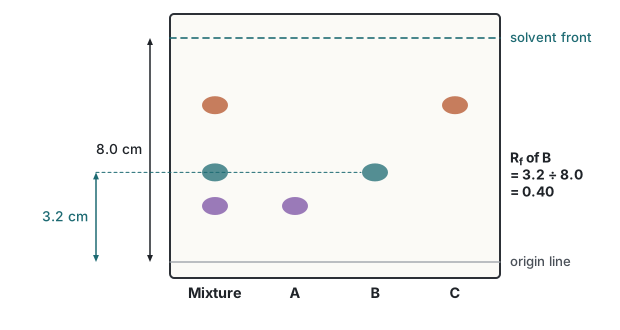
MethodRunning a one-way chromatogram
- Draw an origin line in pencil about 1.5 cm from the bottom of the plate, and mark the positions of the spots on it. Pencil does not dissolve in the solvent.
- Put a small spot of each sample on the line, using a capillary tube, and let it dry.
- Stand the plate in a container with a little solvent. The origin line must be above the solvent level. Put on a lid.
- When the solvent has nearly reached the top, remove the plate and mark the solvent front at once with a pencil.
- If the spots are colourless, make them visible (with ultraviolet light, iodine vapour or a locating agent).
The Rf value 15.22
An value has no units and is always between 0 and 1. It is the same for a given substance if the solvent, stationary phase and temperature are the same, so it can be compared with a known value to identify a substance.
Worked exampleRf values from the plate
From the plate above, the solvent front moved 8.0 cm. Spots A, B and C moved 2.0 cm, 3.2 cm and 5.6 cm. Calculate each .
- A: 2.0 ÷ 8.0 = 0.25
- B: 3.2 ÷ 8.0 = 0.40
- C: 5.6 ÷ 8.0 = 0.70
A has the lowest , so it is the most strongly held by the stationary phase and/or the least soluble in the solvent. C moved furthest, so it is the most soluble in the mobile phase and the least strongly attracted to the stationary phase.
The reasons for differences in values are therefore the different solubilities in the mobile phase and the different strengths of attraction to the stationary phase. A different solvent gives different values for the same substances.
Check yourself
- State what is meant by the stationary phase and the mobile phase in thin-layer chromatography.
- A spot has moved 4.5 cm when the solvent front has moved 9.0 cm. Calculate its .
- A substance has = 0.30. The solvent front moved 7.5 cm. How far did the spot move?
- Explain why the origin line is drawn in pencil and why it must be above the level of the solvent.
- Two substances, P and Q, have values of 0.20 and 0.65 in the same solvent. Explain which one is more strongly held by the stationary phase.
- State the main reasons for a difference in between two substances.
Answers cover these until you have tried the questions
- The stationary phase is the solid (silica or alumina) layer on the plate, which does not move. The mobile phase is the solvent that rises up the plate carrying the sample.
- = 4.5 ÷ 9.0 = 0.50
- Distance = 0.30 × 7.5 = 2.25 cm
- Pencil is insoluble in the solvent and so does not run up the plate. The origin line must be above the solvent level so that the spots are not washed off the plate into the solvent.
- P (0.20) is more strongly held, because it moved less far. It is more attracted to the stationary phase and/or less soluble in the solvent than Q.
- The substances have different solubilities in the mobile phase and different attractions to the stationary phase.