Topic 15 · page 8 of 28
Reducing carbonyl compounds with LiAlH₄
Lithium tetrahydridoaluminate(III) in dry ether reduces an aldehyde to a primary alcohol and a ketone to a secondary alcohol. A ketone such as butanone gives a racemic product, because the flat C=O is attacked from both sides.
Read first: Naming aldehydes and ketones, Optical activity as evidence for a mechanism
The reagent and the reaction 15.8(ii)
Lithium tetrahydridoaluminate(III), , is also called lithium aluminium hydride. It is a powerful reducing agent. It adds hydrogen to the C=O group, turning it into a C–OH group.
In equations the reducing agent can be written as [H], as the specification allows.
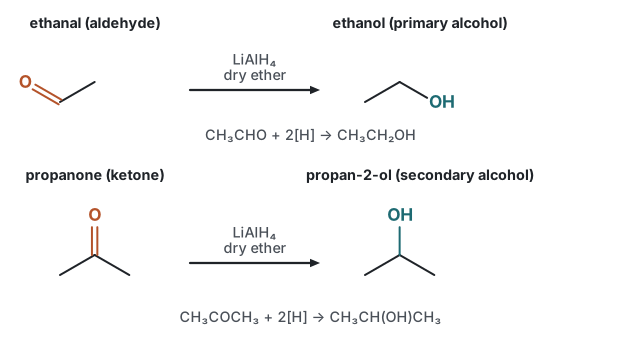
| Starting material | Product | Product type |
|---|---|---|
| aldehyde, R–CHO | R–CH₂OH | primary alcohol |
| ketone, R–CO–R′ | R–CH(OH)–R′ | secondary alcohol |
MethodConditions
Use lithium tetrahydridoaluminate(III) in dry ether (ethoxyethane). The ether must be dry, because the reagent reacts violently with water. Water or dilute acid is added carefully afterwards to give the alcohol.
The same reagent reduces carboxylic acids to primary alcohols, which you meet on the page about reactions of carboxylic acids.
What the product tells you about the C=O group 15.5
The carbon of the C=O group is trigonal planar: the carbon and the three atoms bonded to it lie in one plane. The hydride ion can attack from above or below the plane with equal chance.
Reduce butanone, , and the product is butan-2-ol. The new C–OH carbon has four different groups, H, OH, CH₃ and CH₂CH₃, so it is a chiral centre. Attack from the front gives one enantiomer and attack from behind gives the other, in equal amounts.
The product is a racemic mixture and is optically inactive. This is evidence that the C=O group is planar and attacked from both sides equally.
With propanone the product, propan-2-ol, has two identical CH₃ groups and is not chiral, so there is no optical activity to test.
Check yourself
- State the reagent and the conditions for reducing propanal to propan-1-ol.
- Write equations using [H] for the reduction of (a) butanal and (b) pentan-3-one, naming each product.
- Explain why the ether used must be dry.
- Butanone is reduced with lithium tetrahydridoaluminate(III) and the product shows no optical activity. Explain.
- State the class of alcohol formed from an aldehyde and from a ketone.
Answers cover these until you have tried the questions
- Lithium tetrahydridoaluminate(III) in dry ether (ethoxyethane).
- (a) , butan-1-ol. (b) , pentan-3-ol.
- The reagent reacts violently with water, producing hydrogen, so any water would destroy the reagent and could cause an explosion.
- The product, butan-2-ol, has a chiral centre. The C=O group is planar, so the hydride ion attacks from either side with equal probability and forms equal amounts of the two enantiomers. This racemic mixture has no net rotation, so it is optically inactive.
- An aldehyde gives a primary alcohol. A ketone gives a secondary alcohol.