Topic 15 · page 14 of 28
Making carboxylic acids
Carboxylic acids are made by oxidising primary alcohols or aldehydes under reflux with acidified dichromate(VI), or by hydrolysing a nitrile with acid or alkali. The nitrile route lengthens the carbon chain by one carbon.
Read first: Naming carboxylic acids, Oxidation tests for aldehydes
Oxidising alcohols and aldehydes 15.11
A primary alcohol is oxidised in two stages: first to an aldehyde, then to a carboxylic acid. The reagent is acidified potassium dichromate(VI), which turns from orange to green as it is reduced.
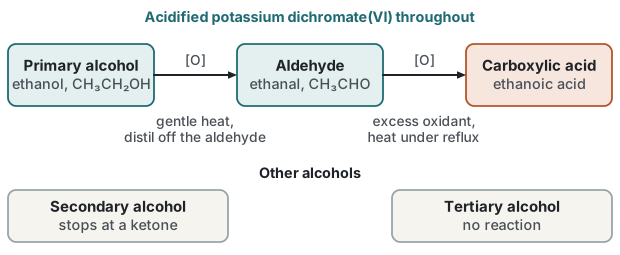
Add the two together to get the overall equation for the alcohol going straight to the acid.
| Wanted product | Conditions |
|---|---|
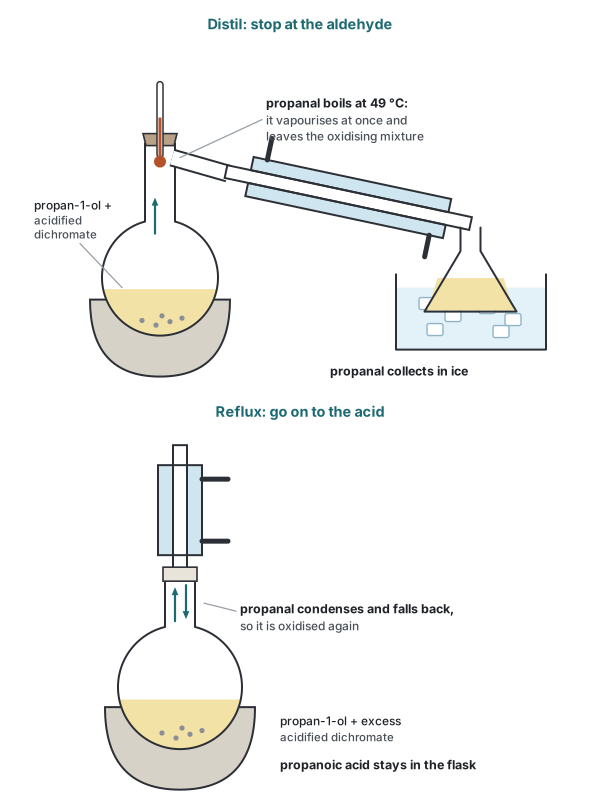
| aldehyde | warm the alcohol with a slight excess of the alcohol and distil off the aldehyde as it forms, before it is oxidised further |
| carboxylic acid | use an excess of the oxidising agent and heat under reflux so that the aldehyde stays in the flask and is oxidised on |
An aldehyde can also be oxidised directly to the acid, , with the same reagent under reflux.
A secondary alcohol is oxidised only as far as a ketone, and a tertiary alcohol is not oxidised, so neither gives a carboxylic acid.
PracticalPreparing ethanoic acid by oxidising ethanol
This is the further suggested practical. Work in a fume cupboard and wear eye protection and gloves. Acidified dichromate(VI) is toxic and a cancer-causing substance, and concentrated sulfuric acid is corrosive.
- Put the ethanol, dilute sulfuric acid and a few anti-bumping granules in a round-bottomed flask.
- Add potassium dichromate(VI) solution, in excess, a little at a time, because the reaction is exothermic. The orange mixture turns green.
- Fit a reflux condenser, with water flowing in at the bottom and out at the top.
- Heat under reflux for about 20 minutes so that any ethanal formed is oxidised on to the acid.
- Change the apparatus to distillation and collect the liquid that boils close to 118 °C, which is ethanoic acid.
- Test the product: it has a sharp, vinegar smell, turns universal indicator red or orange, and gives effervescence of carbon dioxide with sodium carbonate solution.
Hydrolysing a nitrile 15.11
A nitrile contains the –C≡N group. Heating it under reflux with dilute acid converts it to a carboxylic acid and an ammonium salt. Hydrolysis means breaking down by reacting with water.
With aqueous alkali the product is the salt of the acid, plus ammonia. Add dilute acid afterwards to release the acid.
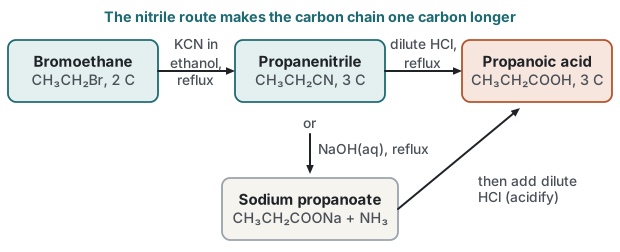
The nitrile itself is made from a halogenoalkane with potassium cyanide in ethanol under reflux, replacing the halogen with CN. The carbon of the –CN group becomes the new carboxyl carbon, so the acid has one more carbon than the halogenoalkane: bromoethane (2 C) gives propanoic acid (3 C).
Check yourself
- State the reagent and conditions for converting propan-1-ol into propanoic acid, and write the overall equation using [O].
- Explain why propan-2-ol cannot be converted into a carboxylic acid by oxidation.
- State how you would stop the oxidation of ethanol at ethanal.
- Write equations for the conversion of bromoethane into propanoic acid in two steps, giving reagents and conditions.
- Why does a hydrolysis of a nitrile with sodium hydroxide need a further step to give the acid?
Answers cover these until you have tried the questions
- Acidified potassium dichromate(VI), in excess, heated under reflux.
- Propan-2-ol is a secondary alcohol. Oxidation gives a ketone (propanone), and a ketone cannot be oxidised further by this reagent, as it has no hydrogen on the carbonyl carbon.
- Use gentle heating and distil the ethanal out of the mixture as it forms (its boiling temperature is much lower than that of ethanol or ethanoic acid), so it cannot be oxidised further.
- Step 1: , using KCN in ethanol, heated under reflux. Step 2: , using dilute hydrochloric acid, heated under reflux.
- In alkaline conditions the product is the carboxylate salt, for example sodium propanoate, not the acid. Adding a dilute strong acid protonates the carboxylate ion to give the carboxylic acid.