Topic 15 · page 12 of 28
Naming carboxylic acids
A carboxylic acid contains the –COOH group and its name ends in -oic acid. The carboxyl carbon is always carbon 1, so a number is never needed for it.
Read first: Naming aldehydes and ketones
The carboxyl group 15.9
A carboxylic acid contains the carboxyl group, –COOH. It is a carbonyl group, C=O, and a hydroxyl group, O–H, on the same carbon atom. The name combines "carbonyl" and "hydroxyl".
The two parts affect each other. The carboxyl group behaves differently from a ketone or an alcohol, which you see in the reactions on the next pages.
Naming rules 15.9
- Find the longest carbon chain that includes the carboxyl carbon.
- The stem takes the ending -oic acid: methanoic, ethanoic, propanoic, butanoic.
- The carboxyl carbon is always carbon 1, so no number is needed for the acid group.
- Name branches as prefixes with numbers counted from the carboxyl carbon: 2-methylpropanoic acid.
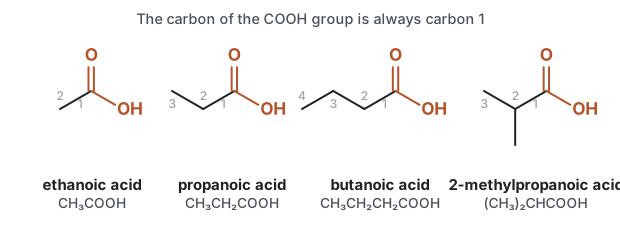
| Name | Structural formula | Skeletal formula |
|---|---|---|
| methanoic acid | one carbon with C=O and OH | |
| ethanoic acid | CH₃COOH | zig-zag of two carbons, C=O and OH at one end |
| propanoic acid | CH₃CH₂COOH | three carbons, carboxyl at one end |
| butanoic acid | CH₃CH₂CH₂COOH | four carbons, carboxyl at one end |
| 2-methylpropanoic acid | (CH₃)₂CHCOOH | three-carbon chain with CH₃ on carbon 2 |
In a displayed formula the carboxyl carbon is bonded to C (or H), to O by a double bond, and to O–H. Draw the O–H bond and the hydrogen explicitly.
Salts and substituents 15.9
Replace the acid hydrogen with a metal and the name changes from -oic acid to -oate: sodium ethanoate, CH₃COONa. The ion, CH₃COO⁻, is the ethanoate ion.
A hydroxy group on the chain is a prefix: 2-hydroxypropanoic acid, CH₃CH(OH)COOH, which you met as a chiral molecule on the page about drawing enantiomers.
Carboxylic acids are weak acids. They are only partly dissociated in water, as in the equilibrium for ethanoic acid from the acid–base topic.
Check yourself
- Name CH₃CH₂CH₂CH₂COOH and (CH₃)₂CHCH₂COOH.
- Give the structural formula of 2,2-dimethylpropanoic acid.
- Why does butanoic acid need no number before "oic acid"?
- Name the salt CH₃CH₂COONa.
- Draw the displayed formula of ethanoic acid, and say which bond in it is polar and responsible for the acidic behaviour.
Answers cover these until you have tried the questions
- CH₃CH₂CH₂CH₂COOH is pentanoic acid. (CH₃)₂CHCH₂COOH is 3-methylbutanoic acid: the four-carbon chain runs from the carboxyl carbon, and the branch is on carbon 3.
- (CH₃)₃CCOOH: carbon 2 holds two methyl groups.
- The carboxyl carbon is always carbon 1 because it is at the end of the chain, so there is only one possible position for the acid group.
- Sodium propanoate.
- A carbon bonded to CH₃, to O by a double bond (C=O), and to O–H, with each of the three C–H bonds in CH₃ drawn. The O–H bond is polar and its hydrogen is the one lost as H⁺ when the acid dissociates.