Topic 10 · page 27 of 27
Identifying an unknown
Use the mass spectrum for the relative molecular mass, the infrared spectrum for the functional groups, and the fragments to choose between isomers. Every preparation ends with this question: did we make what we meant to make?
Read first: Mass spectra, Infrared spectra
A routine for unknowns 10.2110.22
In Core Practical 7 you prepare propanal and propanoic acid in Core Practical 7. How do you show that the distillate is propanal and not its isomer, propanone? Two spectra together answer it, and each gives a different piece of information.
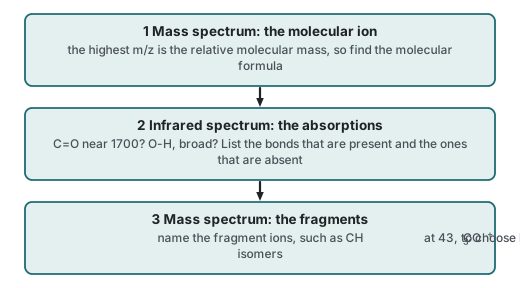
MethodIdentifying a compound from spectra
- Molecular ion. Read the highest m/z. This is . Find the molecular formula that fits, if it is given or can be worked out.
- Infrared. Look first for C=O (about 1700) and O–H (about 3350, or very broad 2500–3300). Say which are present and which are absent.
- Fragments. Name the fragment ions (CH₃⁺ 15, C₂H₅⁺ 29, CH₂OH⁺ 31, CH₃CO⁺ 43, 45). They show which groups are joined together.
- Write the structure and check that every piece of data fits it.
Worked problems 10.2110.22
Worked exampleCompound X
X has a molecular ion at m/z 60, with peaks at 45 and 43. Its infrared spectrum has a very broad absorption from 2500 to 3300 cm⁻¹ and a strong sharp peak at 1710 cm⁻¹. Identify X.
- The molecular ion gives = 60. Possible formula C₂H₄O₂: 24.0 + 4.0 + 32.0 = 60.0.
- The very broad O–H (2500–3300) and the C=O (1710) show a carboxylic acid.
- The peak at 45 is and the peak at 43 is CH₃CO⁺.
- X is ethanoic acid, CH₃COOH.
Worked exampleCompound Y
Y is C₃H₈O. Its infrared spectrum has a broad absorption near 3350 cm⁻¹ and no peak between 1650 and 1750 cm⁻¹. The base peak in its mass spectrum is at m/z 31. Suggest a structure.
- The broad O–H at 3350 shows an alcohol. There is no C=O.
- C₃H₈O alcohols are propan-1-ol and propan-2-ol.
- A peak at 31 is CH₂OH⁺. That fragment comes from a primary alcohol, where the C–C bond next to the CH₂OH group breaks. Propan-2-ol would give its base peak at 45, CH₃CHOH⁺, by losing a CH₃ group.
- Y is propan-1-ol, CH₃CH₂CH₂OH.
Worked exampleCompound Z
Z is C₃H₆O with a molecular ion at m/z 58. Its infrared spectrum has a strong sharp absorption at 1715 cm⁻¹ and none above 3000 cm⁻¹. The mass spectrum has a base peak at 43 and a smaller peak at 15. Is Z propanal or propanone?
- of C₃H₆O = 36.0 + 6.0 + 16.0 = 58.0, so the molecular ion fits.
- C=O is present and there is no O–H, so Z is an aldehyde or a ketone.
- Fragments at 43 (CH₃CO⁺) and 15 (CH₃⁺) fit propanone. Propanal would give a base peak at 29.
- Z is propanone, CH₃COCH₃.
Check yourself
- A compound has M⁺ = 74 and a broad O–H near 3350 cm⁻¹ and no C=O. Suggest the type of compound and a formula.
- A compound has M⁺ = 58 and a strong peak at 1720 cm⁻¹. The mass spectrum shows a base peak at 29. Identify it.
- State two ways in which the mass spectra of propan-1-ol and propan-2-ol differ.
- An organic compound has no O–H, no C=O and absorptions at 2950 and 580 cm⁻¹. State what bonds are present.
- Explain why the infrared spectrum cannot distinguish all isomers, with an example.
- Describe how spectra show that the distillate in Core Practical 7, Part A, is propanal.
Answers cover these until you have tried the questions
- An alcohol, with formula C₄H₁₀O (4(12.0) + 10(1.0) + 16.0 = 74.0), for example butan-1-ol.
- = 58 with a C=O at 1720 (no O–H) and a base peak at 29 (CH₃CH₂⁺ or CHO⁺): propanal.
- Propan-1-ol: base peak at 31 (CH₂OH⁺). Propan-2-ol: base peak at 45 (CH₃CHOH⁺). Both have M⁺ at 60.
- C–H (about 2950, alkane) and C–Br (about 500–600), so the compound is a bromoalkane.
- Isomers with the same functional groups, such as propan-1-ol and propan-2-ol, give similar infrared spectra, because each has an O–H bond and C–H bonds. The mass spectrum fragments distinguish them.
- The mass spectrum shows M⁺ at 58 and a base peak at 29. The infrared spectrum shows a C=O at 1680–1750, the aldehyde C–H at 2700–2900, and no O–H. Propanone would give a base peak at 43.