Topic 10 · page 8 of 27
Water as the nucleophile
Water is a weak nucleophile and hydrolyses a halogenoalkane slowly. Silver ions in aqueous silver nitrate catch the halide ion as a coloured precipitate, so the time it takes to appear measures how fast the C–X bond breaks.
Read first: Ammonia and cyanide
Water attacks the δ+ carbon 10.810.8(iii)
Water has two lone pairs on oxygen. It is a weaker nucleophile than OH⁻ because it carries no charge, but it will still attack a δ+ carbon. The halogenoalkane is hydrolysed: the halogen is replaced by –OH and the halide ion goes into solution.
Halogenoalkanes do not dissolve in water, and silver nitrate is in water. So the reaction is done in ethanol, which mixes with both. Ethanol is the solvent. Water is the nucleophile.
Silver nitrate is added to the mixture. Silver ions combine with the halide ions as soon as they form:
The overall change is:
Which precipitate? 10.810.8(iii)
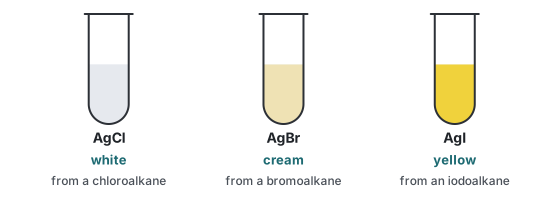
| Halogen in the halogenoalkane | Halide ion | Precipitate | Colour |
|---|---|---|---|
| Cl | Cl⁻ | AgCl | white |
| Br | Br⁻ | AgBr | cream |
| I | I⁻ | AgI | yellow |
The colours are the ones you used for halide ions in Topic 8. Here they identify the halogen in an unknown halogenoalkane. Do not add nitric acid in this experiment: there is no carbonate to remove, and the acid would be an extra variable.
Worked exampleAn unknown halogenoalkane
A halogenoalkane is warmed with aqueous silver nitrate in ethanol. A cream precipitate forms slowly. Identify the type of halogenoalkane and write the equations.
- The cream precipitate is silver bromide, so the halogenoalkane contains bromine: it is a bromoalkane.
- The Br⁻ comes from hydrolysis by water: .
- The silver ions precipitate it: .
Five reagents on one page 10.8
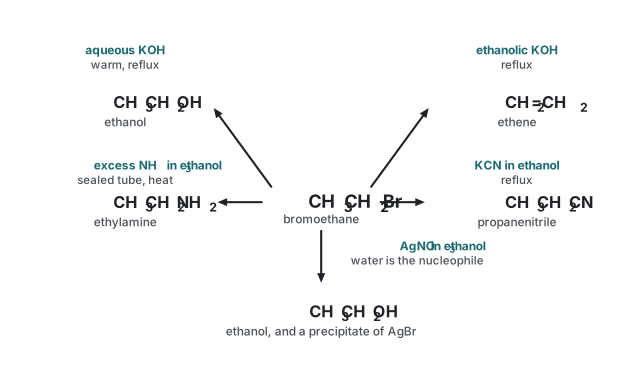
| Reagent | Condition | Product from bromoethane | Species and role |
|---|---|---|---|
| KOH(aq) | heat under reflux | ethanol | OH⁻, nucleophile |
| KOH in ethanol | heat under reflux | ethene | OH⁻, base |
| AgNO₃(aq) in ethanol | warm | ethanol, and an AgBr precipitate | H₂O, nucleophile |
| NH₃ in ethanol, excess | sealed tube, heat | ethylamine | NH₃, nucleophile |
| KCN in ethanol | heat under reflux | propanenitrile | CN⁻, nucleophile |
Check yourself
- Write the equation for the hydrolysis of 1-chlorobutane by water, and name the nucleophile.
- Write the ionic equation, with state symbols, for the formation of the precipitate in this reaction.
- Explain why ethanol is used as the solvent.
- A halogenoalkane gives a yellow precipitate. Name the precipitate and the halogen in the halogenoalkane.
- Explain why the time for the precipitate to appear can be used to compare the rates of hydrolysis.
- List the reagent, the condition and the role of the hydroxide ion for the conversion of a halogenoalkane into an alkene.
Answers cover these until you have tried the questions
- . The nucleophile is water.
- Ethanol is miscible with both the halogenoalkane (which does not dissolve in water) and the aqueous silver nitrate, so the two can mix and react.
- Silver iodide, AgI, so the halogen is iodine.
- The halide ion is released only when the C–X bond breaks, and the silver ions precipitate it at once. So the time for the precipitate to appear is the time taken for a fixed amount of bond breaking: the shorter the time, the faster the hydrolysis.
- Reagent: potassium hydroxide in ethanol (ethanolic KOH). Condition: heat under reflux. OH⁻ acts as a base.