Topic 10 · page 2 of 27
Mechanisms and curly arrows
A mechanism is a step-by-step account of which bonds break and which form. Curly arrows show a pair of electrons moving, and breaking a bond unevenly, heterolytic fission, makes ions.
Read first: Seven types of reaction
What a mechanism shows 10.2
An equation says what you start with and what you finish with. It does not say how. A mechanism shows how, one step at a time, by following the electrons.
A mechanism has four parts. You will use all four in this topic.
- The reactants, drawn so that every lone pair and every partial charge that matters is shown.
- Curly arrows, one for each pair of electrons that moves.
- The intermediate or products that result, with the charges they carry.
- The type of reaction, named: for example nucleophilic substitution.
Some mechanisms take one step and some take two. The electrophilic addition of Topic 5 took two steps with a carbocation between them. The substitutions on pages 9 and 10 are drawn as one step (hydroxide) and two steps (ammonia).
Curly arrows 10.2
A curly arrow shows where a pair of electrons moves.
| Rule | What it means |
|---|---|
| The arrow shows a pair of electrons | it has a full head. A half-headed arrow shows one electron, which is for the radical reactions of Topic 4 |
| It starts at a bond or at a lone pair | never at an atom symbol, and never at a + or − charge |
| It ends at the atom that receives the pair, or in the gap where a new bond forms | the head touches the atom or points at the gap |
| Charges balance afterwards | the atom that gains a pair becomes more negative, the atom that loses it more positive |
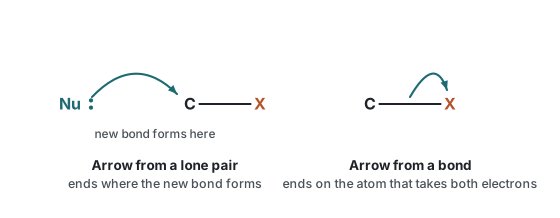
In nearly every mechanism in this topic there are two such arrows. One starts at a lone pair and forms a new bond. One starts at a bond and breaks it.
Heterolytic fission makes ions 10.3
When a covalent bond breaks, its two electrons must go somewhere.
- In homolytic fission each atom takes one electron. Two radicals form. This is the first step of the alkane reactions in Topic 4, and needs UV light.
- In heterolytic fission one atom takes both electrons. A positive ion and a negative ion form.
The atom that takes the pair is the more electronegative one. In the C–Br bond that is bromine.
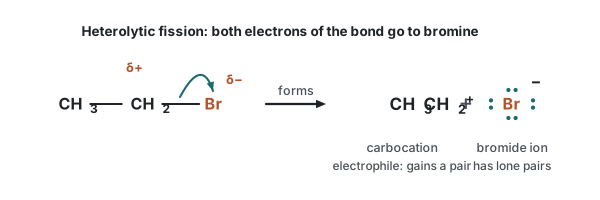
The two ions are very different:
- The positive ion has an atom short of a pair of electrons. It can accept a pair, so it is an electrophile.
- The negative ion has a full set of lone pairs. It can donate a pair to a positive centre, so it can act as a nucleophile.
Check yourself
- Define the term reaction mechanism.
- State where a curly arrow must start, and where it must end.
- A student starts an arrow on the minus sign of a bromide ion. Explain what is wrong and how to correct it.
- What does a curly arrow with a full head show, and what does one with a single barb show?
- Draw the heterolytic fission of the C–Cl bond in chloroethane, CH₃CH₂Cl. Show the curly arrow and the charges on both products.
- Explain why bromine, not carbon, takes the electrons when C–Br breaks heterolytically.
Answers cover these until you have tried the questions
- A reaction mechanism is a step-by-step account of how bonds break and form as reactants become products, using curly arrows to show the movement of electron pairs.
- It must start at a bond or a lone pair, and end at the atom that receives the pair, or at the gap where the new bond forms.
- An arrow must start at a lone pair or a bond, not at a charge. Draw the lone pair on Br⁻ as two dots and start the arrow there.
- A full head shows the movement of a pair of electrons. A single barb (a half arrow) shows one electron, in a radical reaction.
- CH₃CH₂–Cl, with one full arrow from the middle of the C–Cl bond to the Cl atom. Products: CH₃CH₂⁺ (positive charge on carbon) and Cl⁻ (four lone pairs, negative charge).
- Bromine is more electronegative than carbon (2.8 against 2.5), so it attracts the bonding pair more strongly. It takes both electrons and becomes Br⁻.