Topic 10 · page 5 of 27
Primary, secondary and tertiary halogenoalkanes
A halogenoalkane is primary, secondary or tertiary according to how many other carbon atoms are bonded to the carbon that carries the halogen. The class decides how fast it reacts.
Read first: Naming and drawing halogenoalkanes
Counting carbons on the C–X carbon 10.7
Find the carbon that carries the halogen. Count how many other carbon atoms are bonded to it.
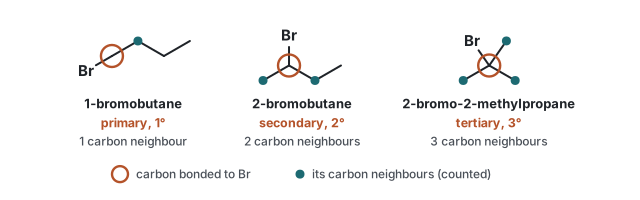
| Class | Carbon neighbours of the C–X carbon | Hydrogens on the C–X carbon | Example |
|---|---|---|---|
| Primary (1°) | 1 | 2 | 1-bromobutane, CH₃CH₂CH₂CH₂Br |
| Secondary (2°) | 2 | 1 | 2-bromobutane, CH₃CHBrCH₂CH₃ |
| Tertiary (3°) | 3 | 0 | 2-bromo-2-methylpropane, (CH₃)₃CBr |
Bromomethane has no carbon neighbours at all. It is usually treated with the primary halogenoalkanes in reactions.
Isomers have different classes 10.7
Four halogenoalkanes have the formula C₄H₉Br. They are structural isomers: the same molecular formula and different structures.
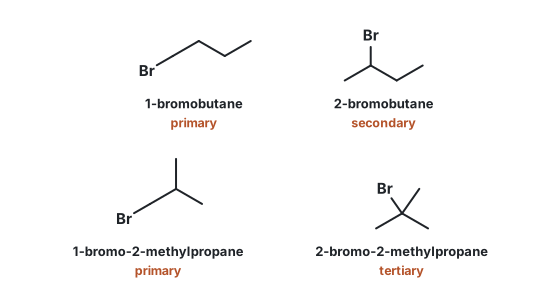
Different classes react at different rates. Core Practical 5 compares the primary, secondary and tertiary isomers, and the next pages say why.
Worked exampleClassify and name an isomer of C₅H₁₁Br
Classify CH₃CH₂C(CH₃)₂Br and name it.
- The carbon bonded to Br is bonded to CH₃, CH₃ and CH₂CH₃: three carbon atoms.
- It is tertiary.
- The longest chain is CH₃CH₂C–CH₃, four carbons (butane). Br and a methyl group are on carbon 2.
- Name: 2-bromo-2-methylbutane.
Check yourself
Classify each halogenoalkane as primary, secondary or tertiary.
- 2-chloropropane
- 1-iodopropane
- 3-bromopentane
- 1-bromo-2-methylpropane
- 2-bromo-2-methylbutane
- Give the names and classes of the two isomers of C₃H₇Br.
Answers cover these until you have tried the questions
- Secondary. The C–Cl carbon (carbon 2) is bonded to two other carbons.
- Primary. The C–I carbon is an end carbon, bonded to one other carbon.
- Secondary. Carbon 3 of pentane is bonded to carbons 2 and 4.
- Primary. The C–Br carbon is bonded to one carbon (the CH). The methyl branch is on the next carbon.
- Tertiary. Carbon 2 is bonded to carbon 1, carbon 3 and the methyl group.
- 1-bromopropane, primary, and 2-bromopropane, secondary.