Topic 10 · page 13 of 27
Core Practical 5: method
Time how long the silver halide precipitate takes to hide a cross, for halogenoalkanes of different class or different halogen. Everything else is kept the same, so the time measures only the rate of hydrolysis.
Read first: Rates of hydrolysis: chloro, bromo, iodo
Aim and idea 10.11
Core Practical 5 is the investigation of the rates of hydrolysis of some halogenoalkanes. The aim is to compare how fast different halogenoalkanes are hydrolysed by water, using silver nitrate in ethanol to show when the halide ion has formed.
You do the experiment twice:
- once with three isomers (primary, secondary and tertiary) to test the effect of the class of halogenoalkane, and
- once with three halogens (chloro, bromo, iodo) on the same carbon skeleton, to test the effect of the halogen.
The reaction in each tube is the hydrolysis you met on page 8:
Method 10.11
PracticalMethod
- Label three test tubes. Add 1 cm³ of ethanol to each.
- Add 5 drops of a different halogenoalkane to each tube. Use the three isomers in one run and the three halogens in another.
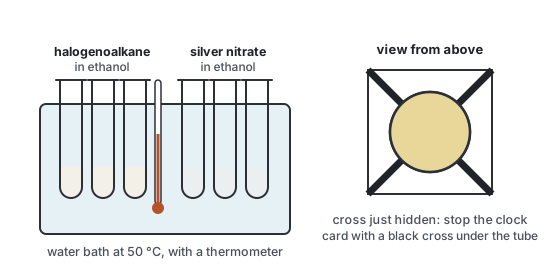
- In three more tubes put 1 cm³ of aqueous silver nitrate, all from the same solution. Stand all six tubes in a water bath at 50 °C for about 5 minutes, so they reach the same temperature.
- Pour one silver nitrate tube into one halogenoalkane tube and start the stopwatch at once. Stand the mixture over a black cross on white paper, and keep it in the water bath if you can.
- Stop the stopwatch when the precipitate first hides the cross. Record the time.
- Repeat for each halogenoalkane. Repeat the whole set to get a mean for each.
| Variable | Which one | How it is controlled |
|---|---|---|
| Independent | the halogenoalkane (class or halogen) | changed on purpose |
| Dependent | the time for the precipitate to hide the cross | measured with a stopwatch |
| Control | volume and concentration of silver nitrate | same solution and same measuring syringe |
| Control | amount of halogenoalkane | the same number of drops |
| Control | volume of ethanol | 1 cm³ each time |
| Control | temperature | water bath at 50 °C, tubes pre-warmed |
| Control | the end point | same cross, same observer, same view |
Safety and good practice 10.11
- Ethanol is flammable. Warm it in a water bath, not over a flame, and keep it away from naked flames.
- Silver nitrate stains skin and clothes, and damages eyes. Wear gloves and goggles.
- Halogenoalkanes are harmful and flammable. Keep the tubes closed when you can, and work in a ventilated place.
- Collect the silver-containing waste in a labelled container. Do not pour it down the sink.
Check yourself
- Write the equation for the hydrolysis of 1-bromobutane and the equation for the precipitation that follows.
- State the independent variable and the dependent variable in the experiment.
- List four variables that must be kept constant, and say how.
- Explain why the silver nitrate and the halogenoalkane are warmed in separate tubes first.
- Give two hazards and a precaution for each.
- A student starts the stopwatch before the two liquids are mixed. Say what effect this has on the results, and why it matters.
Answers cover these until you have tried the questions
- , then .
- Independent: the halogenoalkane (its class or its halogen). Dependent: the time for the precipitate to hide the cross.
- Any four of: volume and concentration of silver nitrate (same solution and measuring syringe); volume of ethanol (1 cm³); amount of halogenoalkane (same number of drops); temperature (water bath at 50 °C); end point (same cross and observer).
- So that both are at the same temperature before mixing, and so that no reaction starts until the stopwatch is started.
- Ethanol is flammable: use a water bath, no naked flames. Silver nitrate stains skin and damages eyes: wear gloves and goggles.
- The recorded time is too long, by the time between starting the watch and mixing. The error is bigger relative to the short times (tertiary, iodo), so it can reduce the apparent differences between samples.