Topic 10 · page 25 of 27
Mass spectra
The peak at the highest m/z in a mass spectrum is the molecular ion, and its m/z is the relative molecular mass. The smaller peaks are fragments, and the way a molecule breaks up helps to show its structure.
The molecular ion 10.21
In a mass spectrometer a molecule, M, has an electron knocked off. This gives a positive ion that is also a radical, the molecular ion:
The spectrum plots abundance (height) against m/z, the mass-to-charge ratio. For a singly charged ion the m/z equals the mass of the ion.
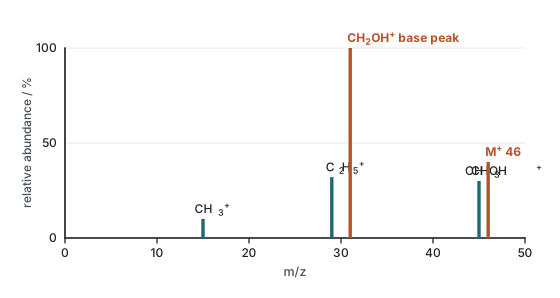
The tallest peak is the base peak. It is the most abundant ion, which is often a fragment and not the molecular ion. The molecular ion is not always the tallest.
Worked exampleMolecular formula from the molecular ion
A compound containing only C, H and O has a molecular ion at m/z 74. Show that two different formulae fit.
- of C₄H₁₀O = 4(12.0) + 10(1.0) + 16.0 = 74.0.
- of C₃H₆O₂ = 3(12.0) + 6(1.0) + 2(16.0) = 74.0.
- Both fit, so the molecular ion alone does not give the formula. Fragments, the infrared spectrum or other data are needed to choose.
Fragmentation 10.21
The molecular ion is unstable and many of the ions break apart. A bond breaks, and the ion splits into a positive fragment ion and a neutral radical:
Only the positive ion, X⁺, is detected. The radical is not charged, so it does not appear in the spectrum. The peak for each fragment shows its mass.
The difference between the molecular ion and a fragment shows what was lost:
| Mass lost from M⁺ | Neutral species lost |
|---|---|
| 15 | CH₃ |
| 17 | OH |
| 18 | H₂O |
| 29 | C₂H₅ or CHO |
Learn the common fragment ions:
| m/z | Fragment ion |
|---|---|
| 15 | CH₃⁺ |
| 29 | C₂H₅⁺ or CHO⁺ |
| 31 | CH₂OH⁺ |
| 43 | CH₃CO⁺ or C₃H₇⁺ |
| 45 | or CH₃CHOH⁺ |
| 57 | C₄H₉⁺ or C₂H₅CO⁺ |
The fragment masses are sums of atomic masses. For CH₂OH⁺: 12 + 2(1) + 16 + 1 = 31. For CH₃CO⁺: 12 + 3(1) + 12 + 16 = 43.
Same molecular ion, different fragments 10.21
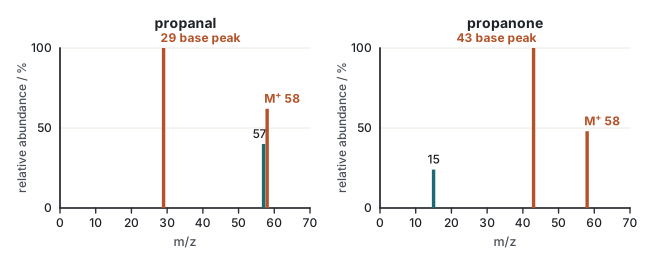
Propanal, CH₃CH₂CHO, and propanone, CH₃COCH₃, are isomers. Both have = 58.0, so the molecular ion at 58 cannot tell them apart. The fragments can.
| Propanal | Propanone | |
|---|---|---|
| Molecular ion | 58 | 58 |
| Key fragments | 29 (CH₃CH₂⁺ or CHO⁺), 57 | 43 (CH₃CO⁺), 15 (CH₃⁺) |
| Why | breaking either C–C bond next to the C=O gives CH₃CH₂⁺ or CHO⁺, both at m/z 29 | breaking the C–C bond next to the C=O leaves CH₃CO⁺ and a CH₃ radical |
Check yourself
- State what the peak at the highest m/z in a mass spectrum shows.
- Explain why only some of the fragments appear as peaks.
- A compound has a molecular ion at m/z 60 and fragments at 45 and 43. Suggest the fragment ions for 45 and 43.
- Calculate the m/z of CH₃CH₂⁺ using values.
- Propanal and propanone both have a molecular ion at m/z 58. Explain how their spectra differ.
- Calculate the of C₃H₆O and say what you could not tell from the molecular ion alone.
Answers cover these until you have tried the questions
- The molecular ion: its m/z is the relative molecular mass of the compound.
- Only positive ions are detected. In each break the molecular ion gives a positive ion and a neutral radical, and the radical is not seen.
- 45: . 43: CH₃CO⁺. (The compound is ethanoic acid, CH₃COOH.)
- 2(12.0) + 5(1.0) = 29.0, so the ion is at m/z 29.
- Propanal has its base peak at 29 (and a peak at 57). Propanone has its base peak at 43 (CH₃CO⁺) and a peak at 15 (CH₃⁺).
- 3(12.0) + 6(1.0) + 16.0 = 58.0. The molecular ion cannot say whether the compound is an aldehyde (propanal) or a ketone (propanone), or another isomer such as prop-2-en-1-ol.