Topic 10 · page 7 of 27
Ammonia and cyanide
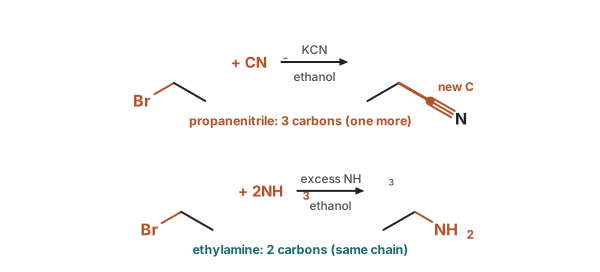
Ammonia turns a halogenoalkane into an amine and cyanide turns it into a nitrile. Both are nucleophiles attacking the δ+ carbon, and the cyanide reaction adds a carbon atom to the chain.
Read first: Hydroxide: substitution or elimination
Ammonia: an amine 10.810.8(iv)
Heat a halogenoalkane with ammonia dissolved in ethanol, in a sealed tube so that the mixture is under pressure. An amine forms. Excess ammonia is used.
Ammonia is a nucleophile. The lone pair on nitrogen attacks the δ+ carbon and Br⁻ leaves. The reaction is nucleophilic substitution. A second ammonia molecule then removes an H⁺ from the nitrogen, which is why two moles of NH₃ appear in the equation. The mechanism is on page 10.
| Reagent | ammonia dissolved in ethanol, in excess |
|---|---|
| Condition | heat in a sealed tube, under pressure |
| Product | an amine, –NH₂ (ethylamine from bromoethane) |
| Role of NH₃ | nucleophile |
Ammonia is a gas. Ethanol boils at 78 °C, so a sealed tube stops the ammonia and the solvent escaping when the mixture is heated.
Cyanide: a nitrile 10.810.8(v)
Heat a halogenoalkane with potassium cyanide dissolved in ethanol, under reflux. A nitrile forms.
The cyanide ion is a nucleophile: the lone pair on carbon attacks the δ+ carbon. The product contains the –C≡N group. Its carbon atom counts in the name: CH₃CH₂CN has three carbons, so it is propanenitrile.
| Reagent | potassium cyanide dissolved in ethanol |
|---|---|
| Condition | heat under reflux |
| Product | a nitrile, –C≡N, with one more carbon than the halogenoalkane |
| Role of CN⁻ | nucleophile |
Cyanide is highly toxic. In a school or college it is a demonstration or a written exercise only.
Worked exampleNames of nitriles
Name the products of KCN in ethanol with (a) 1-bromopropane and (b) 2-bromopropane.
- (a) . The chain is four carbons including the nitrile carbon: butanenitrile.
- (b) . The longest chain through the nitrile carbon is three carbons (C≡N carbon, CH, CH₃), with a methyl group on carbon 2: 2-methylpropanenitrile.
Check yourself
- Write the equation for bromoethane with excess ammonia in ethanol, and name the organic product.
- State two conditions for the reaction with ammonia, and say why each is needed.
- Write the equation for 1-bromopropane with potassium cyanide, and name the product.
- Explain why the cyanide reaction is useful to a chemist.
- State the role of the nucleophile in each of the two reactions, and say which atom of the nucleophile attacks the carbon.
- Name the organic product of 2-bromopropane with ethanolic KCN.
Answers cover these until you have tried the questions
- . The product is ethylamine (ethanamine).
- Ammonia in excess, to stop the amine reacting further and to supply the second NH₃ that removes H⁺; a sealed tube (under pressure), so the ammonia and ethanol do not escape on heating.
- . The product is butanenitrile.
- It makes a new C–C bond, so it lengthens the carbon chain by one carbon.
- Both ammonia and cyanide are nucleophiles. In NH₃ the nitrogen lone pair attacks the carbon. In CN⁻ the carbon lone pair attacks the carbon.
- 2-methylpropanenitrile, CH₃CH(CN)CH₃.