Topic 10 · page 10 of 27
Mechanism: ammonia and a primary halogenoalkane
Ammonia is a neutral nucleophile, so the first product carries a positive charge on nitrogen. A second ammonia molecule removes an H⁺ in a second step, which is why two moles of ammonia appear in the equation.
Read first: Mechanism: hydroxide and a primary halogenoalkane, Ammonia and cyanide
Step 1: ammonia attacks the carbon 10.910.9(ii)
The overall reaction is the one from page 7:
Ammonia has a lone pair on nitrogen and no charge. Like hydroxide, it is attracted to the δ+ carbon. The first step has the same two arrows as the hydroxide mechanism.
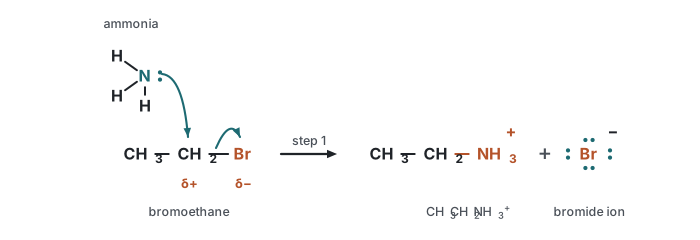
- Arrow 1 starts at the lone pair on nitrogen and points to the δ+ carbon. The pair becomes the new C–N bond.
- Arrow 2 starts at the C–Br bond and points to bromine. Br⁻ leaves with both electrons.
Nitrogen has now used its lone pair to make a fourth bond, so it carries a + charge. The product is the ethylammonium ion, CH₃CH₂NH₃⁺, with Br⁻ as the counter-ion.
Step 2: a second ammonia removes H⁺ 10.910.9(ii)
The ethylammonium ion is positive and has an N–H bond that can give up H⁺. A second ammonia molecule has a lone pair, so it acts as a base.
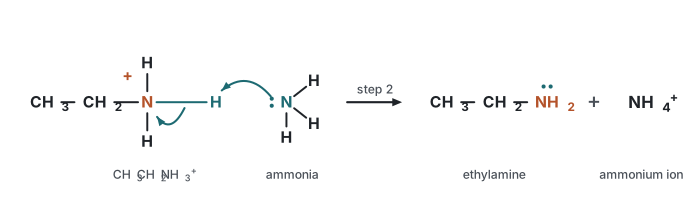
- Arrow 3 starts at the lone pair on the second NH₃ and points to a hydrogen on the nitrogen of the ethylammonium ion.
- Arrow 4 starts at the N–H bond and points to the nitrogen. The pair stays with nitrogen and becomes its lone pair again.
The products are ethylamine, CH₃CH₂NH₂, and the ammonium ion, NH₄⁺. With the bromide ion they form ammonium bromide, NH₄Br, which is why the overall equation has 2NH₃ on the left and NH₄Br on the right.
MethodDrawing the mechanism for ammonia
- Draw the halogenoalkane with δ+ on carbon and δ− on the halogen. Draw NH₃ with its lone pair.
- Arrow 1: from the lone pair on N to the δ+ carbon. Arrow 2: from the C–X bond to X.
- Draw the CH₃CH₂NH₃⁺ ion and X⁻.
- Draw a second NH₃ with its lone pair. Arrow 3: from that lone pair to an H on the N⁺. Arrow 4: from the N–H bond to N.
- Draw ethylamine and NH₄⁺.
Check yourself
- Draw step 1 of the mechanism for 1-bromopropane with ammonia.
- Write the formula of the ion formed in step 1, and explain why it carries a positive charge.
- Describe step 2: what the second ammonia molecule does and what is formed.
- Explain why two moles of ammonia are needed for each mole of halogenoalkane.
- Name the type of mechanism for step 1.
- State where curly arrow 1 starts and ends.
Answers cover these until you have tried the questions
- A lone pair on N of NH₃ to the δ+ carbon of CH₃CH₂CH₂–Br; the C–Br bond to Br. Products: CH₃CH₂CH₂NH₃⁺ and Br⁻. (Same arrows as in the figure for bromoethane.)
- CH₃CH₂NH₃⁺ (ethylammonium). The nitrogen used its lone pair to form a fourth bond, and it kept all its protons, so it has four bonds and a + charge.
- A second NH₃ acts as a base. Its lone pair takes an H⁺ from the N⁺, and the N–H pair stays on nitrogen. Ethylamine, CH₃CH₂NH₂, and the ammonium ion, NH₄⁺, form.
- One NH₃ is the nucleophile that attacks the carbon, and a second removes the H⁺ from the product. Two NH₃ per halogenoalkane.
- Nucleophilic substitution.
- It starts at the lone pair on the nitrogen of NH₃ and ends at the δ+ carbon.