Topic 10 · page 4 of 27
Naming and drawing halogenoalkanes
A halogenoalkane is named from its longest carbon chain, with the halogen as a numbered prefix. You need to draw it three ways, displayed, skeletal and structural, and to go from a name to a drawing and back.
Naming halogenoalkanes 10.6
A halogenoalkane is an alkane in which one or more hydrogen atoms have been replaced by halogen atoms. The name has three parts: the numbered prefix for each halogen or branch, the stem from the longest chain, and -ane.
MethodNaming a halogenoalkane
- Find the longest carbon chain that includes the carbon bonded to the halogen. It gives the stem: methane, ethane, propane, butane, and so on.
- The halogen is a prefix: fluoro-, chloro-, bromo- or iodo-.
- Number the chain from the end that gives the lowest numbers to all the substituents (halogens and branches) taken together. Every substituent gets its own number.
- List the prefixes in alphabetical order (bromo, chloro, methyl). Ignore di-, tri- when you put them in order.
- Use di-, tri- for repeats, with a comma between numbers and a hyphen between numbers and letters: 1,2-dibromoethane.
| Structural formula | Name | Why |
|---|---|---|
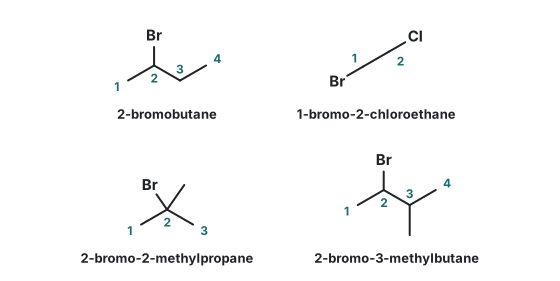
| CH₃CHBrCH₂CH₃ | 2-bromobutane | four-carbon chain, Br on carbon 2 |
| CH₂BrCH₂Cl | 1-bromo-2-chloroethane | alphabetical order: bromo before chloro |
| (CH₃)₃CBr | 2-bromo-2-methylpropane | longest chain has three carbons; a methyl and a Br share carbon 2 |
| CH₃CHBrCH(CH₃)₂ | 2-bromo-3-methylbutane | both ends give the numbers 2 and 3; the tie is broken by alphabetical order, so bromo gets the lower number |
| CH₂BrCH₂Br | 1,2-dibromoethane | two identical groups: di- |
Three ways to draw one molecule 10.6
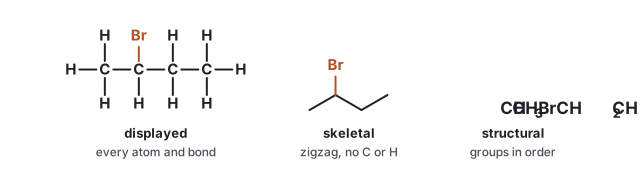
The same molecule can be drawn three ways. The exam tells you which one to use, and the words matter.
| Formula | What it shows |
|---|---|
| Displayed | every atom and every bond, including each C–H. No CH₃ shortcut. |
| Skeletal | a zigzag of lines. Each end and each corner is a carbon atom. C–H bonds and hydrogen atoms are left out. Other atoms (Br, Cl, I, O) are drawn. |
| Structural | the atoms grouped along the chain in order: CH₃CHBrCH₂CH₃. |
Worked exampleFrom a name to three formulae: 1-chloropropane
- Propane has three carbons. Draw the chain C–C–C.
- Put Cl on carbon 1, the end carbon.
- Displayed: add enough H atoms so that every carbon has four bonds. Carbon 1 has Cl and two H, carbon 2 has two H, carbon 3 has three H.
- Skeletal: a zigzag of three vertices with Cl on the first.
- Structural: CH₂ClCH₂CH₃, or ClCH₂CH₂CH₃.
- Check: the molecular formula is C₃H₇Cl. Each formula must agree.
Check yourself
- Name CH₃CH₂CH₂CH₂Br.
- Name CH₃CHClCH₃.
- Name BrCH₂CH(CH₃)CH₃.
- Draw the displayed formula of 1,2-dichloropropane.
- Draw the skeletal formula of 2-bromo-3-methylbutane.
- Write the structural formula of 1-bromo-2-chloroethane and give its molecular formula.
Answers cover these until you have tried the questions
- 1-bromobutane. Four carbons, Br on the end carbon.
- 2-chloropropane. Three carbons, Cl on the middle one.
- 1-bromo-2-methylpropane. The longest chain is three carbons; Br is on carbon 1 and the methyl group on carbon 2.
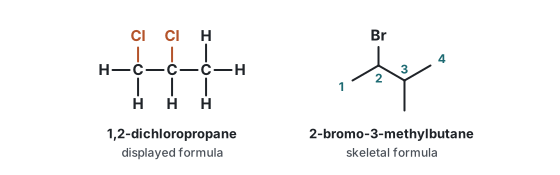
- See the left-hand drawing in the figure below. Each carbon has four bonds: C1 has Cl, two H and the C–C bond; C2 has Cl, one H and two C–C bonds; C3 has three H.
- See the right-hand drawing in the figure below: a four-carbon zigzag, Br on carbon 2 and a methyl group on carbon 3.
- CH₂BrCH₂Cl, molecular formula C₂H₄BrCl.