Topic 10 · page 19 of 27
Separating, drying and checking a liquid
A crude liquid product is separated from water with a separating funnel, dried with an anhydrous salt, and then distilled. The boiling temperature shows whether it is pure.
Read first: Heating under reflux and distillation
Extraction with a separating funnel 10.1910.19(ii)
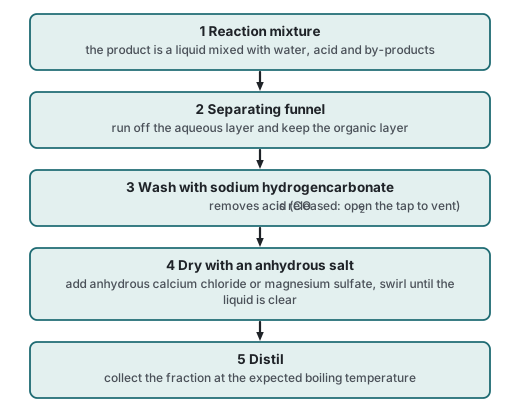
After a preparation, the liquid product is mixed with water, acid, unreacted starting material and by-products. If the product does not mix with water, the two liquids form separate layers, and a separating funnel can split them.
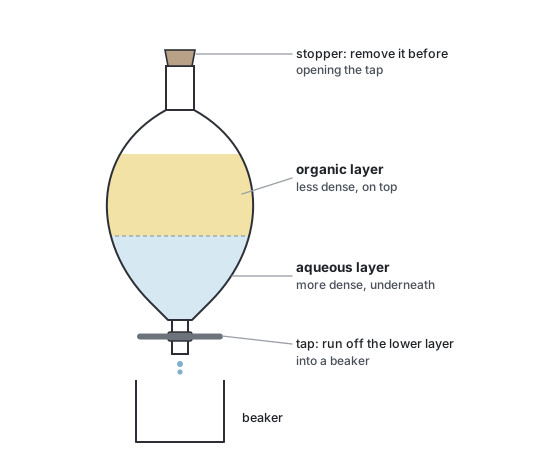
PracticalUsing a separating funnel
- Check that the tap is closed, then pour the mixture in with the stopper out. Put the stopper in.
- Shake gently, then turn the funnel upside down and open the tap to release the pressure. Close the tap. Repeat.
- Stand the funnel in a ring and let the layers settle.
- Remove the stopper, so that air can enter. Run off the lower layer through the tap into a flask.
- Pour the upper layer out through the top. Keep both layers until you know which one holds the product.
The denser liquid is the lower layer. Water is the reference: an organic liquid with a density lower than water floats on top, and one denser than water sinks. Do not guess: in Core Practical 6 the chloroalkane is less dense than water and is the upper layer, but a halogenoalkane with several halogen atoms is often denser than water.
Drying with an anhydrous salt 10.1910.19(iv)
The separated liquid still holds a trace of dissolved water, and may look cloudy. An anhydrous salt removes it by taking the water into its crystals.
MethodDrying a liquid
- Put the liquid in a dry flask.
- Add a spatula of an anhydrous salt: calcium chloride, magnesium sulfate or sodium sulfate. Swirl.
- If the salt clumps together, there is still water present. Add more until some salt stays free-flowing, like a loose powder, and the liquid is clear.
- Decant or filter the liquid into a clean, dry flask.
Clumping salt means there is water left to remove. Free-flowing salt means the liquid is dry.
Checking purity by boiling temperature 10.1910.19(v)
Distil the dried liquid and note the temperature on the thermometer while the liquid distils. A pure liquid boils at a single, fixed temperature (at a given pressure). An impure liquid boils over a range, and often at a different temperature from the pure compound. Compare the value with a data book.
| What you find | What it means |
|---|---|
| a steady temperature that matches the data book | the liquid is pure |
| a temperature that rises over several degrees | a mixture: impurities are present |
| a temperature that is steady but different from the data book | a different compound from the one expected |
Collect only the fraction that comes over within a narrow range around the expected boiling temperature. The next page, on Core Practical 6, shows all three techniques in one preparation.
Check yourself
- Explain how a separating funnel separates two liquids, and state which liquid leaves first.
- Describe two precautions when using a separating funnel.
- Name two anhydrous salts used to dry an organic liquid.
- How can you tell when enough drying agent has been added?
- A liquid distils over the range 47–58 °C. The data book gives 51 °C. What does this suggest?
- Explain why the boiling temperature of a pure liquid is a single value.
Answers cover these until you have tried the questions
- The two liquids do not mix and have different densities, so they form separate layers. The denser (lower) layer is run off first through the tap.
- Release the pressure by opening the tap while the funnel is inverted; remove the stopper before running off the lower layer; keep both layers until the product is identified.
- Any two of anhydrous calcium chloride, anhydrous magnesium sulfate and anhydrous sodium sulfate.
- The salt stops clumping and some of it stays free-flowing, and the liquid becomes clear.
- The liquid is impure: it boils over a range, and the range is wider and different from the pure value. Another liquid or water is present.
- In a pure liquid all the molecules are the same, so all need the same energy to escape, and the liquid boils at a fixed temperature. Impurities change the boiling behaviour.