Topic 10 · page 26 of 27
Infrared spectra
Each bond absorbs infrared radiation at a characteristic wavenumber. Finding the absorptions in a spectrum, and matching them to the data table, shows which functional groups are present.
What an infrared spectrum shows 10.2210.22(i)10.22(ii)10.22(iii)10.22(iv)10.22(v)10.22(vi)
Bonds in a molecule vibrate, stretching and bending like springs. A bond absorbs infrared radiation of just the frequency that matches its own vibration. Each type of bond absorbs in its own region, so the pattern of absorptions shows which functional groups are present.
The position of an absorption is given as a wavenumber in cm⁻¹. In an infrared spectrum:
- the horizontal axis is the wavenumber, usually from 4000 on the left to 500 cm⁻¹ on the right;
- the vertical axis is transmittance, so an absorption is a dip pointing down;
- the absorptions that are strong, and sharp or broad, help to identify the bond.
Stiffer bonds and lighter atoms vibrate at higher wavenumbers. So O–H, N–H and C–H absorb at high wavenumbers, C=O and C=C in the middle, and bonds to heavier atoms, such as C–Cl and C–Br, at low wavenumbers.
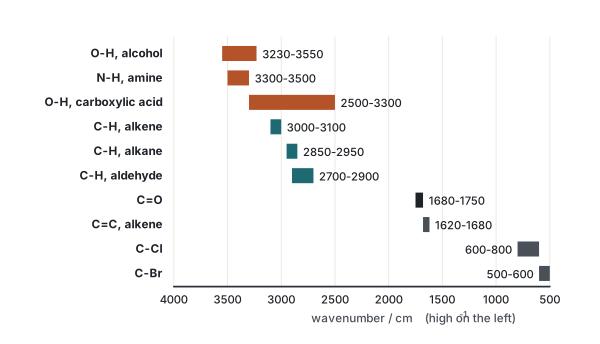
| Bond | Where it is found | Wavenumber range / cm⁻¹ |
|---|---|---|
| O–H | alcohols (broad) | 3230–3550 |
| O–H | carboxylic acids (very broad) | 2500–3300 |
| N–H | amines | 3300–3500 |
| C–H | alkenes | 3000–3100 |
| C–H | alkanes | 2850–2950 |
| C–H | aldehydes | 2700–2900 |
| C=O | aldehydes, ketones, carboxylic acids (strong, sharp) | 1680–1750 |
| C=C | alkenes | 1620–1680 |
| C–Cl | chloroalkanes | 600–800 |
| C–Br | bromoalkanes | 500–600 |
The ranges are taken from the data used with this specification. In the exam the data are given, so practise using them: find the absorption, then name the bond. Check them against your own data booklet.
Reading three spectra 10.2210.22(iii)10.22(iv)
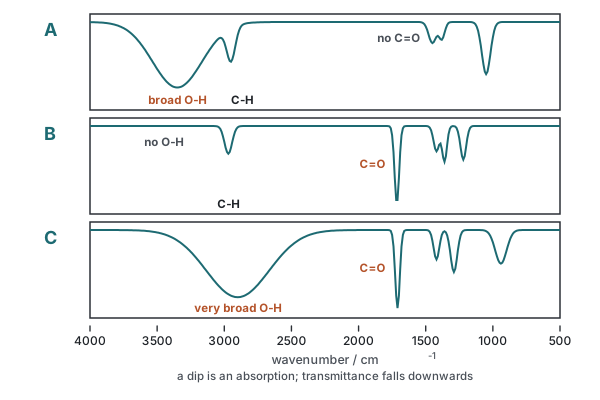
| Spectrum | Key absorptions | Compound |
|---|---|---|
| A | broad O–H near 3350, C–H near 2950, no C=O | propan-1-ol, an alcohol |
| B | strong sharp C=O near 1715, C–H near 2970, no O–H | propanone, a ketone |
| C | very broad O–H 2500–3300 and strong C=O near 1710 | propanoic acid, a carboxylic acid |
Spectrum B and spectrum C both have a C=O. Only the acid has the very broad O–H, so that is how to tell them apart.
Predicting absorptions 10.2210.22(i)
To predict the absorptions of a compound, list its bonds and find each one in the table.
Worked examplePredict the absorptions of propanal
List the infrared absorptions above 1650 cm⁻¹ for propanal, CH₃CH₂CHO.
- The bonds are C–H (alkane part), C–H (aldehyde), C=O and C–C. C–C absorbs below 1650 and is not in the table.
- C–H in the CH₃CH₂ group: 2850–2950.
- C–H of the aldehyde group: 2700–2900 (one or two weak peaks).
- C=O: 1680–1750, strong and sharp.
- There is no O–H and no N–H, so there is no broad absorption above 3000.
Check yourself
- State the wavenumber range of the C=O absorption and describe its appearance.
- Which bond gives a broad absorption at 3350 cm⁻¹?
- How can you tell a carboxylic acid from a ketone using an infrared spectrum?
- List the absorptions you would predict above 1650 cm⁻¹ for ethanoic acid, CH₃COOH.
- A compound has a strong absorption at 1715 cm⁻¹ and no broad absorption between 2500 and 3600 cm⁻¹. What functional group does it contain, and what does the compound not contain?
- Where would the C–Br absorption be, and why is it at a low wavenumber?
Answers cover these until you have tried the questions
- 1680–1750 cm⁻¹. It is a strong, sharp absorption.
- The O–H bond in an alcohol (3230–3550, broad).
- Both have a strong C=O near 1700. The acid also has a very broad O–H absorption (2500–3300 cm⁻¹). The ketone has no O–H.
- O–H very broad, 2500–3300; C–H of CH₃ at about 2850–2950 (inside the broad O–H); C=O 1680–1750, strong and sharp.
- It contains a C=O (a carbonyl compound, for example a ketone). It does not contain an O–H (so not an acid or an alcohol) and no N–H.
- 500–600 cm⁻¹. The bromine atom is heavy, so the bond vibrates more slowly and absorbs at a low wavenumber.