Topic 10 · page 23 of 27
Telling the products apart
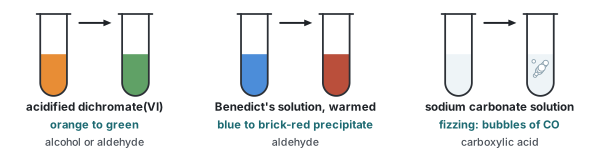
Dichromate turns green when anything is oxidised. Benedict's or Fehling's solution gives a brick-red precipitate with an aldehyde but not a ketone, and sodium carbonate fizzes with a carboxylic acid. Together the tests name the product.
Read first: Distil to stop, reflux to go on
Three tests 10.1810.18(i)10.18(ii)
The colour change of the dichromate tells you only that something was oxidised. To say what was made, test the product.
| Product | Acidified dichromate(VI) | Benedict's or Fehling's, warmed | Sodium carbonate or hydrogencarbonate |
|---|---|---|---|
| Aldehyde | orange to green | blue to brick-red precipitate | no fizzing |
| Ketone | stays orange | stays blue | no fizzing |
| Carboxylic acid | stays orange | stays blue | fizzes, CO₂ |
| Primary or secondary alcohol | orange to green | stays blue | no fizzing |
PracticalTesting a sample
Benedict's test. Add a few drops of the sample to about 2 cm³ of Benedict's solution in a test tube. Warm in a water bath. A brick-red precipitate of copper(I) oxide forms with an aldehyde. The solution stays blue with a ketone. Fehling's solution is used in the same way.
Carbonate test. Add the sample to a little sodium carbonate solution (or sodium hydrogencarbonate solution) in a test tube. Fizzing shows carbon dioxide, and so an acid. You can bubble the gas through limewater, which turns cloudy (milky).
The aldehyde is oxidised by the Benedict's reagent: the blue copper(II) ions are reduced to red copper(I) oxide, and the aldehyde becomes a carboxylate. A ketone has no hydrogen on its carbonyl carbon, so it cannot be oxidised in this way.
The acid reacts as a typical acid:
Worked exampleIdentifying the product
Alcohol P is oxidised by warm acidified dichromate(VI) and the product is distilled out at once. The distillate gives a brick-red precipitate with Benedict's solution but no fizzing with sodium carbonate. Alcohol Q, also C₃H₈O, gives a distillate that gives neither test. Identify P and Q and the products.
- The distillate from P gives a brick-red precipitate, so it is an aldehyde. A primary alcohol gives an aldehyde when distilled, so P is propan-1-ol and the product is propanal.
- There is no fizzing, so the product is not an acid.
- The distillate from Q gives no Benedict's result and no fizzing. It is not an aldehyde and not an acid, so it is a ketone.
- A secondary alcohol gives a ketone, so Q is propan-2-ol and the product is propanone.
Check yourself
- State the result of Benedict's solution with (a) an aldehyde and (b) a ketone.
- State the observation when sodium carbonate solution is added to a carboxylic acid, and name the gas.
- Write the equation for propanoic acid with sodium hydrogencarbonate.
- A sample turns acidified dichromate green, but gives no brick-red precipitate with Benedict's solution and no fizzing with sodium carbonate. Suggest what the sample could be.
- Explain why the colour change of dichromate alone cannot distinguish an aldehyde from an alcohol.
- A student tests the mixture left in the flask after reflux with sodium carbonate, sees fizzing, and concludes that an acid has been made. Explain why the conclusion is not safe.
Answers cover these until you have tried the questions
- (a) An aldehyde: blue to a brick-red precipitate (when warmed). (b) A ketone: no change, stays blue.
- Fizzing (effervescence). The gas is carbon dioxide.
- An alcohol (primary or secondary). It is oxidised by dichromate, so the colour changes to green, but it is not an aldehyde (no Benedict's result) and not an acid (no fizzing). A ketone would not turn dichromate green.
- Acidified dichromate turns green with any compound that is oxidised, an alcohol (primary or secondary) or an aldehyde, so it does not say which one is present.
- The mixture still contains sulfuric acid, which also fizzes with sodium carbonate. The fizzing may come from it and not from the organic acid. Distil the product from the flask and test the distillate.