Topic 10 · page 12 of 27
Rates of hydrolysis: chloro, bromo, iodo
For primary halogenoalkanes the order of reactivity is iodo > bromo > chloro. Bond polarity predicts the opposite order, so the explanation is bond enthalpy: the weaker the C–X bond, the faster it breaks.
Read first: Rates of hydrolysis: primary, secondary, tertiary
Same skeleton, different halogen 10.1010.10(ii)
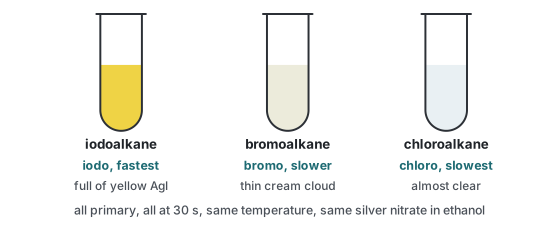
Now keep the class the same and change the halogen. Compare three primary halogenoalkanes with the same carbon chain: 1-chlorobutane, 1-bromobutane and 1-iodobutane. Each is warmed with aqueous silver nitrate in ethanol, and the precipitate also names the halogen: white AgCl, cream AgBr, yellow AgI.
| Halogenoalkane | Precipitate | Time, t / s | Rate ∝ 1000 ÷ t |
|---|---|---|---|
| 1-chlorobutane | AgCl, white | 300 | 3.3 |
| 1-bromobutane | AgBr, cream | 90 | 11 |
| 1-iodobutane | AgI, yellow | 14 | 71 |
These times are illustrative. The order is what real experiments show:
Why: bond enthalpy, not polarity 10.13
The slow part of each reaction is the breaking of the carbon–halogen bond. Two things might control how easily it breaks.
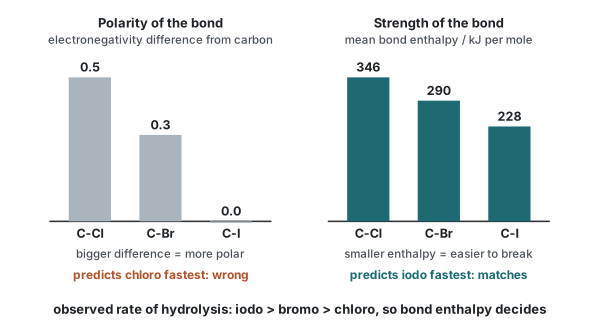
Polarity. The more polar the bond, the more δ+ the carbon, so the stronger the attraction to the nucleophile. Electronegativity differences from carbon (2.5): C–Cl 0.5, C–Br 0.3, C–I 0.0. Polarity falls from chloro to iodo, so it predicts that chloroalkanes should be fastest. That is wrong.
Bond enthalpy. The mean bond enthalpy of C–X falls down the group: C–Cl 346, C–Br 290, C–I 228 kJ mol⁻¹. A lower bond enthalpy means a weaker bond and less energy needed to break it. Bond enthalpy predicts iodoalkanes should be fastest. That matches the experiment.
Worked exampleExplain the order of hydrolysis
Explain why 1-iodobutane gives a precipitate with silver nitrate before 1-chlorobutane does, although C–Cl is the more polar bond.
- Hydrolysis needs the C–X bond to break.
- The mean bond enthalpy of C–I (228 kJ mol⁻¹) is lower than that of C–Cl (346 kJ mol⁻¹), so the C–I bond is weaker.
- Less energy is needed to break C–I, so it breaks more easily and the reaction is faster.
- The rate is controlled by bond breaking, not by polarity, so the more polar bond is not the faster one.
Check yourself
- State the order of rate of hydrolysis for primary chloro-, bromo- and iodoalkanes.
- Give the colour of the precipitate for each.
- Explain the order using bond enthalpy values.
- Explain why polarity gives the wrong order of reactivity.
- 1-bromobutane takes 90 s and 1-chlorobutane takes 300 s. How many times faster is the bromoalkane?
- A student says "the iodoalkane reacts fastest because C–I is the most polar bond". Correct this.
Answers cover these until you have tried the questions
- Iodo > bromo > chloro.
- Chloro: white (AgCl). Bromo: cream (AgBr). Iodo: yellow (AgI).
- The C–X bond must break. The mean bond enthalpies are C–Cl 346, C–Br 290, C–I 228 kJ mol⁻¹. C–I is the weakest, so it needs the least energy to break and reacts fastest. C–Cl is the strongest and is slowest.
- Chlorine is the most electronegative of the three, so C–Cl is the most polar bond and polarity would predict chloroalkane fastest. The experiment shows it is the slowest.
- Ratio = 300 ÷ 90 = 3.33, so 3.3 times faster.
- C–I is the least polar of the three bonds (an electronegativity difference of 0.0). It reacts fastest because it has the lowest bond enthalpy, so it is the weakest and easiest to break.