Topic 17 · page 17 of 20
Core Practical 14: preparing a transition metal complex
Reduce dichromate(VI) with zinc and acid to blue chromium(II), then run it into sodium ethanoate to make the red complex chromium(II) ethanoate. Air must be kept out throughout.
Read first: Chromium: reduction and oxidation
Aim and chemistry 17.33
Aim: to prepare a sample of a transition metal complex, chromium(II) ethanoate, and calculate the percentage yield.
There are two stages.
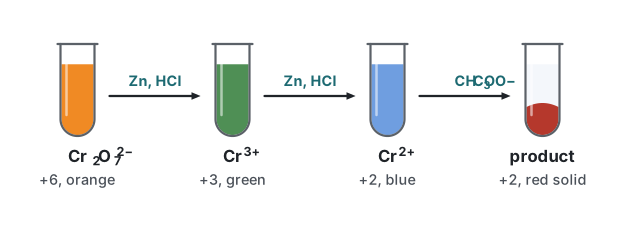
- Reduction. Zinc and concentrated hydrochloric acid reduce orange dichromate(VI) first to green Cr³⁺ and then to blue Cr²⁺ (page 9).
- Precipitation. Cr²⁺ ions react with ethanoate ions and water to form a red solid:
The product is a neutral complex: each chromium(II) ion has ethanoate ligands and a water ligand.
Worked exampleCheck the equation
Charge on the left: 2 × (2+) + 4 × (1−) = 0, and the product is neutral. Chromium: 2 and 2. Carbon: 8 and 8. Hydrogen: 4 × 3 + 2 × 2 = 16 on the left, 4 × 3 + 2 × 2 = 16 on the right. Oxygen: 4 × 2 + 2 = 10 on both sides.
The method 17.3317.20(i)
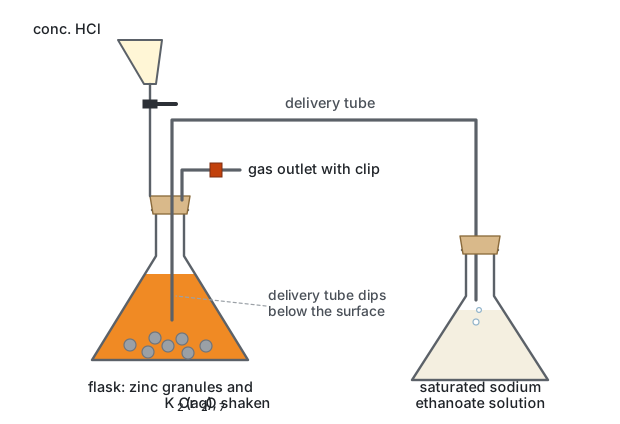
PracticalMaking chromium(II) ethanoate
- Put zinc granules (in excess) and potassium dichromate(VI) solution in the flask. Fit the tap funnel, the delivery tube and the gas outlet. Put saturated sodium ethanoate solution in the second flask, with the delivery tube dipping into it.
- Add concentrated hydrochloric acid slowly from the tap funnel, with the gas outlet open. Hydrogen is given off and drives the air out.
- Watch the colours change orange → green → blue. The blue is Cr²⁺.
- When the solution is blue, close the gas outlet. The pressure of hydrogen pushes the blue solution through the delivery tube into the sodium ethanoate.
- A red precipitate of chromium(II) ethanoate forms at once.
- Filter off the solid under suction. Wash it with a little water, then with ethanol, and let it dry.
| Step | Why |
|---|---|
| Zinc in excess | Zinc must reduce all the chromium, from +6 to +2 |
| Concentrated HCl, added slowly | Supplies H⁺ for the reduction and for hydrogen; slow addition keeps the reaction controlled |
| Hydrogen drives out the air | Oxygen oxidises Cr²⁺ to Cr³⁺ (E°cell = +1.23 − (−0.41) = +1.64 V) and would spoil the product |
| Closing the outlet | The pressure of hydrogen forces the Cr²⁺ solution into the ethanoate without letting air in |
| Sodium ethanoate | The ethanoate ions are the ligand that gives an insoluble neutral complex |
| Filter under suction | Quick, so the solid is exposed to air for less time |
| Wash with water, then ethanol | Water removes soluble salts such as zinc chloride; ethanol removes the water and dries the solid quickly |
If air gets in, the red solid turns grey-green as Cr(II) is oxidised to Cr(III).
Safety. Potassium dichromate(VI) is toxic and a carcinogen: wear gloves and avoid skin contact. Concentrated hydrochloric acid is corrosive. Hydrogen is flammable, so keep naked flames away.
Yield 17.33
The method does not fix an exact mass. This calculation uses illustrative quantities: start with 5.00 g of potassium dichromate(VI) and collect 3.20 g of dry product.
Worked examplePercentage yield
values: K₂Cr₂O₇ = 2(39.1) + 2(52.0) + 7(16.0) = 294.2; [Cr₂(CH₃COO)₄(H₂O)₂] = 2(52.0) + 4(59.0) + 2(18.0) = 376.0.
- n(K₂Cr₂O₇) = 5.00 ÷ 294.2 = 0.016995 mol.
- Each Cr₂O₇²⁻ gives 2 Cr²⁺, and 2 Cr²⁺ give one complex: n(product) = 0.016995 mol, in theory.
- Theoretical mass = 0.016995 × 376.0 = 6.390 g.
- Percentage yield = 3.20 ÷ 6.390 × 100 = 50.1%.
The yield is below 100% because some Cr²⁺ is oxidised, some solution is left behind when the Cr²⁺ is transferred, the complex is slightly soluble in water, and some solid is lost on the filter. A yield much lower than expected usually means air got in.
Check yourself
- Why is the zinc used in excess?
- Explain why hydrogen is allowed to escape before the gas outlet is closed.
- State the colour of each stage in the preparation, and what is happening to chromium's oxidation number.
- Why is the product washed with ethanol after the water?
- A student starts with 2.50 g of K₂Cr₂O₇ and obtains 1.40 g of product. Calculate the percentage yield.
- The solid obtained is grey-green instead of red. Explain what has gone wrong.
Answers cover these until you have tried the questions
- Zinc must reduce all the dichromate(VI) through Cr³⁺ to Cr²⁺. Leftover zinc ensures that the reduction does not stop early.
- Hydrogen drives out the air, so oxygen cannot oxidise Cr²⁺ to Cr³⁺ (+1.64 V).
- Orange (Cr₂O₇²⁻, +6), then green (Cr³⁺, +3), then blue (Cr²⁺, +2). Adding sodium ethanoate gives the red solid (Cr(II) complex, +2).
- Water removes soluble impurities such as zinc chloride. Ethanol then removes the water, so the solid dries quickly, with less time for air to oxidise it.
- n(K₂Cr₂O₇) = 2.50 ÷ 294.2 = 0.0084975 mol. Theoretical mass = 0.0084975 × 376.0 = 3.195 g. Yield = 1.40 ÷ 3.195 × 100 = 43.8%.
- Air has oxidised chromium(II) to chromium(III). Oxygen entered during the transfer or filtering, or the hydrogen did not remove all the air at the start.