Topic 17 · page 7 of 20
No colour, and changes of colour
An ion is colourless when no d electron can be promoted, which happens with empty and full d sub-shells. The colour changes when the oxidation number, the ligands or the coordination number changes the splitting.
Read first: Why complexes are coloured
When there is no colour 17.9
For an ion to absorb visible light, two things must be true:
- there is a d electron to promote, and
- there is room in the upper level for it to go.
Two cases fail one of these tests.
- 3d⁰ ions have no d electrons at all. Examples: Sc³⁺ and Ti⁴⁺.
- 3d¹⁰ ions have both levels completely full, so there is no space for an electron to move into. Examples: Zn²⁺ and Cu⁺.
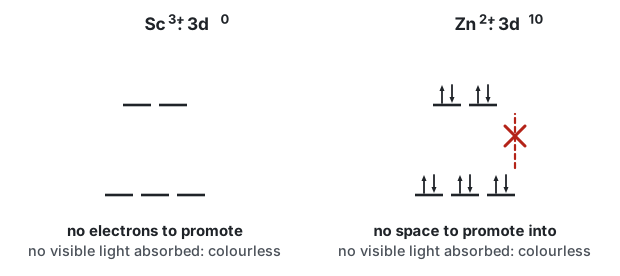
No visible light is absorbed, so the solution is colourless and a solid is white.
| Species | Electrons in 3d | Appearance |
|---|---|---|
| [Sc(H₂O)₆]³⁺ | 0 | colourless solution |
| TiO₂ (Ti⁴⁺) | 0 | white solid |
| [Zn(H₂O)₆]²⁺ | 10 | colourless solution |
| CuCl (Cu⁺) | 10 | white solid |
The same argument covers other complex ions of Zn²⁺ and Cu⁺, such as [Zn(OH)₄]²⁻ and [Zn(NH₃)₄]²⁺, which are also colourless.
A change of oxidation number 17.11(i)
Changing the oxidation number changes the charge on the metal ion and the number of d electrons. Both change the splitting ΔE and which promotions are possible, so the colour changes.
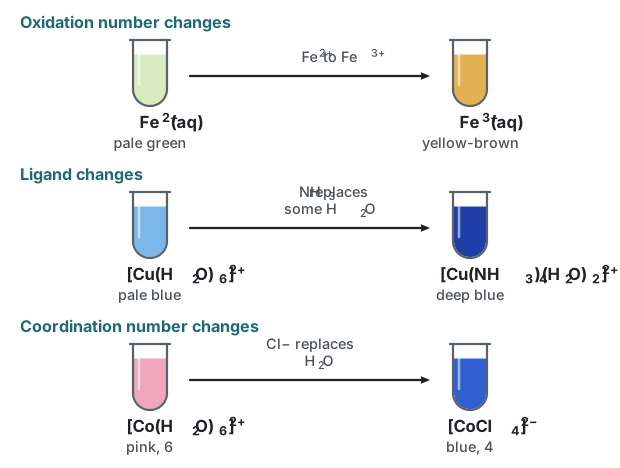
- Fe²⁺(aq) is pale green; Fe³⁺(aq) is yellow-brown.
- Vanadium goes yellow (+5), blue (+4), green (+3), violet (+2).
A change of ligand 17.11(ii)
Different ligands split the d-orbitals by different amounts. Replacing one ligand with another changes ΔE.
- [Cu(H₂O)₆]²⁺ is pale blue; [Cu(NH₃)₄(H₂O)₂]²⁺ is deep blue. Four ammonia ligands have replaced four water ligands.
A change of coordination number 17.11(iii)
A change of coordination number is also a change of shape (octahedral to tetrahedral), and the splitting is different in a different shape. The ligand usually changes as well.
- [Co(H₂O)₆]²⁺ is pink (coordination number 6); [CoCl₄]²⁻ is blue (coordination number 4).
Check yourself
- Explain why [Sc(H₂O)₆]³⁺ is colourless.
- Explain why [Zn(H₂O)₆]²⁺ is colourless even though it has d electrons.
- State whether you would expect Ti⁴⁺ compounds and Cu⁺ compounds to be coloured. Explain each.
- Adding concentrated hydrochloric acid to pink [Co(H₂O)₆]²⁺ gives blue [CoCl₄]²⁻. Give two changes that account for the new colour.
- Name the factor that changes the colour in each: (a) Fe²⁺(aq) turns yellow-brown on oxidation; (b) [Cu(H₂O)₆]²⁺ turns deep blue with excess ammonia.
- Does the colour change from [Cu(H₂O)₆]²⁺ to [Cu(NH₃)₄(H₂O)₂]²⁺ involve a change of oxidation number? Explain.
Answers cover these until you have tried the questions
- Sc³⁺ is 3d⁰: there are no d electrons to promote, so no visible light is absorbed.
- Zn²⁺ is 3d¹⁰: both energy levels are full, so there is no space into which an electron can be promoted. No visible light is absorbed.
- Ti⁴⁺ is 3d⁰ and Cu⁺ is 3d¹⁰. In neither is a promotion possible, so neither is expected to be coloured: compounds are white or colourless (TiO₂ and CuCl are white).
- The ligand changes (H₂O replaced by Cl⁻) and the coordination number changes (6 to 4, octahedral to tetrahedral).
- (a) a change of oxidation number (+2 to +3). (b) a change of ligand (NH₃ replaces H₂O).
- No. Copper is +2 in both. Ammonia and water are neutral ligands, so only the ligands change.