Topic 17 · page 16 of 20
Haemoglobin and carbon monoxide
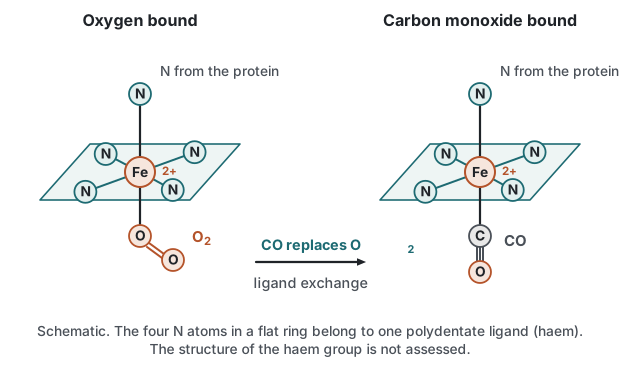
Haemoglobin carries oxygen as a ligand on iron(II). Carbon monoxide replaces the oxygen by ligand exchange and binds much more strongly, so the blood can no longer carry oxygen.
Read first: Stability and entropy
Iron(II) in haemoglobin 17.17
Haemoglobin is the protein in red blood cells that carries oxygen. At its centre are iron(II) ions, each held in a complex ion.
- The iron is surrounded by a large, flat, polydentate ligand called haem. It bonds to the Fe²⁺ through four nitrogen atoms.
- A fifth nitrogen atom, from the protein chain, bonds on one side of the iron.
- The sixth position, on the other side, is where an oxygen molecule attaches.
That gives a coordination number of 6.
Carrying oxygen 17.17
The oxygen molecule uses a lone pair to form a dative bond to Fe²⁺. This bond is fairly weak, so it is easy to break:
In the lungs, where oxygen is plentiful, the equilibrium moves to the right and haemoglobin picks up oxygen. In the tissues, where the oxygen level is lower, it moves left and the oxygen is released.
Carbon monoxide poisoning 17.17
Carbon monoxide molecules also have a lone pair, on carbon, and can bond to Fe²⁺. If CO is breathed in, it replaces the O₂ molecule by ligand exchange:
The Fe–CO dative bond is much stronger than the Fe–O₂ bond. CO is therefore not easily released and haemoglobin is no longer free to carry oxygen. Cells receive too little oxygen, which is why carbon monoxide is poisonous.
Check yourself
- State the oxidation number of iron in haemoglobin and the coordination number of the iron.
- What type of ligand is the haem group? Name the type of bond it forms to iron.
- Describe how oxygen is carried and then released.
- Explain, using the term ligand exchange, why carbon monoxide is toxic.
- Write an equation to show carbon monoxide replacing oxygen from haemoglobin (use Hb to represent the rest of the molecule).
Answers cover these until you have tried the questions
- The iron is iron(II), oxidation number +2. The coordination number is 6.
- A polydentate ligand (four of its nitrogen atoms bond to the iron). The bonds are dative (coordinate) covalent bonds.
- Oxygen bonds to Fe²⁺ as a ligand, by a dative bond. The bond is fairly weak, so oxygen is picked up where it is plentiful (lungs) and released where its concentration is lower (tissues).
- CO replaces O₂ on the Fe²⁺ by ligand exchange. CO bonds more strongly than O₂, so it is not easily released. The haemoglobin can no longer carry oxygen.