Topic 17 · page 3 of 20
Ligands and complex ions
A complex ion is a central metal ion with ligands attached by dative bonds. Learn to count the bonds, work out the charge, and draw the ion.
Read first: Transition metals and their electrons
Ligands and dative bonds 17.417.5
Transition metal ions have empty orbitals at low energy. A molecule or ion with a lone pair of electrons can donate that pair into one of them. The shared pair forms a bond, and both of its electrons came from the same atom.
Once formed, a dative bond is no different from any other covalent bond. It is drawn as an ordinary line, or as an arrow pointing from the ligand to the metal ion.
The three ligands in the specification are:
| Ligand | Donor atom | Lone pair used |
|---|---|---|
| H₂O (water) | O | one of the two on oxygen |
| NH₃ (ammonia) | N | the one on nitrogen |
| OH⁻ (hydroxide) | O | one of the three on oxygen |
Each of these uses one lone pair to make one dative bond. A ligand that makes one bond to the metal ion is monodentate.
Chloride, Cl⁻, is also a monodentate ligand, and you will meet it in later pages.
Complex ions 17.617.12
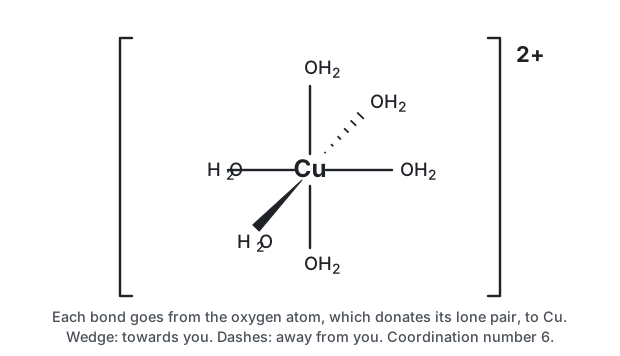
The formula is written in square brackets with the charge outside: [Cu(H₂O)₆]²⁺ is a copper(II) ion with six water ligands.
The overall charge is the charge on the metal ion plus the charges on the ligands. Water and ammonia are neutral. Hydroxide and chloride are each 1−.
Worked exampleThe charge on a complex
- [Cu(H₂O)₆]²⁺: +2 + 6(0) = 2+.
- [Cr(OH)₆]³⁻: +3 + 6(−1) = 3−.
- [CuCl₄]²⁻: +2 + 4(−1) = 2−.
- [Cr(OH)₃(H₂O)₃]: +3 + 3(−1) + 3(0) = 0, a neutral complex.
The same sum run backwards gives the oxidation number of the metal. In [CoCl₄]²⁻ the four chloride ligands contribute −4 and the ion is 2−, so cobalt is +2.
Coordination number 17.10
For monodentate ligands this is simply the number of ligands. With ligands that make more than one bond (the next pages) it is not.
| Complex | Ligands | Coordination number |
|---|---|---|
| [Cu(H₂O)₆]²⁺ | 6 H₂O | 6 |
| [Cu(NH₃)₄(H₂O)₂]²⁺ | 4 NH₃ and 2 H₂O | 6 |
| [Cr(OH)₆]³⁻ | 6 OH⁻ | 6 |
| [CuCl₄]²⁻ | 4 Cl⁻ | 4 |
| [Zn(OH)₄]²⁻ | 4 OH⁻ | 4 |
| [Pt(NH₃)₂Cl₂] | 2 NH₃ and 2 Cl⁻ | 4 |
Check yourself
- Define the terms ligand and complex ion.
- Explain how a water molecule forms a bond to a Cu²⁺ ion. Name the type of bond.
- Give the overall charge of each complex: Ni²⁺ with six NH₃; Fe³⁺ with five H₂O and one OH⁻; Zn²⁺ with four OH⁻.
- State the coordination number of [Cu(NH₃)₄(H₂O)₂]²⁺ and of [CoCl₄]²⁻.
- Name the donor atom in each of H₂O, NH₃ and OH⁻.
- Work out the oxidation number of the metal in [CuCl₄]²⁻ and in [Cr(OH)₃(H₂O)₃].
Answers cover these until you have tried the questions
- A ligand is a molecule or ion with a lone pair that forms a dative covalent bond to a metal ion. A complex ion is a central metal ion surrounded by ligands.
- A lone pair on the oxygen atom is donated into an empty orbital on Cu²⁺. Both electrons in the shared pair come from oxygen: a dative (coordinate) covalent bond.
- Ni²⁺ with six NH₃: +2 + 6(0) = 2+, [Ni(NH₃)₆]²⁺. Fe³⁺ with five H₂O and one OH⁻: +3 + 5(0) + (−1) = 2+, [Fe(H₂O)₅(OH)]²⁺. Zn²⁺ with four OH⁻: +2 + 4(−1) = 2−, [Zn(OH)₄]²⁻.
- [Cu(NH₃)₄(H₂O)₂]²⁺: 4 + 2 = 6. [CoCl₄]²⁻: 4.
- H₂O: oxygen. NH₃: nitrogen. OH⁻: oxygen.
- [CuCl₄]²⁻: x + 4(−1) = −2, so +2. [Cr(OH)₃(H₂O)₃] is neutral: x + 3(−1) = 0, so +3.