Topic 17 · page 1 of 20
Transition metals and their electrons
A transition metal is defined by its ions, not its atoms. Work out the electron configuration of an ion first, then ask whether its 3d sub-shell is partly filled.
Configurations of Sc to Zn 17.2
The ten elements from scandium to zinc fill the 3d sub-shell. They are the d-block elements of Period 4. Three rules give every configuration:
- after [Ar], the 4s sub-shell fills before 3d;
- in 3d, each orbital takes one electron before any orbital takes a second;
- two exceptions, chromium and copper, move one 4s electron into 3d.
| Element | Atomic number | Configuration |
|---|---|---|
| Sc | 21 | [Ar] 3d¹ 4s² |
| Ti | 22 | [Ar] 3d² 4s² |
| V | 23 | [Ar] 3d³ 4s² |
| Cr | 24 | [Ar] 3d⁵ 4s¹ |
| Mn | 25 | [Ar] 3d⁵ 4s² |
| Fe | 26 | [Ar] 3d⁶ 4s² |
| Co | 27 | [Ar] 3d⁷ 4s² |
| Ni | 28 | [Ar] 3d⁸ 4s² |
| Cu | 29 | [Ar] 3d¹⁰ 4s¹ |
| Zn | 30 | [Ar] 3d¹⁰ 4s² |
Writing 4s before 3d is also correct. Choose one order and keep to it.
Configurations of ions 17.2
A positive ion has fewer electrons than its atom. The 4s electrons are in the outer shell, so they are lost first, and 3d electrons only after that.
MethodConfiguration of a d-block ion
- Number of electrons = atomic number − charge.
- Write the configuration of the atom.
- Remove electrons from 4s first, then from 3d, until you reach the number in step 1.
- Check that the superscripts add up to the number of electrons.
Worked exampleFe²⁺ and Fe³⁺
- Iron, Z = 26, is [Ar] 3d⁶ 4s².
- Fe²⁺ has 24 electrons: remove the two 4s electrons. Fe²⁺ is [Ar] 3d⁶.
- Fe³⁺ has 23 electrons: remove one more, from 3d. Fe³⁺ is [Ar] 3d⁵.
Worked exampleCr³⁺ and Cu²⁺
- Chromium, Z = 24, is [Ar] 3d⁵ 4s¹. Cr³⁺ has 21 electrons. Remove the 4s electron, then two from 3d. Cr³⁺ is [Ar] 3d³.
- Copper, Z = 29, is [Ar] 3d¹⁰ 4s¹. Cu²⁺ has 27 electrons. Remove the 4s electron, then one from 3d. Cu²⁺ is [Ar] 3d⁹.
- Copper(I) loses only the 4s electron: Cu⁺ is [Ar] 3d¹⁰.
What a transition metal is 17.1
Many textbooks say a transition metal is "any element in the d-block". That is not good enough for the exam. The definition is about the ions.
A sub-shell is incompletely filled if it holds some electrons but not the maximum. For 3d the maximum is ten, so an ion qualifies when it has between 1 and 9 electrons in 3d.
| Ion | Electrons in 3d | Incompletely filled? |
|---|---|---|
| Sc³⁺ | 0 | No: empty |
| Ti³⁺ | 1 | Yes |
| Fe²⁺ | 6 | Yes |
| Cu²⁺ | 9 | Yes |
| Zn²⁺ | 10 | No: full |
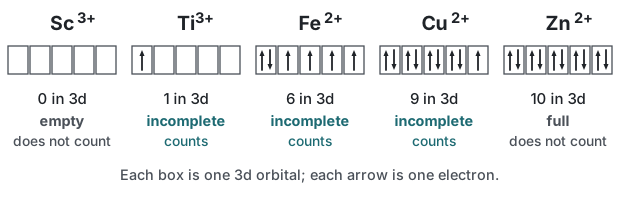
Scandium forms only Sc³⁺, which is 3d⁰. Zinc forms only Zn²⁺, which is 3d¹⁰. Neither forms an ion with a partly filled 3d sub-shell, so neither is a transition metal, although both are in the d-block.
Copper is a transition metal because Cu²⁺ is 3d⁹. It does not matter that Cu⁺ is 3d¹⁰. One stable ion with an incompletely filled 3d sub-shell is enough.
Check yourself
- Give the full electronic configuration of vanadium (Z = 23) and of V³⁺.
- Give the configurations of Cu (Z = 29) and Cu²⁺, using [Ar].
- Give the configuration of Mn²⁺ (Z = 25) and of Ni²⁺ (Z = 28), using [Ar].
- Write the configuration of Cr³⁺ (Z = 24). A student gives [Ar] 3d¹ 4s². Explain the mistake.
- Zinc is in the d-block. Explain why it is not a transition metal.
- Define a transition metal. Use the definition to explain why iron is one.
Answers cover these until you have tried the questions
- V: 1s² 2s² 2p⁶ 3s² 3p⁶ 3d³ 4s². V³⁺ has 23 − 3 = 20 electrons. The 4s electrons go first, then one 3d electron: 1s² 2s² 2p⁶ 3s² 3p⁶ 3d².
- Cu is [Ar] 3d¹⁰ 4s¹. Cu²⁺ has 27 electrons: lose 4s¹, then one 3d electron: [Ar] 3d⁹.
- Mn is [Ar] 3d⁵ 4s², so Mn²⁺ loses both 4s electrons: [Ar] 3d⁵. Ni is [Ar] 3d⁸ 4s², so Ni²⁺ is [Ar] 3d⁸.
- Cr is [Ar] 3d⁵ 4s¹. Cr³⁺ has 21 electrons: lose 4s¹, then two 3d: [Ar] 3d³. The student's answer has the right number of electrons (21) but arranged as in a neutral scandium atom. In a d-block ion the 4s sub-shell is emptied first, so no electrons stay in 4s.
- Zinc forms only the ion Zn²⁺, which is [Ar] 3d¹⁰. The 3d sub-shell is full, so zinc forms no stable ion with an incompletely filled d sub-shell.
- A transition metal is a d-block element that forms one or more stable ions with an incompletely filled d sub-shell. Iron forms Fe²⁺ ([Ar] 3d⁶) and Fe³⁺ ([Ar] 3d⁵), and both have a partly filled 3d sub-shell.