Topic 17 · page 9 of 20
Chromium: reduction and oxidation
Zinc in acid reduces orange dichromate(VI) through green Cr³⁺ to blue Cr²⁺. Going back up, hydrogen peroxide oxidises Cr³⁺ to chromate(VI), but only in alkaline conditions.
Read first: Vanadium: four oxidation states
Three oxidation states 17.20(i)
| Oxidation number | Species | Colour |
|---|---|---|
| +6 | Cr₂O₇²⁻ (dichromate(VI)) | orange |
| +3 | Cr³⁺ | green |
| +2 | Cr²⁺ | blue |
Some data are needed:
- has E° = +1.33 V.
- has E° = −0.41 V.
- has E° = −0.76 V.
- has E° = +1.23 V.
Reduction by zinc in acid 17.20(i)
Add zinc to an acidified solution of dichromate(VI), for example with hydrochloric acid. The colour changes orange → green → blue.
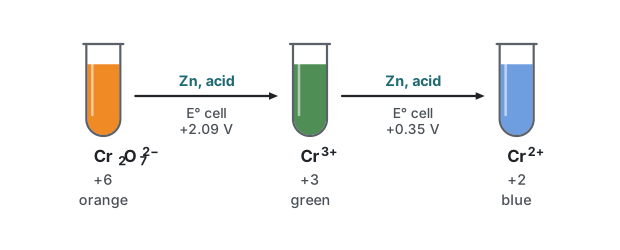
Both steps have a positive cell potential:
E°cell = +1.33 − (−0.76) = +2.09 V.
E°cell = −0.41 − (−0.76) = +0.35 V.
Air must be kept out. Oxygen oxidises Cr²⁺ back to Cr³⁺: E°cell = +1.23 − (−0.41) = +1.64 V, so the blue solution turns green in air. In the reaction mixture the hydrogen given off by zinc and acid helps to push air away.
Oxidation by hydrogen peroxide in alkali 17.20(ii)
The reverse change, from Cr³⁺ to chromium(VI), does not happen in acid. It needs alkaline conditions. The route has three steps.
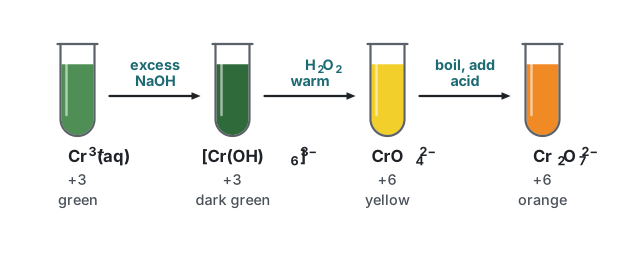
- Add excess sodium hydroxide. A green precipitate forms and dissolves to a dark green solution of [Cr(OH)₆]³⁻.
- Add hydrogen peroxide and warm. Chromium(III) is oxidised to chromium(VI) and the solution turns yellow (chromate(VI), CrO₄²⁻).
- Boil to remove excess hydrogen peroxide, then acidify. The yellow solution turns orange as dichromate(VI) forms.
Why alkaline? 17.20(ii)
The potential of the chromium couple depends strongly on the conditions.
- In acid, E°(Cr₂O₇²⁻/Cr³⁺) = +1.33 V. This is large and positive, so Cr³⁺ is a poor reducing agent and is hard to oxidise.
- In alkali, E°(CrO₄²⁻/Cr(OH)₃) = −0.13 V. This is much less positive, so chromium(III) is easy to oxidise.
Hydrogen peroxide in alkali has E°(H₂O₂/OH⁻) = +0.88 V:
E°cell = +0.88 − (−0.13) = +1.01 V.
Positive, so the oxidation is feasible.
Worked exampleCheck the balancing
Charge on the left of the peroxide equation: 2 × (3−) = 6−. On the right: 2 × (2−) + 2 × (1−) = 6−. Oxygen on the left: 2 × 6 + 3 × 2 = 18; on the right: 2 × 4 + 2 + 8 = 18. Hydrogen on the left: 2 × 6 + 3 × 2 = 18; on the right: 2 + 16 = 18. The equation is balanced.
Check yourself
- Give the colours of Cr₂O₇²⁻, Cr³⁺ and Cr²⁺ and the oxidation number of chromium in each.
- Write the equation for the reduction of dichromate(VI) to Cr³⁺ by zinc in acid and calculate the cell potential. (Cr₂O₇²⁻/Cr³⁺ +1.33 V; Zn²⁺/Zn −0.76 V)
- Use E° values to explain why a solution containing Cr²⁺ must be kept away from air. (O₂/H₂O +1.23 V; Cr³⁺/Cr²⁺ −0.41 V)
- Describe the colour changes when excess sodium hydroxide is added to Cr³⁺(aq), then hydrogen peroxide is added and warmed, then the solution is boiled and acidified.
- Explain why chromium(III) is oxidised in alkaline conditions rather than in acid. Use the two E° values.
- Show that 2[Cr(OH)₆]³⁻ + 3H₂O₂ → 2CrO₄²⁻ + 2OH⁻ + 8H₂O is balanced for charge and atoms.
Answers cover these until you have tried the questions
- Cr₂O₇²⁻: orange, +6. Cr³⁺: green, +3. Cr²⁺: blue, +2.
- and E°cell = +1.33 − (−0.76) = +2.09 V.
- Oxygen oxidises Cr²⁺ to Cr³⁺: E°cell = +1.23 − (−0.41) = +1.64 V, positive, so it is feasible. The blue Cr²⁺ turns green in air.
- Green Cr³⁺ gives a green precipitate that dissolves in excess alkali to a dark green solution. Hydrogen peroxide and warming turns it yellow (CrO₄²⁻). Boiling off the excess peroxide and acidifying turns it orange (Cr₂O₇²⁻).
- In acid, E°(Cr₂O₇²⁻/Cr³⁺) = +1.33 V is large and positive, so Cr³⁺ is hard to oxidise. In alkali, E°(CrO₄²⁻/Cr(OH)₃) = −0.13 V is much less positive, so chromium(III) is much easier to oxidise. With H₂O₂ (+0.88 V), E°cell = +0.88 − (−0.13) = +1.01 V.
- Charge: left 2(3−) = 6−; right 2(2−) + 2(1−) = 6−. Cr: 2 and 2. O: left 12 + 6 = 18, right 8 + 2 + 8 = 18. H: left 12 + 6 = 18, right 2 + 16 = 18. Balanced.