Topic 17 · page 10 of 20
Chromate(VI) and dichromate(VI)
Yellow chromate(VI) and orange dichromate(VI) are linked by an acid-base equilibrium. Alkali moves it to yellow and acid moves it to orange. Chromium is +6 in both, so it is not redox.
Read first: Chromium: reduction and oxidation
The equilibrium 17.21
Dichromate(VI) and chromate(VI) are in equilibrium in water:
| Ion | Colour |
|---|---|
| Cr₂O₇²⁻, dichromate(VI) | orange |
| CrO₄²⁻, chromate(VI) | yellow |
The hydrogen ions are on the right. The position of the equilibrium therefore depends on the acidity of the solution. Apply Le Chatelier's principle.
- Add alkali. The OH⁻ ions remove H⁺ ions by neutralisation. The equilibrium shifts right to replace them, and the solution turns yellow.
- Add acid. The concentration of H⁺ rises. The equilibrium shifts left to remove the extra, and the solution turns orange.
The change is reversible, and you can swap the colour back and forth by adding alkali and acid in turn.
Worked exampleIs it a redox reaction?
- In Cr₂O₇²⁻: 2x + 7(−2) = −2, so 2x = +12 and x = +6.
- In CrO₄²⁻: x + 4(−2) = −2, so x = +6.
- The oxidation number of chromium does not change, and neither does that of oxygen or hydrogen. This is not redox. It is an acid-base equilibrium: H⁺ ions are lost or gained.
The equilibrium constant, from Topic 13, leaves water out because it is the solvent:
A sudden rise in [H⁺] makes the fraction larger than Kc, so the system responds by turning chromate into dichromate until the fraction equals Kc again.
The whole chromium story 17.21
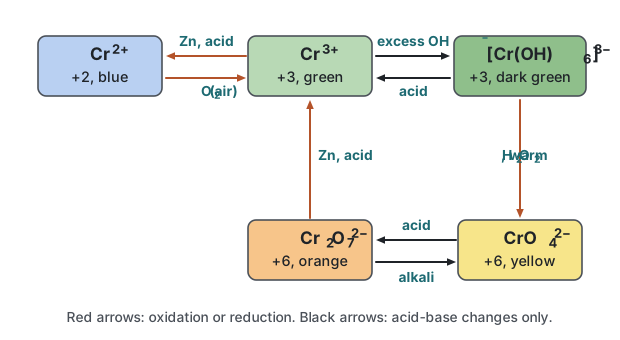
| Change | Reagent | Type of reaction |
|---|---|---|
| Cr₂O₇²⁻ → Cr³⁺ → Cr²⁺ | zinc and acid | reduction |
| Cr³⁺ → [Cr(OH)₆]³⁻ | excess NaOH | deprotonation and amphoteric behaviour |
| [Cr(OH)₆]³⁻ → CrO₄²⁻ | H₂O₂, alkaline | oxidation |
| CrO₄²⁻ ⇌ Cr₂O₇²⁻ | acid or alkali | acid-base equilibrium |
Check yourself
- State the colour of chromate(VI) and of dichromate(VI) ions.
- A yellow solution of potassium chromate(VI) turns orange when dilute sulfuric acid is added. Explain.
- Orange potassium dichromate(VI) solution is made alkaline with sodium hydroxide. State the colour change and explain it.
- Show by oxidation numbers that the change in question 2 is not a redox reaction.
- Write the expression for Kc for the dichromate(VI) / chromate(VI) equilibrium.
Answers cover these until you have tried the questions
- Chromate(VI), CrO₄²⁻: yellow. Dichromate(VI), Cr₂O₇²⁻: orange.
- Adding acid raises [H⁺]. The equilibrium Cr₂O₇²⁻ + H₂O ⇌ 2CrO₄²⁻ + 2H⁺ shifts to the left to remove the extra H⁺, so Cr₂O₇²⁻ forms. The solution turns orange.
- Orange to yellow. The OH⁻ ions remove H⁺ ions, so the equilibrium shifts to the right, forming chromate(VI).
- Cr is +6 in CrO₄²⁻ (x − 8 = −2) and +6 in Cr₂O₇²⁻ (2x − 14 = −2). There is no change in oxidation number, so the change is not redox: it is an acid-base equilibrium.
- Kc = (water is left out because it is the solvent).