Topic 17 · page 8 of 20
Vanadium: four oxidation states
Vanadium has four colourful oxidation states, +5 to +2. A reducing agent takes it down a step only if the cell potential for that step is positive, so the choice of reagent decides where it stops.
Read first: No colour, and changes of colour
Four colours 17.18
Vanadium shows four oxidation states in solution, each with its own colour. They are the clearest example of the colour changing with the oxidation number.
| Oxidation number | Ion | Colour |
|---|---|---|
| +5 | VO₂⁺ | yellow |
| +4 | VO²⁺ | blue |
| +3 | V³⁺ | green |
| +2 | V²⁺ | violet |
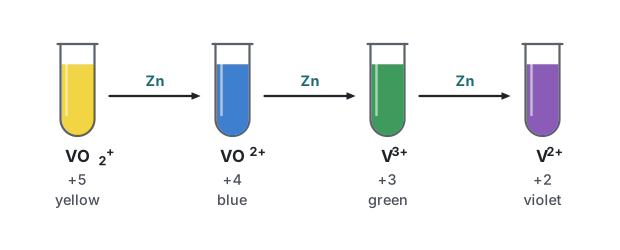
Start with ammonium vanadate(V), NH₄VO₃, in dilute acid. The solution contains VO₂⁺ and is yellow. Add zinc and the vanadium is reduced a step at a time. You see:
yellow → green → blue → green → violet
PracticalKeeping air out
V²⁺ is slowly oxidised back to V³⁺ by oxygen in the air. A loose plug of cotton wool in the neck of the flask keeps most of the air out while letting gas escape.
The potentials 17.19
Each step is a half-equation with its own standard electrode potential. Check the charges: each one balances.
| Half-equation | E° / V |
|---|---|
| +1.00 | |
| +0.34 | |
| −0.26 | |
| −1.18 |
Zinc is the reducing agent. Its couple is , E° = −0.76 V. A step goes if the cell potential is positive:
E°cell = E°(reduced couple) − E°(oxidised couple), with Zn oxidised.
| Step | Cell potential with zinc | Feasible? |
|---|---|---|
| VO₂⁺ → VO²⁺ | +1.00 − (−0.76) = +1.76 V | yes |
| VO²⁺ → V³⁺ | +0.34 − (−0.76) = +1.10 V | yes |
| V³⁺ → V²⁺ | −0.26 − (−0.76) = +0.50 V | yes |
| V²⁺ → V | −1.18 − (−0.76) = −0.42 V | no |
Zinc reduces vanadium all the way to +2, and no further. The equations, balanced for charge and atoms, are:
Stopping at a chosen state 17.19
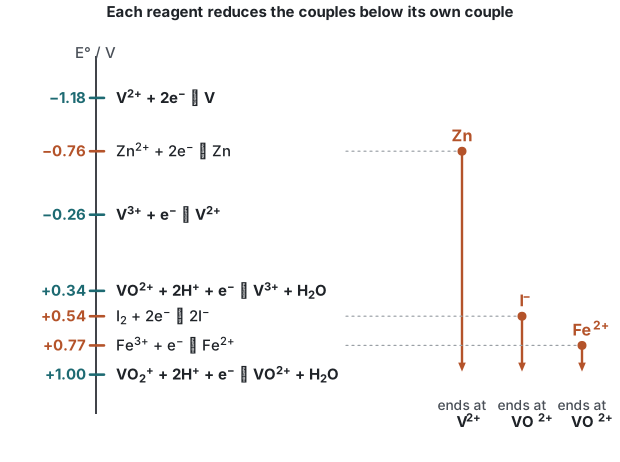
A weaker reducing agent stops sooner. It can reduce a vanadium couple only if its own E° is less positive than that couple's.
Worked exampleIodide and iron(II)
Iodide: I₂ + 2e⁻ ⇌ 2I⁻, E° = +0.54 V. Iron(II): Fe³⁺ + e⁻ ⇌ Fe²⁺, E° = +0.77 V.
- Iodide reduces VO₂⁺: +1.00 − 0.54 = +0.46 V, feasible. It cannot reduce VO²⁺: +0.34 − 0.54 = −0.20 V. Iodide stops at VO²⁺.
- Iron(II) reduces VO₂⁺: +1.00 − 0.77 = +0.23 V, feasible. VO²⁺ → V³⁺: +0.34 − 0.77 = −0.43 V, not feasible. Iron(II) stops at VO²⁺ too.
Worked exampleA reagent that stops at V³⁺
Tin(II) ions have Sn⁴⁺ + 2e⁻ ⇌ Sn²⁺, E° = +0.15 V (value from a data book).
- VO₂⁺ → VO²⁺: +1.00 − 0.15 = +0.85 V, feasible.
- VO²⁺ → V³⁺: +0.34 − 0.15 = +0.19 V, feasible.
- V³⁺ → V²⁺: −0.26 − 0.15 = −0.41 V, not feasible.
Tin(II) stops at V³⁺, so the solution ends green.
Air also oxidises V²⁺: with O₂ + 4H⁺ + 4e⁻ ⇌ 2H₂O, E° = +1.23 V, the cell potential for oxidising V²⁺ to V³⁺ is +1.23 − (−0.26) = +1.49 V. That is why the violet colour fades without protection.
Check yourself
- Give the oxidation number and colour of vanadium in VO²⁺ and in V²⁺.
- Zinc is added to a yellow solution of VO₂⁺ in acid. State the colours seen in order, and explain the first green.
- Use E°(Zn²⁺/Zn) = −0.76 V and E°(V²⁺/V) = −1.18 V to show that zinc cannot reduce V²⁺ to vanadium metal.
- Iron(II) ions are added to VO₂⁺ in acid. Use E° values to find the final vanadium species. (Fe³⁺/Fe²⁺ +0.77 V; VO₂⁺/VO²⁺ +1.00 V; VO²⁺/V³⁺ +0.34 V.)
- Write the half-equation for the reduction of VO²⁺ to V³⁺ in acid.
- Explain why a solution of V²⁺ turns from violet to green if left open to the air. (O₂/H₂O: +1.23 V; V³⁺/V²⁺: −0.26 V.)
Answers cover these until you have tried the questions
- VO²⁺: oxidation number +4, blue. V²⁺: +2, violet.
- Yellow → green → blue → green → violet. The first green is a mixture of yellow VO₂⁺ and blue VO²⁺ as the +5 is part way reduced to +4. The second green is V³⁺.
- E°cell = −1.18 − (−0.76) = −0.42 V. Negative, so the reduction of V²⁺ by zinc is not feasible.
- VO₂⁺ → VO²⁺: +1.00 − 0.77 = +0.23 V, feasible. VO²⁺ → V³⁺: +0.34 − 0.77 = −0.43 V, not feasible. The final species is VO²⁺ (blue).
- Oxygen oxidises V²⁺ to V³⁺: E°cell = +1.23 − (−0.26) = +1.49 V, which is feasible. Violet V²⁺ becomes green V³⁺.