Topic 17 · page 2 of 20
Variable oxidation number
Transition metals form ions with several different charges because the 4s and 3d electrons are close in energy, so removing a few more or a few fewer costs similar energy.
Read first: Transition metals and their electrons
Close in energy 17.3
A calcium atom is [Ar] 4s². It loses its two 4s electrons easily, but the third electron would have to come from the 3p sub-shell, which is much closer to the nucleus. The third ionisation energy is far larger than the second, so calcium is only ever +2.
Titanium is [Ar] 3d² 4s². Its 3d and 4s electrons are close in energy, so they are removed with energies that rise only gradually.
| Successive ionisation energy / kJ mol⁻¹ | 1st | 2nd | 3rd | 4th | 5th |
|---|---|---|---|---|---|
| Ca (rounded data-book values) | 590 | 1150 | 4910 | ||
| Ti (rounded data-book values) | 659 | 1310 | 2650 | 4170 | 9580 |
For calcium the third value is about 4.3 times the second. For titanium each step is only about 1.6 to 2.0 times the one before, until all four 3d and 4s electrons have gone. The fifth electron comes from the 3p sub-shell and the energy rises by 5410 kJ mol⁻¹, compared with 1520 kJ mol⁻¹ for the step before.
Why the extra energy is affordable 17.3
Removing an electron costs energy. That cost is repaid, at least partly, when the ion forms bonds: hydration of the ion, lattice formation, or covalent bonds to other atoms. A higher charge pays back more.
Because the cost of each extra electron rises only slowly, several different numbers of electrons can be removed before the payback stops being worth it. Ions with different numbers of electrons removed are all stable, and the metal shows several oxidation numbers.
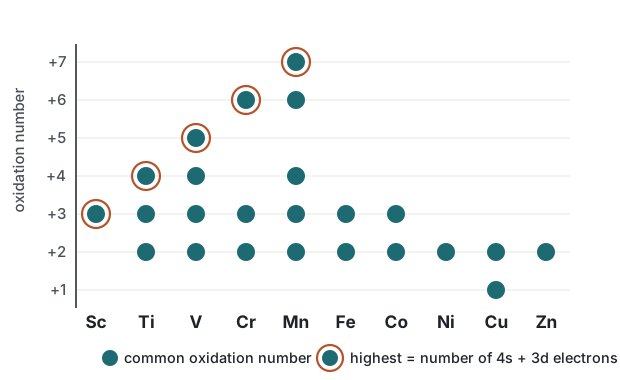
Three patterns are worth noticing:
- +2 and +3 are the commonest. The 4s electrons go first, giving +2, and one 3d electron may follow, giving +3.
- From Sc to Mn the highest oxidation number equals the number of 4s plus 3d electrons: Sc +3, Ti +4, V +5, Cr +6, Mn +7.
- Scandium and zinc each show one oxidation number. Sc³⁺ has no 3d electrons left and Zn²⁺ keeps a full 3d sub-shell, so there is nothing to vary.
Worked exampleOxidation numbers you will meet
Work from the rule that the oxidation numbers add up to the charge, with O as −2 and Cl as −1.
- VO₂⁺: x + 2(−2) = +1, so x = +5.
- VO²⁺: x − 2 = +2, so x = +4.
- Cr₂O₇²⁻: 2x + 7(−2) = −2, so 2x = +12 and x = +6.
- MnO₄⁻: x + 4(−2) = −1, so x = +7.
- [CuCl₄]²⁻: x + 4(−1) = −2, so x = +2.
Check yourself
- Explain why calcium shows only the +2 oxidation number but titanium shows +2, +3 and +4.
- State the highest oxidation number of vanadium and give the formula of an ion in which it occurs. Explain why it cannot go higher.
- Work out the oxidation number of chromium in CrO₄²⁻ and of manganese in MnO₄²⁻.
- Why does zinc show only one oxidation number?
- Work out the oxidation number of the metal in each of: [Cr(OH)₆]³⁻, [Cu(NH₃)₄(H₂O)₂]²⁺, [Co(H₂O)₆]²⁺, [Fe(H₂O)₆]³⁺.
Answers cover these until you have tried the questions
- In calcium the third electron must come from the 3p sub-shell, which is much closer to the nucleus: the third ionisation energy is very large and cannot be repaid by bonding. In titanium the 3d and 4s electrons are close in energy, so successive ionisation energies rise gradually and ions with different numbers of electrons removed are all stable.
- Vanadium is [Ar] 3d³ 4s², so it has five 4s and 3d electrons: highest oxidation number +5, as in VO₂⁺. A sixth electron would have to come from the 3p sub-shell, which needs far more energy.
- CrO₄²⁻: x + 4(−2) = −2, so +6. MnO₄²⁻: x + 4(−2) = −2, so +6.
- Zinc is [Ar] 3d¹⁰ 4s². It loses the two 4s electrons to give Zn²⁺ (3d¹⁰). The full 3d sub-shell is stable and losing any 3d electron costs far more, so only +2 is found.
- [Cr(OH)₆]³⁻: x + 6(−1) = −3, so +3. [Cu(NH₃)₄(H₂O)₂]²⁺: the ligands are neutral, so +2. [Co(H₂O)₆]²⁺: +2. [Fe(H₂O)₆]³⁺: +3.