Topic 17 · page 6 of 20
Why complexes are coloured
Ligands split the five d-orbitals into two energy levels. A d electron absorbs visible light of energy equal to the gap and moves up. The light that is left is the colour you see.
Read first: Ligands and complex ions
Coloured aqueous ions 17.7
Most transition metal ions are coloured in aqueous solution. The colour belongs to the complex ion, which in water is the hexaaqua ion, [M(H₂O)₆]ⁿ⁺.
| Ion | Electrons in 3d | Colour of the aqueous ion |
|---|---|---|
| Cr³⁺ | 3 | green |
| Mn²⁺ | 5 | very pale pink |
| Fe²⁺ | 6 | pale green |
| Fe³⁺ | 5 | yellow-brown |
| Co²⁺ | 7 | pink |
| Ni²⁺ | 8 | green |
| Cu²⁺ | 9 | blue |
| Zn²⁺ | 10 | colourless |
Zinc is the odd one out. The next page explains why.
Splitting the d-orbitals 17.8
In a free metal ion the five 3d orbitals all have the same energy. When ligands approach, their lone pairs repel the electrons in the d-orbitals. The repulsion is not the same for every orbital, so the five orbitals split into two groups at different energies. In an octahedral complex, three are lower and two are higher.
The energy gap between the two groups is ΔE.
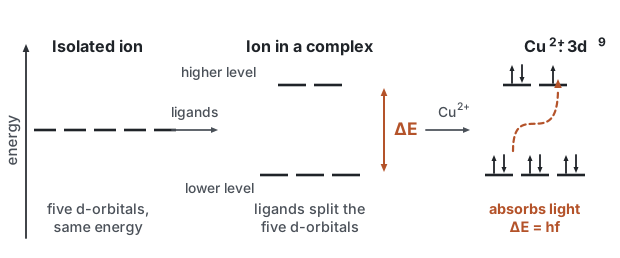
If a d electron can move from the lower level to the higher level, the ion can absorb light whose energy matches the gap:
Here h is the Planck constant, 6.63 × 10⁻³⁴ J s, and f is the frequency of the light in Hz. The ion absorbs only that frequency. The remaining frequencies are transmitted, and the mixture of what is left is the colour you see.
Worked exampleEnergy of an absorbed photon
The aqueous ion absorbs light of frequency 4.5 × 10¹⁴ Hz (illustrative). Calculate ΔE per ion and per mole.
- ΔE = hf = 6.63 × 10⁻³⁴ × 4.5 × 10¹⁴ = 2.98 × 10⁻¹⁹ J per ion.
- Per mole, using the unrounded value of ΔE: 2.9835 × 10⁻¹⁹ × 6.02 × 10²³ = 1.80 × 10⁵ J mol⁻¹ = 180 kJ mol⁻¹.
A bigger gap ΔE absorbs light of higher frequency. A smaller gap absorbs light of lower frequency.
Which colour do you see? 17.8
The colour you see is complementary to the colour absorbed. The table gives the rough pairs.
| Light absorbed | Colour seen |
|---|---|
| red | blue-green |
| orange | blue |
| yellow | violet |
| green | red-purple |
[Cu(H₂O)₆]²⁺ absorbs in the red and orange part of the spectrum, so it looks blue.
Check yourself
- State the energy relationship that links the gap ΔE to the frequency of light absorbed.
- Explain why [Cu(H₂O)₆]²⁺(aq) is blue.
- Light of frequency 5.2 × 10¹⁴ Hz is absorbed by an ion. Calculate ΔE per ion in J. (h = 6.63 × 10⁻³⁴ J s)
- A complex ion has a splitting ΔE of 3.9 × 10⁻¹⁹ J. Calculate the frequency of the light it absorbs, and say whether that is visible. (Visible light spans about 4.0 × 10¹⁴ to 7.5 × 10¹⁴ Hz.)
- A student says "the electron gives out blue light, so the solution is blue". Explain the error.
- In what way does a ligand change the d-orbitals of a metal ion?
Answers cover these until you have tried the questions
- ΔE = hf, where h is the Planck constant and f the frequency absorbed.
- The water ligands split the 3d orbitals into two energy levels. A d electron absorbs red/orange light of energy ΔE = hf and is promoted to the higher level. The remaining light, mainly blue, is transmitted, so the solution looks blue.
- ΔE = 6.63 × 10⁻³⁴ × 5.2 × 10¹⁴ = 3.4 × 10⁻¹⁹ J (2 s.f., the precision of the frequency).
- f = ΔE ÷ h = 3.9 × 10⁻¹⁹ ÷ 6.63 × 10⁻³⁴ = 5.9 × 10¹⁴ Hz. That lies inside the visible range, so the complex absorbs visible light and is coloured.
- The electron absorbs light as it is promoted; it does not emit the colour we see. The colour seen is the light that is not absorbed.
- The ligands split the five d-orbitals, which are all at the same energy in the free ion, into two groups at different energies, separated by ΔE.