Edexcel International A Level Chemistry
Topic 12: Entropy and Energetics
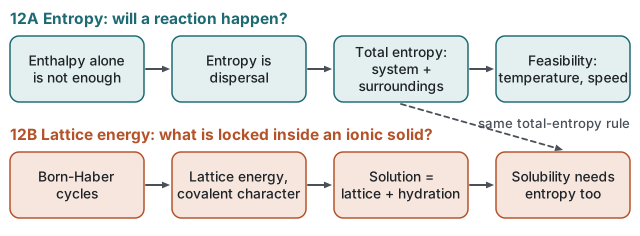
Two questions about energy that enthalpy alone cannot answer. Why do endothermic changes happen, and how strong is the bonding inside an ionic solid? The first is answered by entropy, the second by lattice energy.
The one idea
Enthalpy tells you how much heat a reaction gives out or takes in. It does not tell you whether the reaction will happen. Some endothermic changes occur spontaneously (a cold pack, or ammonium nitrate dissolving), and some exothermic ones never start.
The missing quantity is entropy, a measure of how widely particles and energy are dispersed. A change is feasible when the total entropy of the system and its surroundings increases. Heat given out raises the entropy of the surroundings, which is how enthalpy re-enters the rule.
The second half of the topic turns the same energy thinking to ionic solids. A Born-Haber cycle is Hess's law applied to forming an ionic lattice, and it gives a lattice energy you cannot measure directly. Comparing that with theory shows covalent character. Combining the lattice energy with hydration gives an enthalpy of solution, and with entropy the rule for solubility.
The five jobs
| Job | Pages |
|---|---|
| Explain what entropy is, and say how it changes (solid, liquid, gas; moles of gas; dissolving) | Enthalpy is not enough to Why entropy changes |
| Calculate , and | Entropy change of the system and Surroundings and total entropy |
| Decide whether a reaction is feasible, find the temperature at which it becomes feasible, and separate this from speed | Balance and temperature to Thermodynamic and kinetic stability |
| Define the enthalpy changes for ionic solids, then build and use a Born-Haber cycle | Three definitions to Born-Haber calculations |
| Interpret lattice energies, calculate solution enthalpies, and predict solubility | Covalent character to Group 2 solubility |
What you need first
- Enthalpy changes and Hess's law from the energetics topic: you will use in cycles, and the idea that any route between the same two states gives the same total.
- Ionisation energy and the shapes of ions from the atomic structure and bonding topics.
- Group 2 solubility trends from Unit 2, which this topic explains.
- Activation energy from kinetics, for the difference between feasible and fast.
Values used in these notes
| Quantity | Value |
|---|---|
| gas constant, R | 8.31 J mol⁻¹ K⁻¹ (only needed if you meet ) |
| temperature | K = °C + 273 |
| entropy | J K⁻¹ mol⁻¹ |
| enthalpy | kJ mol⁻¹ (convert to J before dividing by T) |
The standard entropy values used in the worked examples are given in the question, as they would be in an exam.
How to use these notes
- Read the pages in order the first time. Later pages assume the earlier ones.
- Each page opens with its one idea in a sentence. If you can explain that sentence to someone else, you know the page.
- Coloured boxes mean the same thing on every page: definitions you may be asked to quote, key ideas, common mistakes, exam technique, and beyond the spec (interesting, but you will not be examined on it).
- Each page ends with questions and fully worked answers. Cover the answers, try the questions, then mark yourself.
- Use the topic on a page the night before an exam.
Pages
- Enthalpy is not enough
Some reactions take in heat and still happen by themselves. So the sign of ΔH cannot decide whether a reaction occurs, and we need a second quantity.
- Entropy and dispersal
Gases spread and energy spreads because spread-out arrangements vastly outnumber bunched-up ones. Entropy counts those arrangements, and natural change goes towards more of them.
- Entropy of substances
Entropy is zero for a perfect crystal at 0 K, rises with temperature, and jumps at melting and again, by more, at boiling. Solids have the lowest entropy and gases the highest.
- Why entropy changes
Entropy rises with changes of state to a gas, when an ionic solid dissolves, and when a reaction makes more moles of gas. Count the moles of gas first to predict the sign of the entropy change of the system.
- Entropy change of the system
Add up the standard entropies of the products, subtract those of the reactants, and multiply each by its coefficient. The answer is in J K⁻¹ mol⁻¹, and its sign should match your prediction.
- Surroundings and total entropy
Heat passed to the surroundings changes their entropy by −ΔH / T. Add that to the entropy change of the system to get the total, and a change is feasible when the total is positive.
- Balance and temperature
Feasibility is a balance between the entropy change of the system and that of the surroundings. Temperature shifts the balance, because the surroundings term is −ΔH / T and shrinks as T rises.
- The feasibility temperature
At the border of feasibility the total entropy change is zero, which gives T = ΔH ÷ ΔS for the system. Use it to say above or below which temperature a reaction goes.
- Thermodynamic and kinetic stability
Thermodynamic stability asks whether a change is feasible. Kinetic stability asks whether it is fast enough to see. A change can be feasible and still not happen, because of a high activation energy.
- Three definitions for ionic solids
Atomisation, electron affinity and lattice energy are the three new enthalpy changes behind a Born-Haber cycle. Each has a precise definition, and each is easiest to learn as an equation with state symbols.
- Building a Born-Haber cycle
A Born-Haber cycle is Hess's law for an ionic solid. One route goes straight from the elements to the solid. The other goes through gaseous atoms and gaseous ions, and ends with the lattice energy.
- Born-Haber calculations
Rearrange Hess's law to get lattice energy = formation enthalpy minus the sum of the other steps. Watch the multiples for MgCl₂, the second ionisation energy, and the endothermic second electron affinity of oxygen.
- Covalent character in ionic bonds
A lattice energy from a Born-Haber cycle is the real value. One from electrostatic theory assumes pure ionic bonding. The gap between them measures covalent character, which arises when a cation polarises an anion.
- Enthalpy of solution and hydration
Dissolving an ionic solid is lattice energy reversed, followed by hydration of the gaseous ions. The enthalpy of solution is the small difference between two large numbers.
- Charge and radius
Lattice energy and hydration enthalpy both become more exothermic as ionic charge rises and ionic radius falls, because the charges are bigger and closer. Learn to explain every trend with these two factors only.
- Will it dissolve?
Dissolving is one more change that happens when the total entropy change is positive. The enthalpy of solution fixes the surroundings term, and the system term is ions dispersing against water becoming ordered.
- Group 2 solubility trends
Group 2 sulfates become less soluble down the group, and hydroxides more soluble. Both trends come from two terms, lattice energy and hydration enthalpy, which both fall as the cation gets bigger. The size of the anion decides which falls faster.
Also in this topic: Topic 12 on a page
Spec checklist
Every point you can be examined on in this topic, and where it is explained. Tick them off as you go.
| Spec | You should be able to | Where |
|---|---|---|
| 12.1 | understand that, since endothermic reactions can occur spontaneously at room temperature, enthalpy changes alone do not control whether reactions occur | Endothermic, yet it happens |
| 12.2 | understand entropy as a measure of disorder of a system in terms of the random dispersal of molecules and of energy quanta between molecules | Energy spreads out too Entropy The natural direction of change |
| 12.3 | understand that the entropy of a substance increases with temperature, that entropy increases as solid → liquid → gas and that perfect crystals at zero kelvin have zero entropy | The zero point Entropy rises with temperature Solid, liquid, gas |
| 12.4 | be able to interpret the natural direction of change as being in the direction of increasing total entropy (positive entropy change), including gases spread spontaneously through a room | A gas spreads out The natural direction of change Total entropy decides the direction |
| 12.5(i) | understand why entropy changes occur during: changes of state | Changes of state |
| 12.5(ii) | understand why entropy changes occur during: dissolving of a solid ionic lattice | Dissolving an ionic solid |
| 12.5(iii) | understand why entropy changes occur during: reactions in which there is a change in the number of moles from reactants to products | Reactions with a change in moles |
| 12.6 | understand that the total entropy change of any reaction is the sum of the entropy change of the system and the entropy change of the surroundings, summarised by the expression: ΔStotal = ΔSsystem + ΔSsurroundings | System and surroundings Total entropy decides the direction |
| 12.7 | be able to calculate the entropy change of the system for a reaction, ΔSsystem, given the entropies of the reactants and products | The calculation |
| 12.8 | be able to calculate the entropy change in the surroundings, and hence ΔStotal, using the expression ΔSsurroundings = −ΔH / T | Heat and the surroundings |
| 12.9(i) | understand that the feasibility of a reaction depends on: the balance between ΔSsystem and ΔSsurroundings, so that even endothermic reactions can occur spontaneously at room temperature | The balance |
| 12.9(ii) | understand that the feasibility of a reaction depends on: temperature, as higher temperatures decrease the magnitude of ΔSsurroundings so its contribution to ΔStotal is less. Students should be able to calculate the temperature at which a reaction is feasible. Students may also use ΔG = ΔH − TΔSsystem in answers, although this approach is not a requirement of the specification. | Temperature changes the balance Where the total is zero Using ΔG |
| 12.10 | understand that reactions can occur as long as ΔStotal is positive even if one of the other entropy changes is negative | One negative term is fine |
| 12.11 | understand and distinguish between the concepts of thermodynamic stability and kinetic stability | Two kinds of stable |
| 12.12(i) | be able to define the terms: standard enthalpy change of atomisation, ΔatH | Enthalpy change of atomisation |
| 12.12(ii) | be able to define the terms: electron affinity | Electron affinity |
| 12.12(iii) | be able to define the terms: lattice energy (as the exothermic process for the formation of one mole of an ionic solid from its gaseous ions) | Lattice energy |
| 12.13 | be able to construct Born-Haber cycles and carry out related calculations | Two routes, one total The steps, in order Lattice energy from the cycle Magnesium chloride: multiples and a second step Magnesium oxide: an endothermic second electron affinity Working backwards |
| 12.14 | understand that a comparison of the experimental lattice energy value (from a Born-Haber cycle) with the theoretical value (obtained from electrostatic theory) in a particular compound indicates the degree of covalent bonding | Experimental and theoretical values |
| 12.15 | understand that polarisation of anions by cations leads to some covalency in an ionic bond, based on evidence from the Born-Haber cycle | Polarisation of the anion |
| 12.16 | be able to define the terms 'enthalpy change of solution, ΔsolH' and 'enthalpy change of hydration, ΔhydH of an ion' | Two definitions |
| 12.17 | be able to use energy cycles and energy level diagrams to calculate the enthalpy change of solution of an ionic compound, using enthalpy change of hydration and lattice energy | The solution cycle |
| 12.18 | understand the effect of ionic charge and ionic radius on the values of enthalpy change of hydration and the lattice energy of an ionic compound | The data The explanation |
| 12.19 | be able to use entropy and enthalpy changes of solution values to predict the solubility of ionic compounds and discuss trends in the solubility of ionic compounds covered in Unit 2 | The same test as before Temperature and the four cases The trends from Unit 2 Which term falls faster? |