Topic 12 · page 12 of 17
Born-Haber calculations
Rearrange Hess's law to get lattice energy = formation enthalpy minus the sum of the other steps. Watch the multiples for MgCl₂, the second ionisation energy, and the endothermic second electron affinity of oxygen.
Read first: Building a Born-Haber cycle
Lattice energy from the cycle 12.13
Page 11 gave the rule: equals the sum of the steps on the staircase, including the lattice energy. Rearranged for the unknown:
The bracket holds every step except the lattice energy, each with its own sign and each multiplied by the number of moles in the formula.
Worked exampleSodium chloride
= −411, (Na) = +107, (Cl) = +122, first IE(Na) = +496, first EA(Cl) = −349 (all kJ mol⁻¹).
- Sum of the steps = 107 + 122 + 496 + (−349) = +376
- Lattice energy = −411 − 376 = −787 kJ mol⁻¹
Magnesium chloride: multiples and a second step 12.13
MgCl₂ has two chlorine atoms and a 2+ metal ion. Compared with NaCl:
- Atomise two Cl atoms: 2 × 122 = +244.
- Two ionisation energies for Mg: first +738, then second +1451, to make Mg²⁺.
- Two electron affinities: 2 × (−349) = −698, one for each Cl⁻.
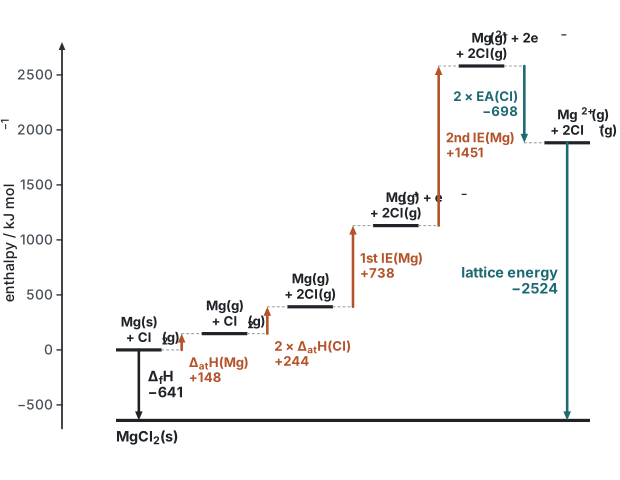
Worked exampleMagnesium chloride
= −641; (Mg) = +148; (Cl) = +122; IE(Mg) = +738 and +1451; first EA(Cl) = −349 (kJ mol⁻¹).
- Sum of the steps = 148 + (2 × 122) + 738 + 1451 + (2 × (−349))
- = 148 + 244 + 738 + 1451 − 698 = +1883
- Lattice energy = −641 − 1883 = −2524 kJ mol⁻¹
Magnesium oxide: an endothermic second electron affinity 12.13
Oxygen needs two electrons. The first electron affinity is exothermic (−141), but the second is endothermic (+798), because the electron is forced onto an ion that is already negative.
Worked exampleMagnesium oxide
= −602; (Mg) = +148; (O) = +249 per mole of O atoms; IE(Mg) = +738 and +1451; EA(O) = −141 and +798 (kJ mol⁻¹).
- Sum of the steps = 148 + 249 + 738 + 1451 + (−141) + 798
- = +3243
- Lattice energy = −602 − 3243 = −3845 kJ mol⁻¹
The lattice energy of MgO is much more exothermic than that of NaCl (−787) or MgCl₂ (−2524). Page 15 explains why: higher charges and smaller ions.
Working backwards 12.13
The cycle is one equation, so any single unknown can be found, not just the lattice energy.
Worked exampleAn unknown formation enthalpy
Find of KCl from: lattice energy −718; (K) = +89; (Cl) = +122; first IE(K) = +419; first EA(Cl) = −349 (kJ mol⁻¹).
- = 89 + 122 + 419 + (−349) + (−718)
- = 281 − 718 = −437 kJ mol⁻¹
Worked exampleAn unknown electron affinity
Find the first electron affinity of chlorine from the NaCl cycle: = −411; lattice energy = −787; (Na) = +107; (Cl) = +122; first IE(Na) = +496 (kJ mol⁻¹).
- = 107 + 122 + 496 + EA + (−787)
- −411 = −62 + EA, so EA = −411 + 62 = −349 kJ mol⁻¹
Check yourself
All values in kJ mol⁻¹.
- Calculate the lattice energy of KCl: = −437; (K) = +89; (Cl) = +122; first IE(K) = +419; first EA(Cl) = −349.
- Find the first ionisation energy of sodium from the NaCl cycle, given = −411; lattice energy = −787; (Na) = +107; (Cl) = +122; first EA(Cl) = −349.
- Calculate of MgCl₂ from lattice energy = −2524 and the steps on this page.
- Explain why the second electron affinity of oxygen is endothermic.
- Both MgO and MgCl₂ contain Mg²⁺. Suggest why the lattice energy of MgO (−3845) is much more exothermic than that of MgCl₂ (−2524).
- A student leaves out the "× 2" for chlorine in the MgCl₂ cycle. What value does the student get for the lattice energy, and by how much is it wrong?
Answers cover these until you have tried the questions
- Sum = 89 + 122 + 419 − 349 = +281. Lattice energy = −437 − 281 = −718 kJ mol⁻¹.
- = 107 + 122 + IE + (−349) + (−787), so −411 = −907 + IE. IE = −411 + 907 = +496 kJ mol⁻¹.
- = 148 + 244 + 738 + 1451 − 698 + (−2524) = 1883 − 2524 = −641 kJ mol⁻¹.
- The second electron is added to O⁻, which is already negatively charged. It is repelled, so energy has to be supplied, making the process endothermic.
- In MgO the anion is O²⁻, with charge 2− and a smaller radius than Cl⁻. The attraction between 2+ and 2− ions that are close together is far stronger than between 2+ and 1− ions, so more energy is released when the lattice forms.
- Without the doubling, the sum = 148 + 122 + 738 + 1451 − 349 = 2110, so the lattice energy = −641 − 2110 = −2751 kJ mol⁻¹. This is 227 kJ mol⁻¹ too exothermic (−2751 compared with the correct −2524).