Topic 12 · page 7 of 17
Balance and temperature
Feasibility is a balance between the entropy change of the system and that of the surroundings. Temperature shifts the balance, because the surroundings term is −ΔH / T and shrinks as T rises.
Read first: Surroundings and total entropy
The balance 12.9(i)
has two parts, and each can be positive or negative. The reaction goes when the sum is positive. Returning to the cold reaction of page 1:
- The system has a large positive (3 mol of solid make gas, liquid and dissolved ions).
- The reaction is endothermic, so is negative.
- At room temperature the first outweighs the second, so is positive and the reaction goes.
Temperature changes the balance 12.9(ii)
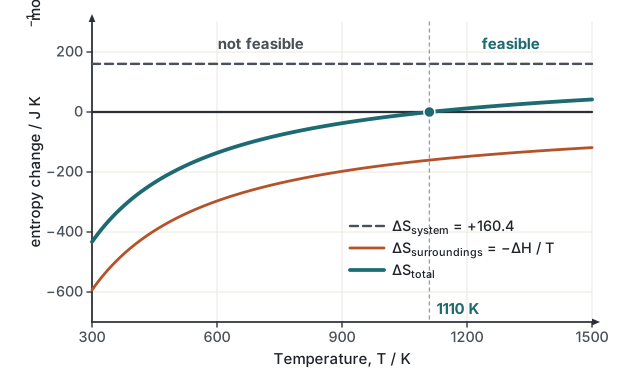
Only one term depends on temperature: . As T rises, gets smaller, so the surroundings matter less. Whichever sign has, its size shrinks as the temperature rises, and gets more say.
The decomposition of calcium carbonate shows this. It has = +178 kJ mol⁻¹ and = +160.4 J K⁻¹ mol⁻¹. We assume both stay constant with temperature.
Worked exampleCalcium carbonate at two temperatures
- At 298 K: = −178 000 ÷ 298 = −597.3. = +160.4 − 597.3 = −437 J K⁻¹ mol⁻¹. Not feasible: limestone is stable in a cliff.
- At 1300 K: = −178 000 ÷ 1300 = −136.9. = +160.4 − 136.9 = +23 J K⁻¹ mol⁻¹. Feasible: limestone decomposes in a lime kiln.
One negative term is fine 12.10
Each term can be positive or negative, so four combinations are possible. Find the sign of and the sign of and the outcome follows.
| Feasible? | Example | |||
|---|---|---|---|---|
| negative | positive | positive | at all temperatures | |
| negative | negative | positive | at low temperature only | (below 463 K) |
| positive | positive | negative | at high temperature only | (above 1110 K) |
| positive | negative | negative | never |
The two middle rows are the interesting ones. In row 2 the reaction goes because the surroundings gain more entropy than the system loses, but only while the temperature is low enough for to be big. In row 3 the reaction goes because the system gains more than the surroundings lose, but only when the temperature is high enough for to be small.
Check yourself
- State, for each combination, whether a reaction is feasible at all temperatures, only at low temperature, only at high temperature, or never: (a) negative, positive; (b) positive, positive; (c) negative, negative; (d) positive, negative.
- Explain how an endothermic reaction can be spontaneous at room temperature.
- A reaction has = +30 kJ mol⁻¹ and = +120 J K⁻¹ mol⁻¹ (illustrative values). Calculate at 298 K and at 400 K.
- A reaction has = −120 kJ mol⁻¹ and = −250 J K⁻¹ mol⁻¹ (illustrative values). Calculate at 298 K and at 600 K, and comment.
- Explain, in terms of , why raising the temperature helps an endothermic reaction with a positive .
- A student says: " is negative, so the reaction cannot occur." Comment.
Answers cover these until you have tried the questions
- (a) at all temperatures (both terms positive). (b) only at high temperature (the surroundings term is negative and shrinks as T rises). (c) only at low temperature (the surroundings term is positive but shrinks as T rises). (d) never (both terms negative).
- is positive and larger than the negative (which is for the endothermic ), so is positive and the reaction is feasible.
- At 298 K: = −30 000 ÷ 298 = −100.7. = 120 − 100.7 = +19 J K⁻¹ mol⁻¹. At 400 K: = −30 000 ÷ 400 = −75. = 120 − 75 = +45 J K⁻¹ mol⁻¹. Feasible at both temperatures, and more so when hotter.
- At 298 K: = 120 000 ÷ 298 = +402.7. = −250 + 402.7 = +153 J K⁻¹ mol⁻¹ (feasible). At 600 K: = 120 000 ÷ 600 = +200. = −250 + 200 = −50 J K⁻¹ mol⁻¹ (not feasible). The reaction is feasible only at low temperature.
- For an endothermic reaction = −ΔH ÷ T is negative. As T rises the size of this negative term falls, so outweighs it more easily and becomes positive.
- Wrong: a reaction can occur if is positive. If the reaction is exothermic, can be positive and large enough to outweigh the negative (as in ammonia synthesis at 298 K).