Topic 12 · page 3 of 17
Entropy of substances
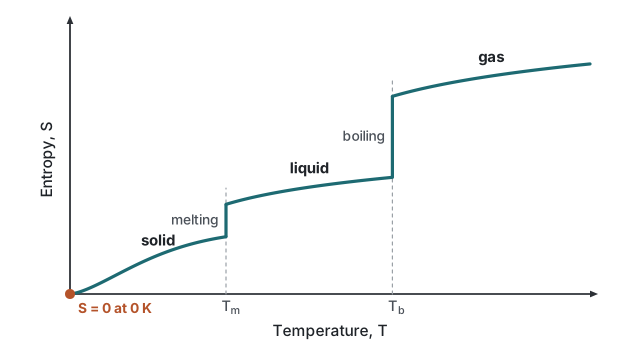
Entropy is zero for a perfect crystal at 0 K, rises with temperature, and jumps at melting and again, by more, at boiling. Solids have the lowest entropy and gases the highest.
Read first: Entropy and dispersal
The zero point 12.3
Entropy counts ways of arranging particles and energy. Take a perfect crystal and cool it to 0 K, the lowest temperature possible. Every particle sits in its place in a regular lattice, so there is exactly one arrangement of the particles. There is no thermal energy to share out either. One way in total gives the smallest possible entropy.
This gives entropy a true zero, unlike enthalpy, where zero is chosen by convention (elements in their standard states).
Entropy rises with temperature 12.3
Heat a solid. The particles vibrate more strongly and the sample holds more energy quanta. More quanta can be shared among the particles in more ways, so the entropy rises steadily.
Solid, liquid, gas 12.3
At a melting point the particles of a solid, locked in a lattice, become free to slide past each other. The number of ways of arranging them jumps, so the entropy jumps. At a boiling point the particles of a liquid become free to move anywhere in a container that may be over a thousand times bigger than the liquid. The jump in the number of arrangements is much larger.
Standard entropy values
The standard entropy, , is the entropy of one mole of a substance in its standard state at 298 K. Tables list it in J K⁻¹ mol⁻¹. Notice the unit: joules, not kilojoules.
| Substance | / J K⁻¹ mol⁻¹ | Comment |
|---|---|---|
| C(s, diamond) | 2.4 | rigid lattice, very few ways to share energy |
| H₂O(s) | 48 | |
| H₂O(l) | 70 | melting adds about 22 |
| H₂O(g) | 189 | boiling adds about 119 |
| NaCl(s) | 72 | ionic lattice |
| CO₂(g) | 214 | a gas |
The three values for water show the ladder: from solid to liquid is +22 J K⁻¹ mol⁻¹, and from liquid to gas is +119 J K⁻¹ mol⁻¹.
Check yourself
- Put these in order of increasing entropy, and explain: 1 mol of H₂O(g), 1 mol of H₂O(l), 1 mol of H₂O(s), all at 298 K for comparison.
- Why is the entropy of Br₂(g) greater than that of Br₂(l)?
- Why does a perfect crystal at 0 K have zero entropy?
- Explain why 1 mol of liquid water at 330 K has more entropy than 1 mol of liquid water at 280 K.
- Diamond has = 2.4 J K⁻¹ mol⁻¹ and carbon dioxide has 214 J K⁻¹ mol⁻¹. Explain the difference.
- Where is the largest step on a graph of entropy against temperature, and why?
Answers cover these until you have tried the questions
- H₂O(s) < H₂O(l) < H₂O(g), that is 48 < 70 < 189 J K⁻¹ mol⁻¹. Going from solid to liquid to gas, the particles become free to move and spread out, so there are more ways of arranging the particles and the energy.
- Gas particles are far more widely dispersed than particles of a liquid, so there are many more ways of arranging the particles and of sharing the energy quanta between them.
- There is only one arrangement of the particles in a perfect crystal, and at 0 K there is no energy to share between them. One way gives zero entropy.
- At the higher temperature there are more energy quanta, so there are more ways of sharing them between the molecules. More ways means higher entropy.
- In diamond every atom is held in a rigid network of strong covalent bonds, so there are very few ways of arranging the particles or sharing energy. CO₂ is a gas: its molecules move freely and are widely dispersed, giving far more arrangements.
- At the boiling point. The particles change from a liquid to a gas and become free to move throughout a much larger volume, so the number of arrangements, and the entropy, rises much more than at the melting point.