Topic 12 · page 6 of 17
Surroundings and total entropy
Heat passed to the surroundings changes their entropy by −ΔH / T. Add that to the entropy change of the system to get the total, and a change is feasible when the total is positive.
Read first: Entropy change of the system
System and surroundings 12.6
The system is the chemicals that are reacting. The surroundings are everything else: the solvent, the flask, the air, the bench. Together they make the universe, and the entropy that counts is the entropy of the whole universe.
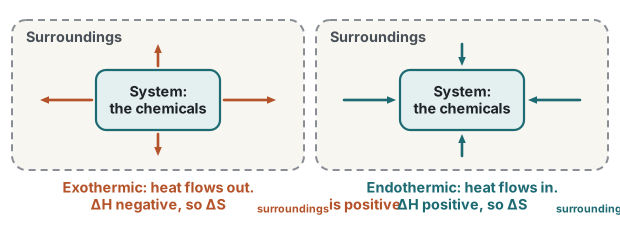
Heat and the surroundings 12.8
An exothermic reaction gives out heat. That heat becomes extra energy quanta in the surroundings, spread over a huge number of molecules, so the entropy of the surroundings rises. An endothermic reaction takes energy quanta from the surroundings, so their entropy falls. This is how enthalpy enters the entropy rule. The size of the effect is:
- The minus sign. An exothermic reaction has negative, so is positive.
- The division by T. The same heat matters more to cold surroundings than to hot ones. One shout is very noticeable in a silent library and barely noticed in a busy station. The same energy adds more disorder to cold surroundings.
MethodCalculating the entropy change of the surroundings
- Convert from kJ mol⁻¹ to J mol⁻¹ by multiplying by 1000.
- Convert the temperature to kelvin: K = °C + 273.
- Calculate . Keep the sign: exothermic gives a positive answer.
- Add , which is already in J K⁻¹ mol⁻¹, to get .
Worked exampleAmmonia synthesis at 298 K
, = −92 kJ mol⁻¹ and = −198.8 J K⁻¹ mol⁻¹. Is the reaction feasible at 298 K?
- = −92 × 1000 = −92 000 J mol⁻¹
- = −(−92 000) ÷ 298 = +309 J K⁻¹ mol⁻¹
- = −198.8 + 308.7 = +110 J K⁻¹ mol⁻¹
- is positive, so the reaction is feasible at 298 K, even though is negative.
Worked exampleBurning magnesium at 298 K
, = −1204 kJ mol⁻¹ and = −216.6 J K⁻¹ mol⁻¹.
- = 1 204 000 ÷ 298 = +4040 J K⁻¹ mol⁻¹
- = −216.6 + 4040.3 = +3824 J K⁻¹ mol⁻¹. The reaction is strongly feasible. Page 9 explains why magnesium ribbon still does not catch fire by itself.
Total entropy decides the direction 12.412.6
The system on its own can mislead. Ammonia synthesis has a negative and still goes at 298 K, because the heat given out raises the entropy of the surroundings by even more. The rule that never fails is:
Worked exampleDoes water freeze?
Water at 0 °C is the border between liquid and solid. has = −6.01 kJ mol⁻¹ (freezing gives out heat) and = 48 − 70 = −22 J K⁻¹ mol⁻¹. Find at 263 K (−10 °C) and at 283 K (+10 °C).
- At 263 K: = 6010 ÷ 263 = +22.85. = −22 + 22.85 = +0.85 J K⁻¹ mol⁻¹. Positive: water freezes.
- At 283 K: = 6010 ÷ 283 = +21.24. = −22 + 21.24 = −0.76 J K⁻¹ mol⁻¹. Negative: water does not freeze.
- The total is zero at T = 6010 ÷ 22 = 273 K, which is 0 °C. The numbers reproduce the freezing point.
The same heat released is worth more entropy to colder surroundings. That is why temperature decides who wins, the subject of page 7.
Check yourself
- Calculate at 298 K for a reaction with = −46 kJ mol⁻¹.
- Calculate at 500 K for a reaction with = +178 kJ mol⁻¹. Why is the sign different from question 1?
- For , = −890 kJ mol⁻¹ and = −242.7 J K⁻¹ mol⁻¹. Calculate at 298 K.
- For , = +57 kJ mol⁻¹ and = +176 J K⁻¹ mol⁻¹. Is it feasible at 298 K?
- A student calculates for = −92 kJ mol⁻¹ at 298 K as +0.309 J K⁻¹ mol⁻¹. What is wrong?
- Why does the same amount of heat released produce a larger entropy change in cold surroundings than in hot ones?
Answers cover these until you have tried the questions
- = −(−46 000) ÷ 298 = +154 J K⁻¹ mol⁻¹
- = −178 000 ÷ 500 = −356 J K⁻¹ mol⁻¹. The reaction in question 2 is endothermic: it takes heat from the surroundings and lowers their entropy. Question 1 is exothermic and raises it.
- = 890 000 ÷ 298 = +2986.6. = −242.7 + 2986.6 = +2744 J K⁻¹ mol⁻¹ (feasible).
- = −57 000 ÷ 298 = −191.3. = +176 − 191.3 = −15 J K⁻¹ mol⁻¹. This is negative, so the reaction is not feasible at 298 K.
- The student left in kJ. It must be −92 000 J mol⁻¹, giving −(−92 000) ÷ 298 = +309 J K⁻¹ mol⁻¹.
- In cold surroundings there are few energy quanta already, so a given amount of extra energy increases the number of ways of sharing them by a large factor. In hot surroundings the same energy is a small addition to what is already there. This is the 1 ÷ T in .