Topic 12 · page 2 of 17
Entropy and dispersal
Gases spread and energy spreads because spread-out arrangements vastly outnumber bunched-up ones. Entropy counts those arrangements, and natural change goes towards more of them.
Read first: Enthalpy is not enough
A gas spreads out 12.4
Open a bottle of perfume in one corner of a room. After a while you can smell it everywhere. Nothing pushes the molecules across the room. Each one moves at random, colliding and bouncing. Yet the gas always spreads out and never gathers back into the corner.
The reason is counting. Imagine a box split into a left half and a right half, with 30 gas particles in it. Each particle is equally likely to be in either half, so there are 2³⁰ = 1 073 741 824 equally likely ways to place them. Only one of those ways has every particle on the left.
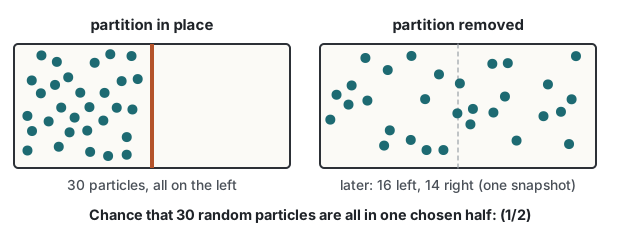
So the chance of finding all 30 on the left is about 1 in 1.07 × 10⁹. An even 15 : 15 split can be arranged in 155 117 520 ways, which is about 14% of all the possibilities. A real flask holds around 10²² particles, and the chance that they all gather on one side is so small that it never happens.
There is no heat flow here. A gas spreading into a vacuum has ΔH ≈ 0, so enthalpy has no say. Something else decides the direction. That something is entropy.
Energy spreads out too 12.2
Matter is not the only thing that spreads. The energy of a substance is stored in the motion of its molecules, and it comes in small packets called energy quanta. In collisions, quanta pass from one molecule to another, so they get shared out between molecules at random.
Count the ways. The figure shows three molecules sharing two quanta.
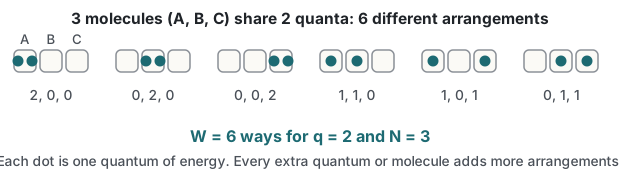
Repeat the count for other numbers of quanta and molecules:
| Quanta shared, q | 2 molecules | 3 molecules |
|---|---|---|
| 1 | 2 ways | 3 ways |
| 2 | 3 ways | 6 ways |
| 3 | 4 ways | 10 ways |
| 4 | 5 ways | 15 ways |
Two patterns matter:
- More quanta (a hotter sample) gives more ways to share them.
- More molecules, or more freedom for each molecule to hold energy, gives more ways too.
Entropy 12.2
Both stories have the same shape: a large number of equally likely arrangements, and a system that drifts towards the arrangements that are most numerous. Entropy is the quantity that measures this.
The natural direction of change 12.412.2
Natural, or spontaneous, change goes in the direction that increases the number of ways: the direction of increasing entropy. The reverse is not forbidden. It is just so improbable that it never happens.
For a gas spreading through a room, the entropy of the gas increases, and nothing happens to the surroundings because ΔH ≈ 0. So the total entropy rises. Page 6 widens the idea: for a chemical reaction you must count the entropy change of the chemicals and the entropy change of everything around them.
Check yourself
- Four gas particles are in a box with two halves. What is the chance that all four are in the left half? What about ten particles?
- In how many ways can four quanta be shared among three molecules? In how many ways can five quanta be shared between two molecules?
- Explain why the entropy of a sample goes up when you heat it.
- A student defines entropy as "how messy something is". Rewrite the definition so that it earns the mark.
- Explain why perfume released in one corner spreads through the whole room but never collects back in the corner.
Answers cover these until you have tried the questions
- Each particle is in the left half with probability ½, so for four particles the chance is (½)⁴ = 1/16 (0.0625). For ten particles it is (½)¹⁰ = 1/1024 (about 0.001).
- Four quanta, three molecules: 15 ways (from the table). Five quanta, two molecules: the pattern for two molecules is q + 1 ways, so 5 + 1 = 6 ways. (Check: 5,0 4,1 3,2 2,3 1,4 0,5.)
- Heating adds energy quanta to the sample. More quanta can be shared among the same molecules in many more ways, so the number of arrangements, and therefore the entropy, increases.
- Entropy is a measure of the disorder of a system, in terms of the random dispersal of its molecules and of the energy quanta between them: the more ways of arranging them, the greater the entropy.
- The molecules move at random. There are vastly more arrangements with the molecules spread through the room than with them all in one corner, so the spread-out state is far more probable and entropy increases. The chance of all the molecules returning to the corner is so tiny that it never happens.