Topic 12 · page 9 of 17
Thermodynamic and kinetic stability
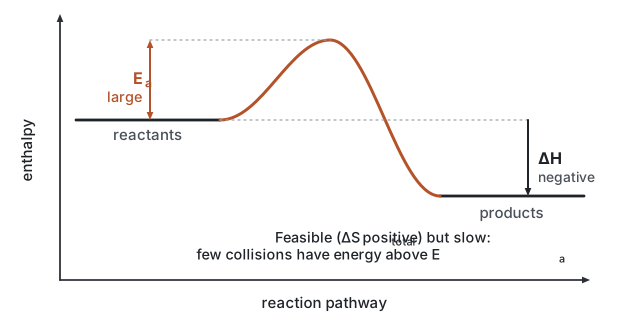
Thermodynamic stability asks whether a change is feasible. Kinetic stability asks whether it is fast enough to see. A change can be feasible and still not happen, because of a high activation energy.
Read first: The feasibility temperature
Two kinds of stable 12.11
Everything so far was about direction. positive means a reaction can happen. It says nothing about whether it will happen in a time you can observe. Speed depends on the activation energy, the energy that colliding particles need before they react.
Magnesium burning has = +3824 J K⁻¹ mol⁻¹ at 298 K (page 6), yet a coil of magnesium ribbon sits in the lab unchanged. Mixtures of methane and air, or of hydrogen and oxygen, sit unchanged until a spark. Diamond is not the stable form of carbon, yet it lasts for ever.
| Thermodynamic stability | Kinetic stability | |
|---|---|---|
| The question | Is the change feasible? | Is the change fast? |
| Decided by | the sign of | the size of the activation energy |
| Affected by a catalyst? | no | yes |
| "Stable" means | is negative: the change will not happen | the activation energy is high: the change is too slow |
Worked exampleDiamond and graphite
Diamond turning into graphite has ≈ −2 kJ mol⁻¹. The entropies are 2.4 J K⁻¹ mol⁻¹ for diamond and 5.7 for graphite.
- = 5.7 − 2.4 = +3.3 J K⁻¹ mol⁻¹
- = 2000 ÷ 298 = +6.7 J K⁻¹ mol⁻¹
- ≈ +10 J K⁻¹ mol⁻¹, which is positive. Diamond is thermodynamically unstable relative to graphite.
- Converting diamond to graphite means breaking the rigid network of strong C–C bonds. The activation energy is enormous, so at room temperature the change does not occur. Diamond is kinetically stable.
A catalyst lowers the activation energy and so changes the rate. It does not change , or , so it cannot make an unfeasible reaction go.
Check yourself
- Define thermodynamic stability and kinetic stability.
- Magnesium reacts with oxygen with = +3824 J K⁻¹ mol⁻¹, yet magnesium ribbon does not burn in air unless it is heated. Explain.
- Substance X is thermodynamically stable with respect to decomposition: is negative for its decomposition. Can a catalyst make it decompose? Explain.
- A reaction has = +200 J K⁻¹ mol⁻¹ and shows no change after a week. Give the most likely reason.
- Why does adding a catalyst not change the value of for a reaction?
Answers cover these until you have tried the questions
- Thermodynamic stability: a substance is thermodynamically stable if the change is not feasible, that is, for the change is negative. Kinetic stability: a substance is kinetically stable if the change is feasible but too slow to observe, because the activation energy is high.
- The reaction is thermodynamically feasible but magnesium is kinetically stable towards oxygen: the activation energy is high, so very few collisions have enough energy to react until the ribbon is heated.
- No. A catalyst only lowers the activation energy and increases the rate. It does not change . If is negative, the decomposition is not feasible at that temperature whatever the catalyst.
- The reaction is feasible but has a high activation energy, so it is too slow: the reactants are kinetically stable.
- A catalyst provides a different route with a lower activation energy, but the reactants and products are the same, so and are unchanged, and so is . It changes only the rate.