Topic 12 · page 8 of 17
The feasibility temperature
At the border of feasibility the total entropy change is zero, which gives T = ΔH ÷ ΔS for the system. Use it to say above or below which temperature a reaction goes.
Read first: Balance and temperature
Where the total is zero 12.9(ii)
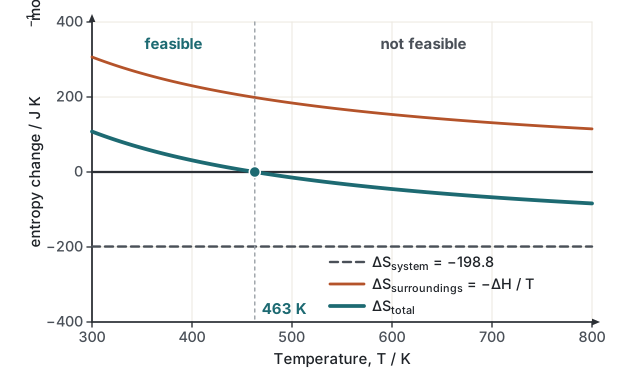
On the graph of page 7, crosses zero at one temperature. On one side the reaction is feasible, and on the other it is not. To find that temperature, set to zero:
Which side is feasible depends on the signs.
- and both positive: feasible above this temperature.
- and both negative: feasible below this temperature.
- If the signs differ, there is no such temperature: the reaction is feasible at all temperatures (page 7, row 1) or at none (row 4).
MethodFinding the temperature at which a reaction becomes feasible
- Convert to J mol⁻¹, so that it matches in J K⁻¹ mol⁻¹.
- Calculate in kelvin. The two minus signs cancel when both are negative.
- Convert to °C if asked: °C = K − 273.
- Say above (both positive) or below (both negative).
- State the assumption: and do not change with temperature.
Worked exampleCalcium carbonate
, = +178 kJ mol⁻¹ and = +160.4 J K⁻¹ mol⁻¹.
- T = 178 000 ÷ 160.4 = 1110 K, which is 1110 − 273 = 837 °C.
- Both signs are positive, so the reaction is feasible above 1110 K.
Worked exampleAmmonia
, = −92 kJ mol⁻¹ and = −198.8 J K⁻¹ mol⁻¹.
- T = −92 000 ÷ −198.8 = 463 K (190 °C).
- Both signs are negative, so the reaction is feasible below 463 K.
- Industry runs this reaction at about 700 K, above 463 K, because lower temperatures are too slow even with a catalyst, a compromise between rate and yield. The calculation says only that products are favoured below 463 K. It says nothing about rate, which is the subject of page 9.
Worked exampleA reaction that is not feasible at room temperature
, = +57 kJ mol⁻¹ and = +176 J K⁻¹ mol⁻¹.
- At 298 K, = 176 − 57 000 ÷ 298 = 176 − 191.3 = −15 J K⁻¹ mol⁻¹, so it is not feasible at 298 K.
- T = 57 000 ÷ 176 = 324 K (51 °C). Both signs are positive, so it is feasible above 324 K.
Using ΔG 12.9(ii)
You may also answer with the Gibbs energy change, . The specification allows it but does not require it.
A reaction is feasible when is negative. This is the same test as positive, because . At the border, , which gives the same temperature .
Worked exampleGibbs energy for two reactions
Use in kJ and in kJ K⁻¹ mol⁻¹ (divide J by 1000).
- Ammonia at 298 K: = −92 − 298 × (−0.1988) = −92 + 59.2 = −32.8 kJ mol⁻¹. Negative, so feasible.
- Calcium carbonate at 298 K: = 178 − 298 × 0.1604 = 178 − 47.8 = +130.2 kJ mol⁻¹. Positive, so not feasible. At 1300 K: = 178 − 1300 × 0.1604 = −30.5 kJ mol⁻¹, feasible.
Check yourself
- Calculate the temperature, in K and °C, above which is feasible. = +176 kJ mol⁻¹ and the entropies are NH₄Cl(s) 94.6, NH₃(g) 192.3, HCl(g) 186.9 J K⁻¹ mol⁻¹.
- A reaction has = −120 kJ mol⁻¹ and = −250 J K⁻¹ mol⁻¹ (illustrative values). Find the temperature at which = 0, and state whether the reaction is feasible above or below it.
- For calculate at 298 K, using = +57 kJ mol⁻¹ and = +176 J K⁻¹ mol⁻¹. Is it feasible?
- A student calculates the feasibility temperature for calcium carbonate as 1.11 K. Find the error.
- State the assumption made when you calculate a feasibility temperature this way.
- Explain, using , why a reaction with both and positive becomes feasible at high temperature.
Answers cover these until you have tried the questions
- = (192.3 + 186.9) − 94.6 = +284.6 J K⁻¹ mol⁻¹. T = 176 000 ÷ 284.6 = 618 K, which is 618 − 273 = 345 °C. Both signs are positive, so feasible above this temperature.
- T = −120 000 ÷ −250 = 480 K (207 °C). Both signs are negative, so the reaction is feasible below 480 K.
- = 57 − 298 × 0.176 = 57 − 52.4 = +4.55 kJ mol⁻¹. Positive, so not feasible at 298 K, which agrees with = −15 J K⁻¹ mol⁻¹ found earlier.
- The student divided 178 (kJ) by 160.4 (J K⁻¹ mol⁻¹) without converting. must be 178 000 J mol⁻¹, giving 178 000 ÷ 160.4 = 1110 K.
- and are assumed not to change with temperature.
- = −ΔH ÷ T is negative because ΔH is positive. As T increases, the size of this negative term decreases, so the positive eventually outweighs it and becomes positive.