Topic 12 · page 15 of 17
Charge and radius
Lattice energy and hydration enthalpy both become more exothermic as ionic charge rises and ionic radius falls, because the charges are bigger and closer. Learn to explain every trend with these two factors only.
Read first: Enthalpy of solution and hydration
The data 12.18
Both quantities measure the strength of an electrostatic attraction: between oppositely charged ions in a lattice, or between an ion and the polar water molecules around it.
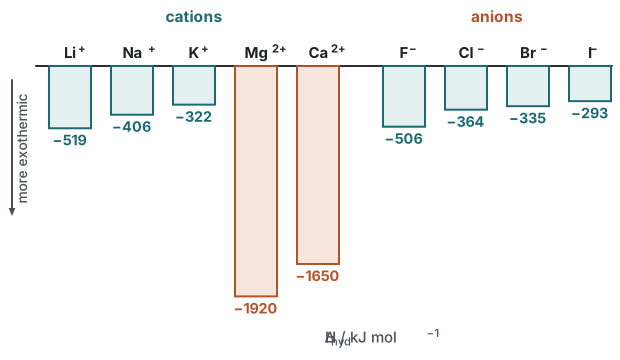
| Ion | / kJ mol⁻¹ | Ion | / kJ mol⁻¹ |
|---|---|---|---|
| Li⁺ | −519 | F⁻ | −506 |
| Na⁺ | −406 | Cl⁻ | −364 |
| K⁺ | −322 | Br⁻ | −335 |
| Mg²⁺ | −1920 | I⁻ | −293 |
| Ca²⁺ | −1650 |
| Compounds compared | Lattice energy / kJ mol⁻¹ | What changes |
|---|---|---|
| NaF, NaCl, NaBr, NaI | −918, −787, −747, −704 | anion radius increases |
| NaCl, KCl | −787, −718 | cation radius increases |
| NaCl, MgCl₂ | −787, −2524 | cation charge increases (1+ to 2+) |
The explanation 12.18
- Radius: a smaller ion lets its neighbour (the opposite ion in the lattice, or the oxygen or hydrogen of a water molecule) approach more closely. Down a group the ions are bigger, so Li⁺ > Na⁺ > K⁺ and F⁻ > Cl⁻ > Br⁻ > I⁻ in order of exothermic hydration.
- Charge: Mg²⁺ has twice the charge of Na⁺ and is smaller, so it attracts water molecules (and chloride ions) much more strongly. This is why its hydration enthalpy and the lattice energy of MgCl₂ are far more exothermic.
An explanation needs both ideas, together with the consequence for the attraction. For example: "Mg²⁺ has a higher charge and a smaller radius than Na⁺, so it attracts the δ− oxygen of water molecules more strongly, and more energy is released."
Check yourself
- Put Li⁺, Na⁺ and K⁺ in order of increasingly exothermic enthalpy change of hydration. Explain.
- Why is of Mg²⁺ (−1920) much more exothermic than that of Na⁺ (−406)?
- Explain the trend in lattice energy NaF, NaCl, NaBr, NaI (−918, −787, −747, −704 kJ mol⁻¹).
- Put NaCl, MgO and KBr in order of increasingly exothermic lattice energy. Explain.
- A student explains that Mg²⁺ has a more exothermic hydration enthalpy than Na⁺ because "magnesium has more electrons". Correct the explanation.
- of Ca²⁺ is −1650 and that of Mg²⁺ is −1920. Explain the difference.
Answers cover these until you have tried the questions
- K⁺ (−322), then Na⁺ (−406), then Li⁺ (−519): K⁺ < Na⁺ < Li⁺ in exothermicity. All have a 1+ charge, but the ionic radius falls from K⁺ to Li⁺, so the water molecules can approach more closely and the attraction to the δ− oxygens is stronger.
- Mg²⁺ has a higher charge (2+ against 1+) and a smaller radius, so it attracts the δ− oxygen atoms of the water molecules much more strongly and more energy is released.
- The cation is the same (Na⁺), but the anion radius increases from F⁻ to I⁻. The ions are further apart, so the electrostatic attraction in the lattice is weaker and the lattice energy becomes less exothermic.
- KBr < NaCl < MgO. KBr has the biggest ions (K⁺ larger than Na⁺, Br⁻ larger than Cl⁻) and charges 1+/1−, so the weakest attraction. NaCl has the same charges with smaller ions. MgO has charges of 2+ and 2−, and small ions, so the strongest attraction, and the most exothermic lattice energy.
- The number of electrons is not the cause. Mg²⁺ has a higher charge and a smaller radius than Na⁺, so it attracts the δ− oxygen of water molecules more strongly.
- Both ions have a charge of 2+. Ca²⁺ is a larger ion than Mg²⁺, so the water molecules are further from its nucleus and the attraction is weaker. Hydration is therefore less exothermic for Ca²⁺.