Topic 19
Topic 19 on a page
Everything from this topic in one place, for the last read before an exam. If anything here is unfamiliar, follow the link back to the full page.
The one idea
The nitrogen lone pair in an amine accepts H⁺ (base), attacks δ+ carbon (nucleophile) and donates to metal ions (ligand). In phenylamine it is delocalised into the ring, so all three are weaker. Amines and water.
Numbers and facts to know
| Quantity or fact | Value |
|---|---|
| order of base strength | butylamine > ammonia > phenylamine |
| diazotisation temperature | below 10 °C |
| reduction of nitrobenzene | Sn and concentrated HCl, reflux |
| nylon-6,6 repeat unit | –[NH(CH₂)₆NHCO(CH₂)₄CO]–, = 226.0 |
| dipeptide Gly-Ala | C₅H₁₀N₂O₃, = 146.0 |
| peptide links in a chain of x amino acids | x − 1 |
| tripeptides from three different amino acids | 6 |
| distance moved by spot ÷ distance moved by solvent front |
Definitions to learn word for word
- Amine: a compound in which one or more hydrogen atoms of ammonia are replaced by alkyl or aryl groups.
- Zwitterion: an ion with a positive and a negative charge and no overall charge.
- Condensation polymerisation: monomers join and a small molecule is lost each time a link forms.
- Addition polymerisation: monomers with C=C join by opening the double bond; nothing is lost.
- Amphoteric: able to react as both an acid and a base.
The reactions of butylamine and phenylamine
| With | Butylamine | Phenylamine |
|---|---|---|
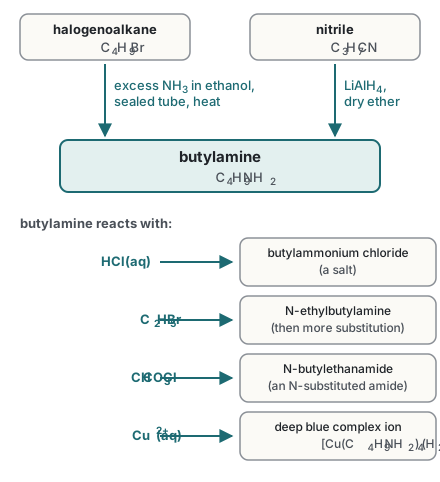
| water | alkaline, ⇌ | very slightly alkaline, ⇌ |
| hydrochloric acid | butylammonium chloride | phenylammonium chloride; dissolves |
| halogenoalkane | secondary, tertiary, quaternary mixture | same, slower |
| ethanoyl chloride | N-butylethanamide + HCl | N-phenylethanamide + HCl |
| copper(II) ions | pale blue precipitate, then deep blue solution | weaker base and ligand |
Making things
| Product | Reagent | Conditions |
|---|---|---|
| primary amine from halogenoalkane | excess concentrated NH₃ in ethanol | sealed tube, heat |
| primary amine from nitrile | LiAlH₄ | dry ether |
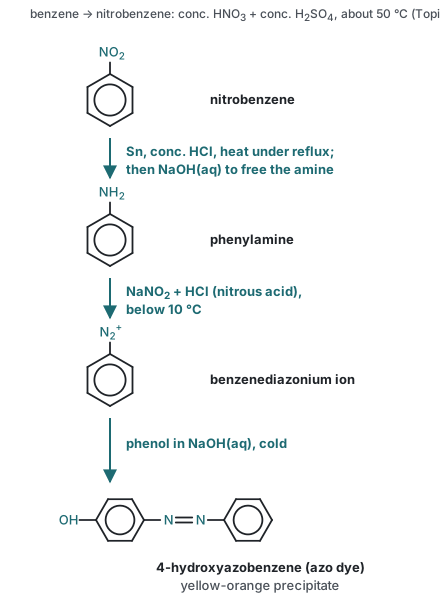
| phenylamine | Sn and concentrated HCl, then NaOH(aq) | reflux |
| diazonium ion | NaNO₂ and HCl | below 10 °C |
| azo dye | phenol in NaOH(aq) | cold |
| amide or N-substituted amide | acyl chloride and NH₃ or amine | room temperature |
Polymers and amino acids
- Nylon-6,6: diamine + diacid (or diacyl dichloride); loses H₂O (or HCl); amide links. Polyamides and proteins.
- Protein repeat unit: –[NH–CHR–CO]–, joined by peptide links.
- Poly(propenamide): –[CH₂–CH()]–. Poly(ethenol): –[CH₂–CH(OH)]–. Two chain carbons in the brackets only. Addition polymers.
- Polyamides are strong: N–H ··· O=C hydrogen bonds between chains. Poly(ethenol) dissolves: –OH groups hydrogen bond to water. Hydrogen bonding in polymers.
- Amino acids: –NH₃⁺ and –COO⁻ (zwitterion); cation in acid, anion in alkali. Amino acids as acids and bases.
- Optical activity: a single enantiomer rotates plane-polarised monochromatic light; glycine and racemic mixtures do not. Polarised light.
- Peptides: hydrolyse with 6 mol dm⁻³ HCl under reflux, then chromatography with ninhydrin. Peptide bonds.
The ten traps
- Calling an amine primary, secondary or tertiary by the carbon, not by the number of carbon groups on N.
- Leaving out the N–H bonds in a displayed formula.
- Using → for the reaction of an amine with water.
- Saying phenylamine is weaker "because of the ring" without the lone pair.
- "Dilute" ammonia, or no ethanol or sealed tube, for making an amine from a halogenoalkane.
- Calling tin a catalyst, or using dilute HCl.
- Diazotising above 10 °C.
- Writing Cl₂ as the product of acylation instead of HCl.
- Putting the side group in the backbone of an addition polymer, or leaving off the extension bonds.
- Saying chromatography after hydrolysis gives the order of amino acids.
Mixed test
Try these with no notes, then check the answers.
- Name CH₃CH₂CH₂CH₂NH₂ and classify (CH₃)₃N.
- Explain why phenylamine is a weaker base than ammonia.
- Write the equation for butylamine and ethanoyl chloride and name the product.
- Give the reagents and conditions for making butylamine from 1-bromobutane, with reasons.
- Describe how phenylamine is converted into an azo dye with phenol, giving reagents and conditions.
- Draw the repeat unit of the polymer from H₂N(CH₂)₆NH₂ and ClOC(CH₂)₄COCl and explain why it is strong.
- Why does poly(ethenol) dissolve in water but poly(ethene) does not?
- 9.30 g of phenylamine reacts with excess ethanoyl chloride, and 10.8 g of N-phenylethanamide forms. Calculate the percentage yield.
Answers cover these until you have tried the questions
- Butylamine (butan-1-amine). (CH₃)₃N has three carbon groups on N: a tertiary amine (trimethylamine).
- The nitrogen lone pair in phenylamine overlaps with the delocalised π system of the ring. Electron density on nitrogen falls, so the lone pair is less available to accept H⁺.
- . The product is N-butylethanamide.
- A large excess of concentrated ammonia in ethanol, heated in a sealed tube. Excess ammonia reduces further substitution to secondary and tertiary amines; ethanol stops water substituting the halogen to make an alcohol; the sealed tube keeps the volatile ammonia in.
- Phenylamine with NaNO₂ and HCl (nitrous acid) below 10 °C gives the benzenediazonium ion. Add this cold solution to phenol dissolved in NaOH(aq): a yellow-orange precipitate of the azo dye forms.
- with extension bonds (nylon-6,6); HCl is lost. It is strong because hydrogen bonds form between N–H groups on one chain and C=O groups on neighbouring chains.
- Poly(ethenol) has –OH groups that hydrogen bond to water molecules, releasing enough energy to separate the chains. Poly(ethene) has only C–H bonds and weak London forces, so it cannot hydrogen bond to water.
- n(C₆H₅NH₂) = 9.30 ÷ 93.0 = 0.100 mol. Theoretical mass of CH₃CONHC₆H₅ = 0.100 × 135.0 = 13.5 g. Percentage yield = 10.8 ÷ 13.5 × 100 = 80.0%.