Topic 19 · page 9 of 13
Hydrogen bonding in polymers
Hydrogen bonds between N–H and C=O groups on neighbouring chains make polyamides strong. Hydrogen bonds between the –OH groups of poly(ethenol) and water make it dissolve, which is why it is used for soluble laundry bags and liquid-detergent capsules.
Read first: Polyamides and proteins, Addition polymers
Why polyamides are strong 19.10
The amide link, –CO–NH–, contains two groups that hydrogen bond:
- the C=O oxygen is δ− and has lone pairs, so it can accept a hydrogen bond;
- the N–H hydrogen is δ+, so it can donate a hydrogen bond.
In a polyamide such as nylon, an N–H group on one chain forms a hydrogen bond to a C=O group on the neighbouring chain. Every amide link can do this, so there are many hydrogen bonds along the length of every pair of chains.
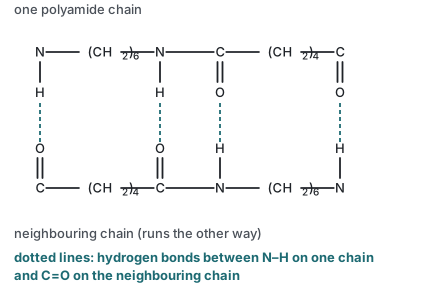
Many hydrogen bonds, together with London forces between the chains, mean that a lot of energy is needed to pull the chains apart or to separate them. This explains the physical properties:
- high tensile strength: the chains do not slide past each other easily, so nylon makes strong fibres for rope, clothing and fishing line;
- relatively high melting temperature: a lot of energy is needed to break the hydrogen bonds;
- insoluble in water: the long hydrocarbon sections do not hydrogen bond to water, and the chains hold on to each other more strongly than they would to water.
Proteins are polyamides too, and hydrogen bonds between peptide links hold protein chains together in the same way.
Why poly(ethenol) dissolves 19.10
Poly(ethenol) has an –OH group on every second carbon of its backbone. The O–H bond is polar, so each –OH can form hydrogen bonds to water molecules: the O–H hydrogen bonds to a lone pair on the oxygen of water, and the lone pairs on the –OH oxygen accept hydrogen bonds from the H atoms of water.
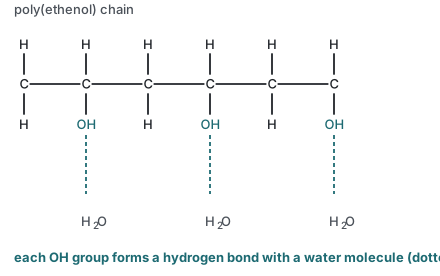
These many hydrogen bonds between the polymer and water give enough energy to separate the chains, so poly(ethenol) dissolves in water. Poly(ethene), by comparison, has only C–H bonds and so has only weak London forces with water. It does not dissolve.
This is the reason for two uses:
- soluble laundry bags: hospital laundry is put into the machine still in the bag, and the bag dissolves in the wash, so staff do not need to handle contaminated clothes;
- liquid-detergent capsules (liquitabs): the detergent is held in a thin poly(ethenol) film, which dissolves when it is dropped into water.
Worked exampleComparing two polymers
Explain why a bag made of poly(ethenol) dissolves in water but a bag made of nylon does not.
- Poly(ethenol) has –OH groups along the chain. These hydrogen bond to water molecules.
- Those hydrogen bonds release enough energy to separate the chains, so it dissolves.
- Nylon has N–H and C=O groups, but these hydrogen bond strongly to each other between the chains, and the long (CH₂) sections cannot bond to water.
- The polymer–water interactions are not enough to separate the chains, so nylon does not dissolve.
Check yourself
- Between which groups do hydrogen bonds form in nylon-6,6? Draw one, marking δ+ and δ−.
- Explain why nylon fibres have high tensile strength.
- Explain why poly(ethenol) dissolves in water.
- Poly(ethene) bags do not dissolve in water. Explain the difference from poly(ethenol).
- Give two uses of poly(ethenol) that depend on its solubility.
- A student says "nylon will dissolve because it contains N–H groups that hydrogen bond". Correct the statement.
Answers cover these until you have tried the questions
- Between the N–H group of one chain (H is δ+) and the C=O group of a neighbouring chain (O is δ−): N–Hδ+ ··· δ−O=C, with a dotted line from the H to a lone pair on O.
- Many hydrogen bonds between N–H and C=O groups on neighbouring chains hold the chains together, and a lot of energy is needed to pull them apart.
- Its –OH groups form hydrogen bonds with water molecules (O–H to lone pair on O of water, and the H of water to lone pairs on the –OH oxygen). These bonds release enough energy to separate the polymer chains.
- Poly(ethene) has only C–H bonds and weak London forces, so it cannot form hydrogen bonds to water. Poly(ethenol) has –OH groups that can.
- Soluble laundry bags (for hospital laundry) and liquid-detergent capsules (liquitabs).
- Nylon does hydrogen bond, but the N–H groups bond mainly to C=O groups on neighbouring chains. These bonds are strong and numerous, and the hydrocarbon sections do not bond to water, so nylon does not dissolve.