Topic 19 · page 4 of 13
Making and extending amines
A halogenoalkane and ammonia give a primary amine, but the amine can react again and again. Reducing a nitrile gives only the primary amine. The same substitution is why butylamine reacts with halogenoalkanes.
Read first: Salts and complex ions
The amine as a nucleophile 19.2(iii)
A nucleophile is an electron pair donor that attacks a δ+ carbon. The lone pair on the nitrogen of an amine does this. A halogenoalkane has a δ+ carbon bonded to the halogen, so the amine substitutes the halogen atom.
The nitrogen lone pair attacks the δ+ carbon of bromoethane, the C–Br bond breaks and bromide leaves. The first product is a salt, [C₄H₉NH₂C₂H₅]⁺Br⁻. A second molecule of amine then removes H⁺ from it, which gives the secondary amine and a salt of the other amine. The equation above shows the overall change, and the HBr is taken up by amine in the mixture.
The product, N-ethylbutylamine, is a secondary amine. It still has a lone pair on nitrogen, so it can attack another molecule of bromoethane. The reaction does not stop.
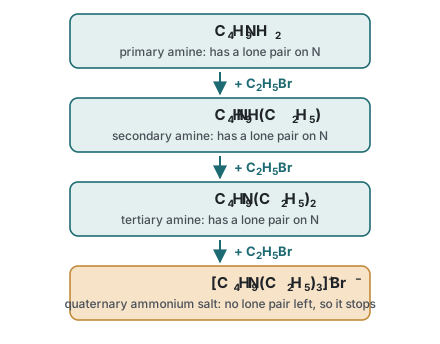
| Product | Formula | Class |
|---|---|---|
| first | C₄H₉NHC₂H₅ | secondary amine |
| second | C₄H₉N(C₂H₅)₂ | tertiary amine |
| third | [C₄H₉N(C₂H₅)₃]⁺Br⁻ | quaternary ammonium salt |
The quaternary ammonium ion has four carbon groups on nitrogen and no lone pair, so substitution stops there. The result is a mixture of products. Phenylamine reacts in the same way, for example with bromoethane to give N-ethylphenylamine, but more slowly because its lone pair is less available.
Primary amines from halogenoalkanes 19.4(i)
You can use the same reaction to make a primary amine, with ammonia as the nucleophile:
The first step gives the salt C₄H₉NH₃⁺Br⁻. A second molecule of ammonia removes H⁺ from it, so two molecules of NH₃ are used for each halogenoalkane. The conditions are:
MethodAmine from a halogenoalkane
- Reagent: a large excess of concentrated ammonia dissolved in ethanol.
- Conditions: heat in a sealed tube, under pressure.
Each part of the conditions has a reason:
- Excess ammonia. With plenty of NH₃, a halogenoalkane molecule is far more likely to meet ammonia than to meet the amine product. That reduces further substitution to secondary and tertiary amines.
- Ethanol as the solvent. With water present, hydroxide ions and water molecules would also substitute the halogen and make an alcohol.
- Sealed tube. Ammonia is a gas, and the reaction needs heat. A sealed tube keeps the ammonia in the mixture.
Primary amines from nitriles 19.4(ii)
A nitrile has the –C≡N group. Reducing it gives a primary amine with the same number of carbon atoms:
MethodAmine from a nitrile
- Reagent: lithium tetrahydridoaluminate(III), LiAlH₄.
- Conditions: in dry ether.
The ether must be dry because LiAlH₄ reacts with water. This route gives only the primary amine: there is no ammonia or halogenoalkane in the mixture, so no further substitution occurs. Some mark schemes also accept hydrogen gas with a nickel catalyst for this step; LiAlH₄ in dry ether is the answer to give unless the question suggests otherwise.
You can make the nitrile from a halogenoalkane, which adds one carbon atom to the chain. Heat the halogenoalkane under reflux with potassium cyanide in ethanol (Topic 10):
Worked exampleTwo steps from 1-bromopropane to butylamine
5.00 g of 1-bromopropane is converted to butanenitrile in 80% yield, and the nitrile is reduced to butylamine in 70% yield (illustrative yields). What mass of butylamine forms?
- M(CH₃CH₂CH₂Br) = 3 × 12.0 + 7 × 1.0 + 79.9 = 122.9 g mol⁻¹, so n = 5.00 ÷ 122.9 = 0.04068 mol
- Both steps are 1 : 1, so the theoretical n(butylamine) = 0.04068 mol
- M(C₄H₉NH₂) = 4 × 12.0 + 11 × 1.0 + 14.0 = 73.0 g mol⁻¹, so theoretical mass = 0.04068 × 73.0 = 2.970 g
- Overall yield = 0.80 × 0.70 = 0.56
- Actual mass = 2.970 × 0.56 = 1.66 g
| Halogenoalkane + NH₃ | Nitrile + LiAlH₄ | |
|---|---|---|
| carbons in the product | same as the halogenoalkane | same as the nitrile |
| products | primary amine, but secondary, tertiary and quaternary products can form | primary amine only |
| conditions | excess NH₃ in ethanol, sealed tube | dry ether |
Check yourself
- Write an equation for butylamine and bromoethane to make a secondary amine. Name the product.
- Explain why reacting an amine with a halogenoalkane gives a mixture of products, and give the formula of the last product.
- State the reagent and conditions to make butylamine from 1-bromobutane.
- Give two reasons why a large excess of ammonia is used.
- Give the reagent and conditions to convert butanenitrile into butylamine. Write the equation, using [H] for the reducing agent.
- Propylamine is to be made from bromoethane. Give the reagents and conditions for each step and the name of the intermediate.
Answers cover these until you have tried the questions
- . The product is N-ethylbutylamine, a secondary amine.
- The secondary amine product still has a lone pair on nitrogen, so it can attack another halogenoalkane, giving a tertiary amine, and again. The final product is a quaternary ammonium salt, [C₄H₉N(C₂H₅)₃]⁺Br⁻, which has no lone pair, so the reaction stops there.
- A large excess of concentrated ammonia in ethanol, heated in a sealed tube.
- With excess NH₃, a halogenoalkane molecule is much more likely to meet NH₃ than the amine already made, so less secondary and tertiary amine forms. Also, a second molecule of NH₃ is needed to remove H⁺ from the salt that first forms (two NH₃ per halogenoalkane).
- LiAlH₄ in dry ether.
- Step 1: heat bromoethane under reflux with potassium cyanide in ethanol to make propanenitrile, CH₃CH₂CN. Step 2: reduce with LiAlH₄ in dry ether to give propylamine, CH₃CH₂CH₂NH₂. (The nitrile route adds one carbon.)