Topic 19 · page 7 of 13
Polyamides and proteins
Condensation polymers join monomers with the loss of a small molecule each time. When the link formed is an amide link, the polymer is a polyamide. Nylon is made from a diamine and a diacid, and proteins from amino acids.
Read first: Acyl chlorides and amides
Condensation polymerisation 19.8(i)
To make a polymer this way, each monomer needs two functional groups, one at each end, so that the chain can grow in both directions. A polyamide is a condensation polymer whose links are amide links, –CO–NH–.
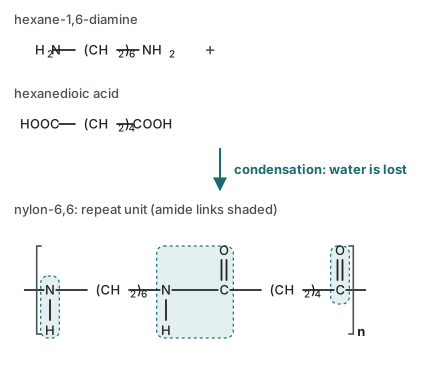
Nylon-6,6 is made from two monomers that each have six carbon atoms (hence the two sixes): hexane-1,6-diamine, H₂N(CH₂)₆NH₂, and hexanedioic acid, HOOC(CH₂)₄COOH.
Each –NH₂ group loses an H and each group loses an OH. The H and OH leave as water, and the nitrogen bonds to the carbonyl carbon.
In industry and in the laboratory an acyl chloride derivative is often used in place of the acid, because it reacts faster (page 5). With hexanedioyl dichloride, ClOC(CH₂)₄COCl, the small molecule lost is hydrogen chloride:
Drawing the repeat unit 19.9
The repeat unit is the smallest section that, repeated, makes the whole chain. For a polyamide it contains one piece from each monomer and two amide links shared with neighbours.
Rules for drawing a condensation repeat unit:
- Put the unit in brackets with a bond through each bracket (the extension bonds), and write n outside.
- Include the amide link –CO–NH– in full.
- Include no end groups: no spare H on N or OH on C inside the brackets.
- You can start the unit at either end, as long as it is one complete repeat.
For nylon-6,6 the repeat unit is . One repeat unit has the formula C₁₂H₂₂N₂O₂ and = 226.0.
Worked examplePredict a repeat unit
Draw the repeat unit of the polymer from H₂N(CH₂)₆NH₂ and ClOC(CH₂)₈COCl. Name the small molecule lost.
- The diamine gives –NH(CH₂)₆NH–, and the diacyl dichloride gives –CO(CH₂)₈CO–.
- Join them through an amide link: –[NH(CH₂)₆NHCO(CH₂)₈CO]–, with extension bonds.
- Each link forms by loss of H from N and Cl from C: hydrogen chloride is lost.
- The polymer is a polyamide (nylon-6,10).
A single monomer can also have both groups. 6-aminohexanoic acid, H₂N(CH₂)₅COOH, joins to itself to give –[NH(CH₂)₅CO]– (nylon-6). Amino acids work this way, which leads to proteins.
Proteins 19.8(i)
Proteins are polyamides made from 2-amino acids, RCH(NH₂)COOH. The amino group of one molecule and the carboxylic acid group of the next lose a molecule of water, forming a peptide link, which is the same –CO–NH– as an amide link.
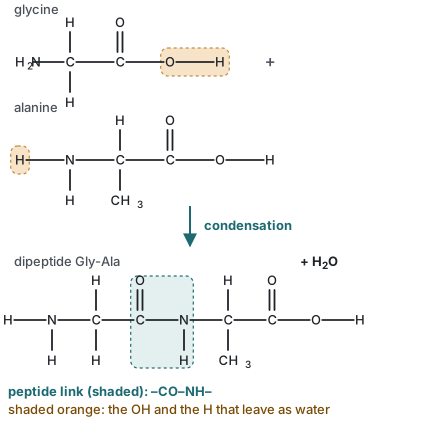
Two amino acids make a dipeptide, three make a tripeptide, and a long chain is a polypeptide or protein. The repeat unit in the general case is:
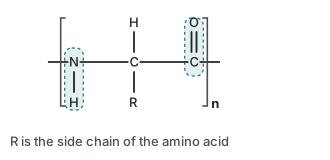
In a real protein, R is different at different places along the chain, so the sequence is not strictly a repeating pattern. The spec asks you to draw the repeat unit, with R standing for the side chain.
Worked exampleTwo glycine molecules
Write the equation for the formation of the dipeptide from two glycine molecules, H₂NCH₂COOH, and find its relative formula mass.
- The OH of one carboxylic acid group and an H of the other molecule's amino group leave as water.
- (glycine) = 75.0, so (dipeptide) = 2 × 75.0 − 18.0 = 132.0.
Check yourself
- Define condensation polymerisation. What small molecule is lost when nylon-6,6 forms from a diamine and a diacid?
- Draw the repeat unit of nylon-6,6.
- Draw the repeat unit of the polymer from H₂N(CH₂)₆NH₂ and ClOC(CH₂)₈COCl and name the small molecule lost.
- Write the equation for two alanine molecules, CH₃CH(NH₂)COOH, forming a dipeptide, and give of the dipeptide.
- Draw the repeat unit of a protein and name the link between the repeat units.
- How many molecules of water are lost when ten amino acid molecules join in one chain?
Answers cover these until you have tried the questions
- Monomers join and a small molecule is lost at each link formed. For nylon-6,6 from a diamine and a diacid, the molecule lost is water.
- with extension bonds through the brackets and n outside; the amide links are –CO–NH–.
- , and hydrogen chloride is lost.
- . (alanine) = 89.0, so (dipeptide) = 2 × 89.0 − 18.0 = 160.0.
- , with extension bonds. The link is the peptide link, –CO–NH–, which is an amide link.
- Ten molecules joined in one chain have nine links, so 9 molecules of water are lost.