Topic 19 · page 6 of 13
Phenylamine and azo dyes
Reduce nitrobenzene with tin and concentrated hydrochloric acid to make phenylamine. Keep phenylamine cold with nitrous acid to make a diazonium ion, then couple it with phenol to make a coloured azo dye.
Read first: Salts and complex ions
Phenylamine from nitrobenzene 19.5
Aromatic amines are made by reducing the nitro compound. Nitrobenzene comes from the nitration of benzene (Topic 18), so the route from benzene to phenylamine has two steps.
MethodReduce nitrobenzene
- Reagents: tin and concentrated hydrochloric acid.
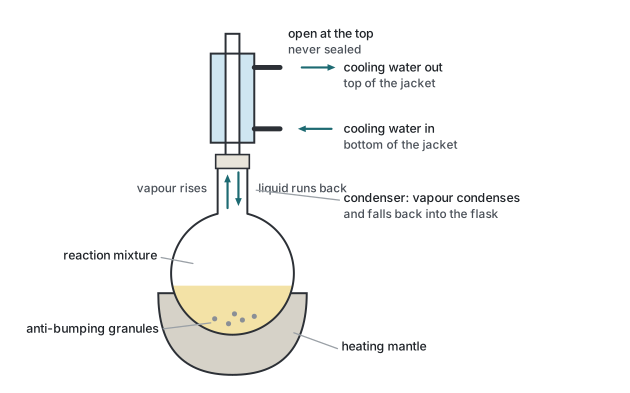
- Conditions: heat under reflux.
- The acid is in excess, so the amine forms as its salt, phenylammonium chloride, C₆H₅NH₃⁺Cl⁻.
- Add excess sodium hydroxide solution to remove H⁺ and release free phenylamine.
The two parts of the last step are the reactions from page 3. The acid makes the salt, and the base reverses it:
Heating under reflux means heating with a condenser fitted vertically, so volatile liquids that boil off are cooled and run back into the flask. Without it the benzene derivatives would boil away.
Worked examplePercentage yield of phenylamine
6.15 g of nitrobenzene gives 3.07 g of phenylamine (illustrative data). Calculate the percentage yield.
- M(C₆H₅NO₂) = 6 × 12.0 + 5 × 1.0 + 14.0 + 2 × 16.0 = 123.0 g mol⁻¹, so n = 6.15 ÷ 123.0 = 0.0500 mol
- Ratio 1 : 1, so theoretical n(phenylamine) = 0.0500 mol
- M(C₆H₅NH₂) = 93.0 g mol⁻¹, so theoretical mass = 0.0500 × 93.0 = 4.65 g
- Percentage yield = 3.07 ÷ 4.65 × 100 = 66.0%
Diazotisation 19.6
Phenylamine reacts with nitrous acid, HNO₂, to form the benzenediazonium ion, C₆H₅N₂⁺. Nitrous acid is unstable, so it is made in the flask from sodium nitrite and hydrochloric acid:
The temperature must be kept below 10 °C, which an ice bath does (0 to 5 °C is typical).
The product is benzenediazonium chloride in solution. The ionic equation is .
Coupling to form a dye 19.6
The diazonium ion is an electrophile. It reacts with a ring that is rich in electron density, such as phenol. In coupling, the diazonium ion joins the ring of phenol, opposite the OH group, and the azo group –N=N– links the two rings.
MethodCoupling
- Dissolve phenol in sodium hydroxide solution. The alkali turns phenol into the phenoxide ion, which is even more reactive than phenol, and removes the H⁺ that forms.
- Keep the solution cold, and add the cold benzenediazonium chloride solution.
- A yellow-orange precipitate of the azo dye forms.
The product is 4-hydroxyazobenzene. The OH group is on carbon 4, para to the azo link.
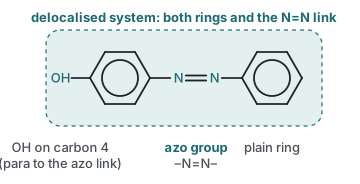
The compound is coloured because the delocalised π system extends over both rings and the –N=N– link. That large system absorbs light in the visible region.
The whole route from nitrobenzene to a dye:
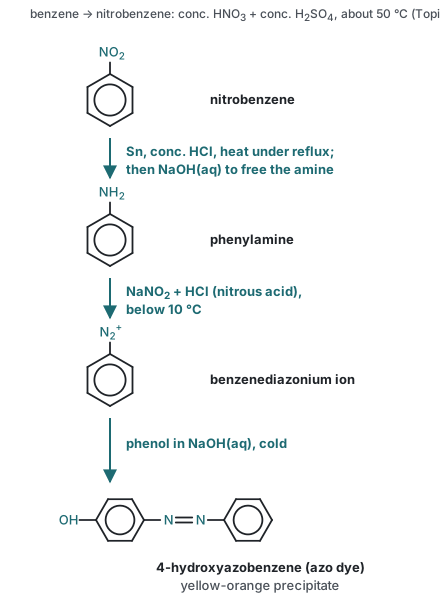
| Step | Reagents | Condition | Product |
|---|---|---|---|
| reduction | Sn, concentrated HCl; then NaOH(aq) | reflux | phenylamine |
| diazotisation | NaNO₂ and HCl (makes HNO₂) | below 10 °C | benzenediazonium ion |
| coupling | phenol in NaOH(aq) | cold | yellow-orange azo dye |
Check yourself
- Give the reagents and conditions for converting nitrobenzene to phenylamine. Write the equation using [H].
- Why is sodium hydroxide added at the end of the reduction?
- Give the reagents and the temperature needed to make a benzenediazonium ion from phenylamine. Why must the temperature be controlled?
- Describe how a diazonium ion is coupled with phenol. What is seen?
- Draw the structure of the azo dye formed from benzenediazonium chloride and phenol, and explain why it is coloured.
- 12.3 g of nitrobenzene is reduced and 6.51 g of phenylamine is obtained (illustrative data). Calculate the percentage yield.
Answers cover these until you have tried the questions
- Tin and concentrated hydrochloric acid, heated under reflux.
- In the acid, the product is the salt phenylammonium chloride, C₆H₅NH₃⁺Cl⁻. Sodium hydroxide removes H⁺ from the ion and releases the free amine: .
- Sodium nitrite and hydrochloric acid (which make nitrous acid) at below 10 °C. The diazonium ion decomposes above this temperature, giving N₂ and phenol, so the yield of the dye drops.
- Add the cold diazonium chloride solution to phenol dissolved in cold sodium hydroxide solution. A yellow-orange precipitate of the azo dye forms.
- HO–C₆H₄–N=N–C₆H₅: two benzene rings joined by –N=N–, with the OH group para to the azo link (4-hydroxyazobenzene). It is coloured because the delocalised π electrons extend over both rings and the N=N link, so it absorbs visible light.
- n(C₆H₅NO₂) = 12.3 ÷ 123.0 = 0.100 mol. Theoretical mass of phenylamine = 0.100 × 93.0 = 9.30 g. Percentage yield = 6.51 ÷ 9.30 × 100 = 70.0%.